Uranus, Neptune, Pluto in Modern Jyotish: Should Outer Planets Be Studied in Vedic Astrology?
Should Uranus, Neptune and Pluto be used in modern Vedic astrology? Explore classical foundations, modern debates, generational themes and practical chart guidance for Jyotish students.
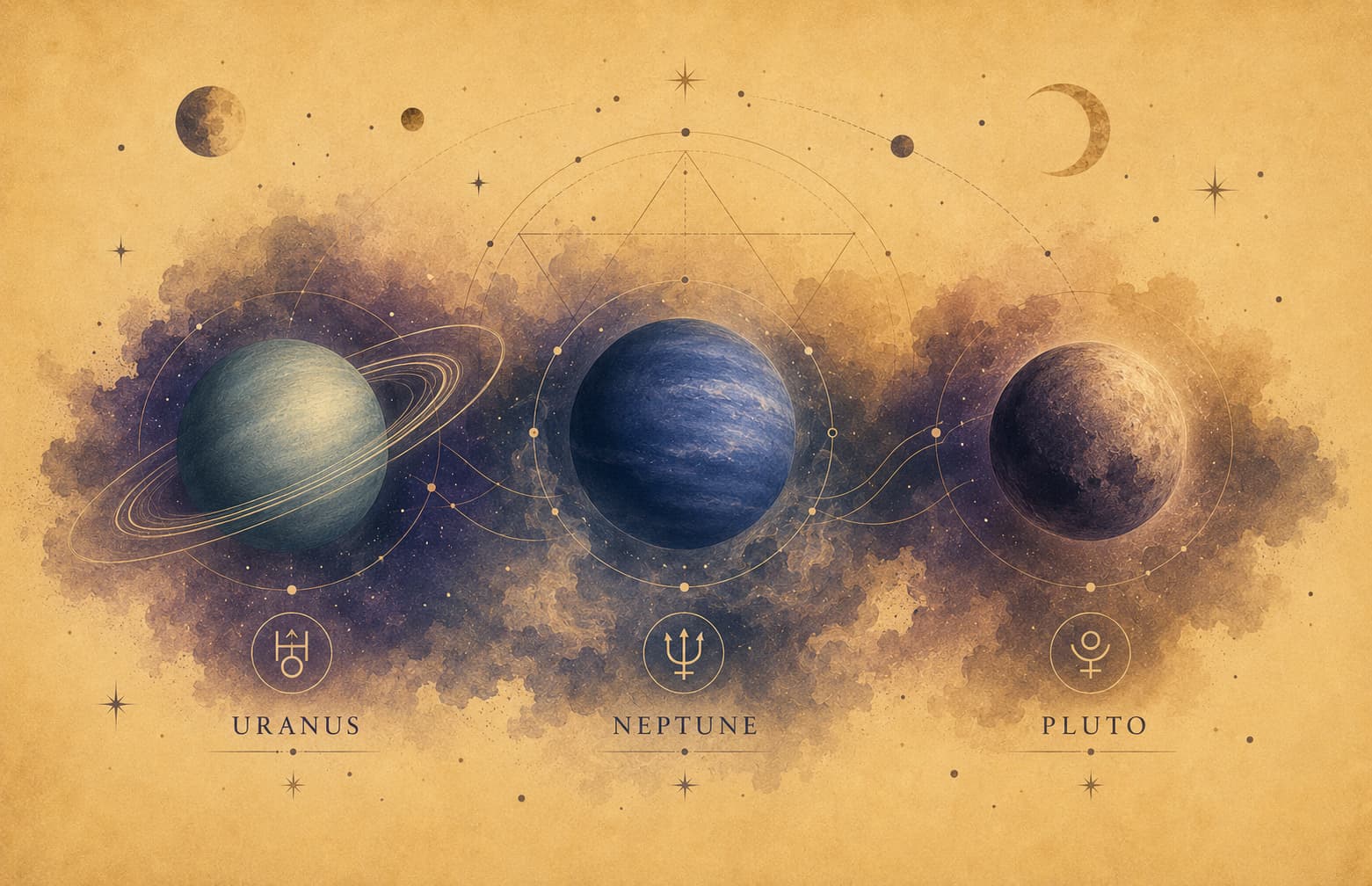
Many students opening a modern astrology software package for the first time notice three extra bodies sitting in their birth chart: Uranus, Neptune and Pluto. The classical texts they have been studying speak only of the Navagraha. Software defaults often place the outer planets automatically. Charts shared online mix both systems. The natural question arises: should a serious student of Jyotish include these distant planets, or leave them aside?
The short answer is that classical Vedic astrology does not use Uranus, Neptune or Pluto for personal prediction. They do not appear in Brihat Parashara Hora Shastra, Jataka Parijata, Phaladeepika or other foundational works. Their orbital periods are so long that they rarely complete even one full cycle within a normal human lifespan. At the same time, a growing number of modern practitioners examine them carefully for generational themes, collective shifts and subtle background colour, especially in mundane astrology. The decision rests on clear understanding of purpose, scale and method rather than fashion or rejection for its own sake.
This article examines the classical foundation, the astronomical realities, the arguments for and against inclusion, the practical ways some modern Jyotishis approach these bodies, and the safeguards needed so that the Navagraha system is never diluted.
Key Takeaways
- Classical Jyotish is built on the Navagraha: Sun, Moon, Mars, Mercury, Jupiter, Venus, Saturn, Rahu and Ketu.
- Uranus, Neptune and Pluto were discovered in 1781, 1846 and 1930 respectively. They are absent from traditional texts.
- Their slow motion makes them better suited to generational and mundane analysis than to fine timing of personal events.
- Some modern practitioners treat them as background modifiers or upagraha-like influences without giving them sign rulership.
- Accurate personal prediction still depends on Lagna, Chandra Rashi, house lords, dignity, aspects, dashas and the overall chart promise.
- Including outer planets requires clear intention: support classical interpretation, do not replace it.
Classical Foundation: The Navagraha System
Jyotish, as systematised in the classical period, works with nine grahas. The seven visible planets plus the two lunar nodes form a complete interpretive language. Each graha has clear natural significations, rules signs, owns houses according to the lagna, participates in yogas, receives and casts aspects, and governs periods through the Vimshottari dasha system.
A stronger technical foundation for this factor can be found in modern meanings of houses and signs.
The system is self-contained. Saturn marks the outer boundary of the visible planets. Beyond Saturn the classical texts do not assign planetary agency for individual charts. Upagrahas such as Dhuma, Vyatipata, Parivesha, Indrachapa and Upaketu are calculated sensitive points derived from the Sun’s longitude or from divisions of the day. They are not physical distant planets. Gulika and Mandi are time-based points linked to Saturn. These shadow factors already provide additional layers of intensity and affliction within the traditional framework.
This distinction becomes easier to apply after reading rare divisional charts.
When modern writers claim that Parashara mentioned five non-luminous planets that somehow correspond to the outer planets, the reference is to these calculated upagrahas, not to Uranus, Neptune or Pluto. The physical bodies simply were not part of the observational or interpretive toolkit available to the classical authors.
This absence is not a flaw. It is a design choice rooted in the practical needs of prediction for a human life measured in decades rather than centuries.
Astronomical Realities and the Question of Impact
Uranus takes approximately 84 years to complete one orbit of the Sun. Neptune takes about 165 years. Pluto requires roughly 248 years. In a typical lifespan of 70 to 90 years, an individual experiences less than one full transit of Uranus through the zodiac and only a fraction of a Neptune or Pluto cycle.
One reasoned argument offered by traditional practitioners is that a planet must complete at least two full circuits of the zodiac within a human lifetime before its influence can be considered individually significant in predictive work. Jupiter completes several such circuits. Saturn completes roughly two to three. The outer planets cannot meet this criterion. Their placement at birth is therefore shared by an entire generation born across many years. The house they occupy and the planets they aspect remain relatively fixed for large cohorts of people.
This does not mean the outer planets are irrelevant to human experience. It means their primary expression operates at a collective or generational scale. Sudden technological breakthroughs, shifts in spiritual fashion, large-scale social restructuring or collective trauma tend to coincide with outer-planet sign changes or major aspects more clearly than with the daily details of an individual’s career or marriage.
Distance also matters. The farther a body, the weaker its gravitational and reflective influence on the Earth-Moon system that forms the practical stage of Jyotish. Classical emphasis on visibility and measurable cycles is consistent with this physical reality.
Arguments Against Routine Inclusion in Personal Charts
Several practical and philosophical reasons support caution.
First, classical methods already deliver precise timing through dashas, transits of the traditional grahas, and divisional charts. Adding three extra slow-moving factors risks diluting focus. Students may begin to attribute every upheaval to Pluto or every confusion to Neptune while overlooking the condition of the eighth lord, the role of Rahu, or the current Mahadasha.
Second, sign rulership becomes inconsistent. Classical Jyotish assigns Aquarius to Saturn, Pisces to Jupiter and Scorpio to Mars. Modern Western systems often reassign these signs to Uranus, Neptune and Pluto. Mixing the two systems without clear boundaries creates contradictory house-lord results and yoga calculations.
Third, the outer planets do not participate in the traditional digbala, shadbala or ashtakavarga systems in any classical formulation. Their strength measurements remain undefined within the inherited framework.
Fourth, over-emphasis can shift interpretation toward psychological or generational abstraction at the expense of concrete, actionable guidance that classical Jyotish is known for: marriage timing, career direction, health tendencies, financial cycles and spiritual discipline.
These concerns do not forbid study. They argue for hierarchy. The Navagraha remain primary. Outer planets, if used at all, occupy a secondary or tertiary layer.
Arguments for Careful, Limited Inclusion
A different group of practitioners, often described as neo-Vedic or modern Jyotishis, argue that knowledge expands. Just as telescopes revealed the outer planets, contemporary life has revealed new patterns of collective experience that the classical toolkit did not need to name explicitly.
Uranus is frequently linked with sudden disruption, originality, technological innovation, rebellion against outdated structures and flashes of insight. Its discovery in 1781 coincided with an age of political and scientific revolution. In a chart it may colour the house it occupies with themes of abrupt change or unconventional expression, especially when tightly conjunct a personal planet or the lagna lord.
Neptune is associated with dissolution of boundaries, idealism, imagination, spiritual longing, illusion and collective compassion or confusion. Its long stay in a sign can mark an era’s prevailing spiritual or artistic mood. In individual charts it may soften or obscure the planet it touches, sometimes supporting devotion or artistic sensitivity, sometimes increasing vulnerability to deception or escapism.
Pluto is linked with deep transformation, power dynamics, elimination of what is no longer viable, and the uncovering of hidden material. Its slow passage through a sign can correspond with generational confrontations with authority, mortality or systemic decay and renewal. In a personal chart a close conjunction with the Sun, Moon or lagna may intensify experiences of crisis and rebirth in the related life area.
Some writers map these three bodies onto the three gunas or onto Hindu deities: Uranus with creative or disruptive force (sometimes linked to Prajapati or Indra-like energy), Neptune with sustaining and dissolving qualities (Varuna), and Pluto with transformative endings (Yama). These are modern interpretive bridges, not classical correspondences. They can be useful as symbolic language provided they are not presented as ancient doctrine.
In mundane astrology the case is stronger. Tracking outer-planet sign ingresses and mutual aspects helps describe long-term historical currents: technological leaps, shifts in collective belief systems, large-scale power struggles. For national charts or world-event analysis they add a valuable slow-moving layer.
A few contemporary teachers report that ignoring tight outer-planet contacts with personal planets sometimes leaves important narrative gaps in a reading. The key is proportion. The outer planet is noted as a background intensifier or thematic colour, not as the primary cause.
How Modern Practitioners Examine Outer Planets in a Chart
Those who choose to include them generally follow a restrained sequence.
- Cast the chart using the sidereal zodiac and the preferred ayanamsha. Outer-planet positions are calculated the same way as any other body.
- Note the sign and house occupied by each outer planet relative to the lagna and to the Moon.
- Check for close conjunctions (within a few degrees) with the lagna, Sun, Moon, lagna lord, or other personal planets. Wide orbs are less meaningful given the slow motion.
- Observe aspects only if the traditional graha aspects or modern conjunctions are being used consistently. Classical Jyotish does not assign special aspects to the outer planets.
- Consider the house topics activated. An outer planet in the tenth house, for example, may colour the professional sphere with generational themes of innovation, idealism or power struggle, but the tenth lord, its dignity and dashas remain decisive.
- Examine current transits of the outer planets only for major life phases or collective events, not for monthly prediction.
- Always return to the classical factors: functional benefic or malefic status of the traditional planets, yogas, dasha periods and divisional charts.
A hypothetical illustration may clarify. Suppose a chart has lagna in Virgo, Mercury in the tenth house in Gemini, and Pluto tightly conjunct Mercury. Classical analysis focuses on Mercury’s strength, the tenth-house themes of career and status, and the current dasha. The Pluto conjunction may be noted as intensifying the desire for transformative or research-oriented work, or as bringing power struggles into professional life. The outer planet does not override Mercury’s condition; it adds a layer of depth or pressure that the traditional factors already point toward.
Positive and Challenging Expressions
When outer planets are studied carefully, constructive possibilities include heightened originality (Uranus), deepened compassion or artistic vision (Neptune), and capacity for profound personal reinvention (Pluto). These qualities often appear when the outer planet supports a well-placed personal planet or when the native is already oriented toward collective or spiritual concerns.
Challenging expressions include restlessness and disruption of stable structures (Uranus), confusion of boundaries or susceptibility to collective illusions (Neptune), and experiences of intensity, loss or forced change that feel larger than the individual (Pluto). In all cases the traditional chart factors determine how constructively or disruptively the theme is lived.
Common Misconceptions
Several misunderstandings circulate widely.
One is that classical seers deliberately omitted the outer planets after full knowledge of them. While some modern accounts mention palm-leaf predictions of future discoveries, these remain anecdotal and unverified against primary classical literature. The safer historical statement is that the planets were not part of the observational and predictive system that developed.
Another misconception is that outer planets rule the signs Aquarius, Pisces and Scorpio in Vedic astrology. They do not. Classical rulership remains intact.
A third is that every difficult event can be blamed on Pluto or every spiritual interest attributed to Neptune. This reduces the rich classical language of dashas, house lords and yogas to a few generational markers.
A fourth is that including outer planets automatically modernises or improves Jyotish. Technique improves only when the added factors are used with clear hierarchy and tested against actual results.
Practical Guidance for Students
Beginners are best served by mastering the Navagraha thoroughly before adding outer planets. Learn the classical significations, house meanings, planetary friendships, exaltation and debilitation, aspects, yogas and the Vimshottari dasha system until they become second nature.
Once that foundation is solid, outer planets may be studied as an optional advanced layer. Software settings can be adjusted so that the outer planets appear only when deliberately requested. Notes can be kept separately from the main classical interpretation.
For mundane work or research into historical cycles, outer planets become more central. For individual consultations focused on marriage, career, health or timing of events, they remain secondary or optional.
The complete birth chart, including lagna, Chandra Rashi, house lords, dignity, aspects, nakshatra placements, dashas and relevant divisional charts, always provides the primary map. Outer planets, when noted, supply additional atmosphere rather than independent predictions.
The interpretive method behind this point is developed further in Lahiri and other ayanamsa systems.
Conclusion
Uranus, Neptune and Pluto occupy a legitimate place in modern astronomical knowledge and in certain streams of contemporary astrological thought. Classical Jyotish, however, developed a precise and self-sufficient system around the Navagraha and the calculated upagrahas. That system continues to serve personal prediction with remarkable clarity when studied and applied with care.
Students of modern Jyotish need not reject outer planets out of dogma, nor adopt them out of novelty. The more useful path is hierarchical: master the classical tools first, understand the generational and collective scale of the outer planets, and introduce them only when they clarify rather than complicate the reading. In this way the tradition remains intact while remaining open to the expanding sky.
The final test is always practical. Does the inclusion of an outer-planet contact deepen understanding of a chart that is already well analysed by classical methods, or does it distract from the core factors? Honest observation over many charts supplies the answer more reliably than theory alone.
Frequently Asked Questions
Do classical texts mention Uranus, Neptune or Pluto? No. The foundational works of Jyotish describe the Navagraha and certain calculated upagrahas. The physical outer planets were discovered long after the classical corpus was formed and do not appear in those texts.
Can outer planets be used for dasha timing? Traditional Vimshottari and other classical dasha systems do not include them. Some modern experimental systems exist, but they lack the long observational foundation of the classical methods and are not recommended for primary timing.
Do Uranus, Neptune and Pluto rule any signs in Vedic astrology? No. Classical sign rulership remains: Saturn rules Aquarius, Jupiter rules Pisces, Mars rules Scorpio. Outer planets are not given ownership in the traditional system.
Are outer planets more useful in mundane astrology? Yes. Their slow movement makes them natural markers for long-term collective and historical themes. Many modern practitioners find them more consistently informative for national charts and world events than for fine personal prediction.
Should beginners study outer planets early? It is better to establish firm command of the Navagraha, houses, yogas and dashas first. Outer planets can be added later as an optional layer once the classical foundation is secure.
How close must an outer planet be to a personal planet to matter? Because of their slow motion, only tight conjunctions (generally within three to five degrees, and preferably closer) are given notable weight by most practitioners who use them. Wide separations shared by an entire generation carry less individual significance.
Is there any traditional remedy connected with outer planets? Classical remedial measures focus on the Navagraha. Practices that cultivate clarity, ethical conduct, devotion and disciplined living remain the most reliable supports regardless of outer-planet placements.
Does Pluto’s demotion to dwarf-planet status change its use in astrology? Astronomical classification does not automatically dictate astrological practice. Those who use Pluto continue to observe its cycles for transformative themes; those who do not use it remain consistent with classical boundaries. The practical choice rests on observed results rather than nomenclature.
About the author
Anika Rao
Editor-in-Chief
Anika Rao is the editor-in-chief of Vedic Astrology Space. Her work brings classical Jyotish into conversation with relationships, identity, emotional life and the questions people carry into a modern chart reading. She is especially interested in nakshatras, the Moon, relational patterns and interpretations that create self-understanding without reducing a person to a placement.
Read the full bioContinue reading
Exalted Jupiter in All 12 Houses: Effects and Behaviour in Vedic Astrology

Sun and Moon in Vedic Astrology: Complete Guide to Surya and Chandra