Modern Interpretation of Vedic Astrology Houses and Signs for Gen Z in 2026
Discover how the 12 Vedic astrology houses and signs apply to Gen Z life in 2026. Fresh interpretations covering social media, AI uncertainty, economic pressure, and digital identity.
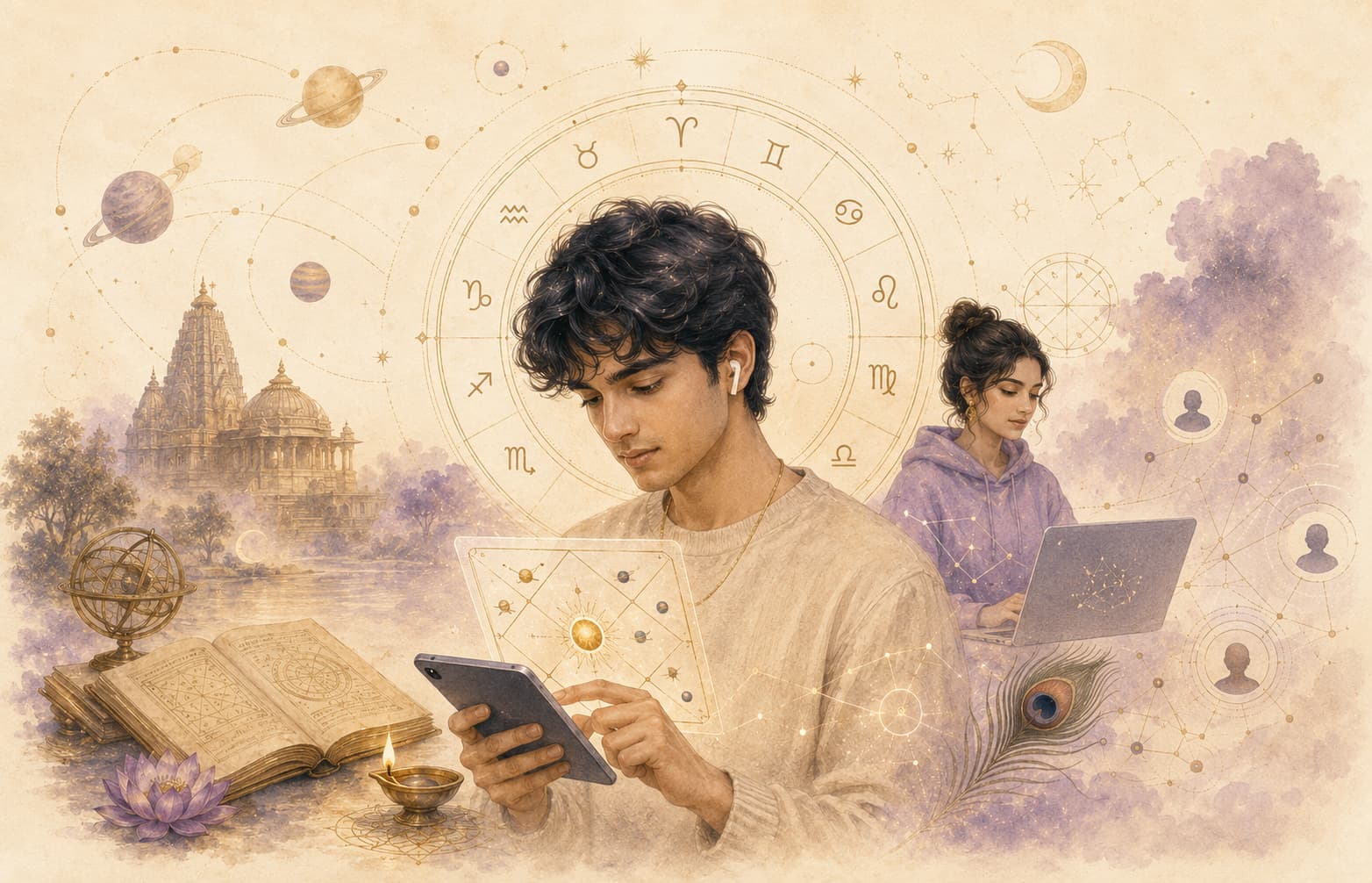
In 2026 most young adults check their phones before they check the sky. Notifications arrive faster than planetary aspects, and algorithms often feel more decisive than any Dasha. Yet the twelve Bhavas and twelve Rashis of Vedic astrology continue to map the same territories of life that they always have. The difference lies in how those territories are lived when internet access is treated as a basic utility, mobile devices never leave the hand, social media shapes identity, AI rewrites career paths overnight, economic security feels fragile, right-wing political currents intensify polarisation, adult content platforms operate in plain sight, and distant wars keep the future uncertain.
This article offers a modern reading of the classical houses and signs that stays faithful to Jyotisha principles while speaking the language of Gen Z experience. It does not replace a full birth-chart analysis. Every placement is modified by the Lagna, the Moon, planetary dignity, aspects, Dashas, and the overall strength of the chart. What follows is a practical framework for understanding the traditional domains through the conditions of 2026.
Key Takeaways
- The twelve Bhavas still govern the same life areas, yet their expression now includes digital identity, platform income, screen-time health, and algorithmic reputation.
- The twelve Rashis retain their elemental and planetary natures, but those natures surface through content creation styles, online conflict patterns, and responses to AI-driven change.
- Interpretation remains chart-dependent. A strong tenth house still supports career visibility, yet that visibility may appear on LinkedIn, Instagram, or an AI-generated portfolio rather than in a traditional office.
- Difficult placements do not equal doom. They often highlight the exact friction points Gen Z already recognises: burnout, debt, online hostility, and existential uncertainty.
- Remedies and practical guidance work best when they address both classical significations and modern behaviour.
What Houses and Signs Mean in Vedic Astrology
In Jyotisha the birth chart is divided into twelve Bhavas, or houses, counted from the Lagna (Ascendant). Each Bhava represents a specific domain of experience. Simultaneously the twelve Rashis, or zodiac signs, form the backdrop against which planets and houses operate. The signs carry elemental qualities (fire, earth, air, water), modalities (cardinal, fixed, dual), and planetary rulerships that colour every placement.
A house shows the area of life. A sign shows the style in which that area is expressed. A planet shows the energy that activates the combination. No single factor works in isolation. The modern interpreter simply asks how each classical domain appears when the native’s daily reality includes constant connectivity, precarious work, and rapid technological shifts.
The Twelve Houses in the World of 2026
First House – Tanu Bhava (Self, Body, Personality)
Classically the first house rules the physical body, appearance, vitality, and the way a person presents themselves to the world. In 2026 that presentation is rarely limited to face-to-face interaction. The digital self often precedes the physical self. Profile photos, bio lines, curated feeds, and even AI-generated avatars form the first impression many people receive.
A well-supported first house may appear as coherent personal branding across platforms, relative ease with self-presentation, and the ability to maintain some separation between online image and private reality. When the house is under pressure, the native may experience heightened body-image anxiety driven by filtered content, identity fragmentation across multiple accounts, or exhaustion from constant performance of selfhood. The classical concern with physical health now expands to include posture from phone use, blue-light sleep disruption, and the mental load of maintaining an online presence.
Second House – Dhana Bhava (Wealth, Family, Speech, Values)
The second house traditionally covers accumulated resources, family of origin, speech, and food. For Gen Z the resources are frequently digital or platform-based. Side-hustle income from content, freelance gigs mediated by apps, digital assets, and even temporary earnings from adult platforms all fall under this domain. Family communication often happens through group chats rather than shared meals.
A constructive second house can support clear personal values around money and the ability to speak or write in ways that generate opportunity. Stress on the house may show as unstable income streams, family arguments conducted over text, or difficulty establishing consistent savings when the cost of living and subscription services keep rising. Speech itself has become public: every post is a form of second-house expression that can attract support or backlash.
Third House – Sahaja Bhava (Courage, Communication, Siblings, Short Journeys)
Courage, initiative, communication skills, younger siblings, and short-distance movement belong to the third house. In the present decade courage often means the willingness to post, to go live, to start a channel, or to speak against prevailing online opinion. Short journeys include the daily commute that may still be physical or the constant mental switching between apps and tabs.
Strong third-house indicators can support effective content creation, networking through messaging platforms, and the resilience needed to handle public feedback. Challenges may appear as sibling rivalry conducted online, restless scrolling that replaces real initiative, or the anxiety of being permanently reachable. The classical association with writing and media finds a natural home in short-form video, newsletters, and community management.
Fourth House – Sukha Bhava (Home, Mother, Emotional Security, Vehicles)
Home, mother, emotional foundations, vehicles, and inner peace form the fourth house. For many in Gen Z the home is also the workplace, the content studio, and the place where most social interaction now occurs through screens. Emotional security is tested by economic uncertainty and by the constant background of global news.
A supportive fourth house may allow the native to create a genuine sanctuary even in a small rented room, maintain meaningful connection with maternal figures (biological or chosen), and treat vehicles or transport apps as practical tools rather than status symbols. Pressure on the house can surface as difficulty switching off work at home, strained maternal relationships conducted at a distance, or a pervasive sense that nowhere feels truly safe when wars and political tensions dominate the news cycle.
Fifth House – Putra Bhava (Creativity, Romance, Speculation, Education)
Children, creative intelligence, romantic expression, speculative ventures, and learning for its own sake belong here. Romance frequently begins on apps. Creativity is measured in views and engagement metrics. Speculation now includes crypto volatility, AI-tool investments, and the gamble of building an audience. Formal education competes with free online courses and rapid skill obsolescence caused by AI.
Positive fifth-house expression can support genuine creative output that feels meaningful rather than purely algorithmic, healthy romantic exploration, and the capacity for joyful learning. Difficult expressions may include creative burnout from constant content demand, romantic disappointment filtered through curated profiles, or reckless financial speculation driven by fear of missing out. The classical link to children may also reflect delayed or reconsidered parenthood in an economically unstable climate.
Sixth House – Ripu Bhava (Health, Service, Debts, Competition, Daily Work)
Enemies, disease, debt, service, and the daily grind are sixth-house themes. Online, enemies appear as trolls, cancel campaigns, or professional rivals competing for the same digital attention. Health concerns expand to include screen fatigue, anxiety disorders, and the physical effects of sedentary digital work. Debt may arise from education loans, credit-card reliance, or the cost of maintaining a lifestyle presented online.
This becomes clearer when placed beside the planetary analysis in exalted Jupiter through all 12 houses.
A functional sixth house can give the capacity to handle conflict without total collapse, maintain routines that protect mental and physical health, and turn service-oriented work into sustainable livelihood. When afflicted, the same house may correlate with chronic stress, difficulty setting boundaries with toxic online interactions, or cycles of debt that feel impossible to escape. The classical idea of “enemies” now includes algorithmic suppression and platform policy changes that can suddenly remove income.
Seventh House – Kalatra Bhava (Partnerships, Marriage, Business Alliances, Open Enemies)
One-to-one relationships, marriage, business partnerships, and the public-facing “other” are ruled by the seventh house. Dating apps, long-distance relationships maintained through video calls, collaborative content creation, and even transactional arrangements on adult platforms all activate this domain. Business alliances are frequently formed and dissolved online.
Supportive seventh-house conditions may allow relatively clear communication of needs, the ability to form alliances that are mutually beneficial, and a realistic view of partnership in a time when traditional marriage timelines have shifted. Challenges can appear as repeated disappointment with online-only connections, contractual disputes in digital collaborations, or the emotional complexity of relationships that begin in highly curated spaces. Open enemies may take the form of public professional conflicts or doxxing attempts.
Eighth House – Ayur Bhava (Transformation, Shared Resources, Occult, Crisis)
Longevity, sudden change, shared finances, inheritance, occult knowledge, and the psychological underworld belong to the eighth. In 2026 transformation often arrives through job displacement by AI, sudden platform bans, or the emotional intensity of digital intimacy. Shared resources include joint digital assets, crowdfunding, and the financial entanglement of online communities. Interest in astrology apps, tarot accounts, and psychological self-work is itself an eighth-house expression for many young people.
A constructive eighth house can support genuine psychological depth, the capacity to recover from sudden disruption, and ethical engagement with transformative knowledge. Difficult expressions may involve obsessive consumption of crisis news, vulnerability to online financial scams, or identity crises triggered by rapid technological change. The classical association with inheritance now includes digital legacies and the question of what data and accounts survive the person.
Ninth House – Dharma Bhava (Higher Learning, Fortune, Father, Long Journeys, Belief)
Dharma, higher education, long-distance travel, father figures, philosophy, and the sense of meaning are ninth-house concerns. University degrees compete with micro-credentials and AI tutors. Long journeys are complicated by geopolitical instability and cost. Father figures may be biological, mentors found online, or ideological leaders amplified by algorithms. Belief systems are constantly tested by polarising political narratives and the rise of authoritarian currents in various parts of the world.
Positive ninth-house influence can support a coherent personal ethic, meaningful learning that goes beyond employability, and the ability to hold perspective during uncertain times. Pressure may show as disillusionment with traditional institutions, difficulty trusting any narrative, or restlessness that has no clear outlet when travel and study feel restricted. The classical link to fortune is often experienced as the unpredictable timing of opportunity in a gig and platform economy.
The emotional and behavioral expression of this pattern is explored further in ADHD, executive dysfunction and neurodivergence.
Tenth House – Karma Bhava (Career, Status, Authority, Public Reputation)
Profession, reputation, authority, and the contribution one makes to society form the tenth house. Careers are increasingly hybrid, remote, or platform-dependent. Status is measured in follower counts, media mentions, and algorithmic reach as much as in traditional titles. Authority can be claimed through expertise demonstrated online rather than through institutional rank.
A strong tenth house may support visible professional contribution, the ability to navigate organisational or platform politics, and a reputation that opens further doors. Challenges include the precariousness of algorithm-dependent income, public cancellation risk, and the difficulty of building lasting authority when AI tools can rapidly replicate surface-level expertise. The classical concern with government and large institutions now also includes the power of tech platforms and the political climates that regulate them.
Eleventh House – Labha Bhava (Gains, Friends, Networks, Fulfilled Desires)
Income from career, friendship circles, social networks, and the realisation of long-held wishes belong here. Online communities, Discord servers, mutual-aid groups, and professional networks formed through LinkedIn or niche platforms are modern eleventh-house territories. Gains may arrive through monetised audiences or through collective support during economic difficulty.
Supportive conditions can produce genuine belonging, income streams that feel aligned with personal values, and the satisfaction of seeing certain goals materialise. Difficult expressions may include superficial online friendships that dissolve under pressure, envy triggered by constant exposure to others’ curated successes, or the frustration of desires that remain permanently just out of reach in an unequal economy. The classical idea of “elder siblings and well-wishers” expands to include mentors and peers met entirely through screens.
Twelfth House – Vyaya Bhava (Loss, Expenditure, Isolation, Foreign Lands, Spirituality, Sleep)
Expenses, losses, isolation, foreign residence, bed pleasures, spiritual retreat, and the unconscious are twelfth-house themes. Subscription costs, doomscrolling, late-night content consumption (including adult platforms), remote work for overseas clients, and the search for meaning through meditation apps or online spiritual communities all activate this house. Sleep quality is frequently compromised by screens and anxiety about the future.
A functional twelfth house can support genuine restorative solitude, ethical engagement with foreign or remote opportunities, and spiritual practices that reduce rather than increase agitation. When stressed, the same house may correlate with financial leakage through impulsive digital spending, addictive patterns around content or substances, profound loneliness despite constant connectivity, or escapism that postpones necessary action. The classical association with moksha or liberation is often sought through digital means, with mixed results.
The Twelve Signs in Contemporary Expression
Mesha (Aries) – Fire, Cardinal, Ruled by Mars
Classical courage, initiative, and competitive drive now appear as the willingness to launch a personal brand, enter online debates, or pivot quickly when AI tools change the landscape. The shadow side can include impulsive posting that later requires damage control and a tendency to treat every interaction as a contest.
Vrishabha (Taurus) – Earth, Fixed, Ruled by Venus
Stability, sensory pleasure, and resource-building translate into careful curation of digital assets, loyalty to platforms that feel reliable, and a preference for slow, high-quality content over viral speed. Challenges may involve resistance to necessary technological change or over-attachment to comfort that becomes escapism.
Mithuna (Gemini) – Air, Dual, Ruled by Mercury
Communication, curiosity, and adaptability find natural expression in multi-platform content, rapid learning of new tools, and the ability to hold several online identities. The difficulty lies in scattered attention, information overload, and the temptation to prioritise cleverness over depth.
Karka (Cancer) – Water, Cardinal, Ruled by Moon
Emotional memory, protective instincts, and the need for belonging surface in strong online communities, nostalgia content, and the desire to create digital “homes.” Vulnerability to mood-driven scrolling and difficulty detaching from collective emotional waves are common modern expressions of imbalance.
Simha (Leo) – Fire, Fixed, Ruled by Sun
Visibility, creative self-expression, and the need for recognition thrive in influencer culture, live streaming, and personal storytelling. The risk is ego entanglement with metrics and the painful experience of public indifference or criticism.
Kanya (Virgo) – Earth, Dual, Ruled by Mercury
Analysis, service, and refinement appear as meticulous content editing, health-tracking apps, and the drive to improve systems (including AI workflows). Over-criticism of self and others, perfectionism that blocks publication, and anxiety about contamination (literal or informational) can become pronounced.
Tula (Libra) – Air, Cardinal, Ruled by Venus
Partnership orientation, aesthetic sense, and the search for balance show in collaborative projects, carefully designed feeds, and diplomatic navigation of online conflict. Indecisiveness, people-pleasing for engagement, and difficulty tolerating asymmetry in relationships are frequent challenges.
Vrischika (Scorpio) – Water, Fixed, Ruled by Mars (and traditionally linked with Ketu in some systems)
Intensity, research into hidden layers, and transformative drive find expression in investigative content, psychological self-work, and deep dives into occult or conspiracy-adjacent material. Possessiveness over digital spaces, trust issues amplified by online betrayal, and cycles of deletion and reinvention can appear when the energy is unbalanced.
Dhanu (Sagittarius) – Fire, Dual, Ruled by Jupiter
Expansion, belief systems, and the search for meaning translate into online teaching, travel content (even when travel is restricted), and strong ideological commitments. Dogmatism, restless seeking that never settles, and over-promising are possible modern pitfalls.
Makara (Capricorn) – Earth, Cardinal, Ruled by Saturn
Structure, long-term ambition, and responsibility appear as disciplined content schedules, strategic career building across platforms, and concern with legacy in an unstable economy. Excessive seriousness, fear of failure magnified by public metrics, and difficulty enjoying the process can weigh heavily.
Kumbha (Aquarius) – Air, Fixed, Ruled by Saturn (with modern association to Uranus-like themes in some contemporary readings)
Networks, innovation, and collective ideals surface in community building, interest in emerging technology, and progressive or unconventional social stances. Detachment that becomes emotional distance, idealism that ignores practical constraints, and sudden breaks with groups are common shadow expressions.
Meena (Pisces) – Water, Dual, Ruled by Jupiter (with modern Neptunian resonance)
Imagination, compassion, and boundary fluidity appear in artistic content, empathetic online presence, and spiritual seeking through digital means. Escapism through endless scrolling or adult content, difficulty distinguishing inspiration from delusion, and porous personal boundaries are frequent contemporary challenges.
How Houses and Signs Interact in Practice
A planet placed in a particular house and sign creates a specific flavour. For example, Mercury in the third house in Mithuna may support highly effective short-form communication, while the same Mercury in the third house in Meena may produce more poetic, less structured output that resonates with niche audiences. The house shows the life area; the sign shows the manner of expression; the planet shows the quality of energy.
Modern interpreters also consider the current technological and social environment as a collective transit of sorts. The rise of AI, the normalisation of adult platforms, economic precarity, and political polarisation colour every individual chart. A difficult sixth house, for instance, may be experienced more acutely when the broader culture already normalises burnout and online hostility.
Factors That Modify Any Interpretation
- The condition of the house lord and its placement.
- Planetary aspects (Graha Drishti) and conjunctions.
- Dignity: exaltation, own sign, friendly or enemy sign, debilitation.
- Strength in relevant divisional charts, especially Navamsha for relationships and Dasamsha for career.
- Current Mahadasha and Antardasha.
- Transits that activate the house or its lord.
- The overall balance of the chart rather than any single placement.
No house or sign operates in isolation. A statement such as “the fifth house rules romance” is only the starting point. The full picture requires the condition of the fifth lord, Venus, the Moon, and the relevant Dasha periods.
This same symbolism can affect inner life in ways examined in body dysmorphia and eating disorders.
Common Misconceptions
One frequent misunderstanding is that a single house or sign determines an entire life theme. Another is the assumption that classical meanings no longer apply because the outer world has changed. The domains remain; only the vehicles of expression have multiplied. A third misconception is that modern difficulties automatically indicate “bad” placements. Many challenging configurations simply highlight the exact pressures that Gen Z already recognises and is actively trying to navigate.
Practical Guidance for Chart Examination
When examining a birth chart with contemporary questions in mind:
- Identify the house that rules the life area under consideration.
- Note the sign on the cusp and any planets occupying the house.
- Assess the house lord’s placement, dignity, and aspects.
- Check the relevant natural significator (Karaka).
- Review the current Dasha and major transits.
- Ask how the classical domain is most likely to appear under present social and technological conditions.
- Weigh constructive and difficult possibilities without assuming inevitability.
This sequence keeps the interpretation grounded in traditional method while remaining relevant to lived experience in 2026.
Conclusion
The twelve houses and twelve signs of Vedic astrology describe enduring human territories. In 2026 those territories are populated with smartphones, algorithms, economic anxiety, digital intimacy, and the background noise of distant conflict. A modern interpretation does not discard classical principles. It simply asks how selfhood, resources, communication, emotional security, creativity, conflict, partnership, transformation, meaning, reputation, networks, and release appear when the native’s daily environment is saturated with technology and uncertainty.
The most useful readings remain those that respect both the technical structure of Jyotisha and the actual conditions under which Gen Z is living. Complete-chart analysis, rather than isolated house or sign descriptions, continues to offer the most reliable guidance.
Frequently Asked Questions
Do the classical house meanings still apply when so much of life is digital?
Yes. The domains of self, resources, communication, home, creativity, conflict, partnership, transformation, belief, career, gains, and release remain. Only the forms through which they are experienced have expanded.
Can social media activity be seen in the birth chart?
Social media expression often activates the third, fifth, tenth, and eleventh houses, along with Mercury, Venus, and the Moon. The specific style depends on the signs and planetary conditions involved.
The interpretive method behind this point is developed further in the secrets of the 8th house.
How should one interpret career indicators when AI is disrupting so many fields?
The tenth house, its lord, and Saturn still describe professional direction and reputation. The modern reading simply includes the possibility that visibility and income may arrive through platforms or AI-assisted work rather than traditional employment structures.
Does a strong twelfth house mean someone will struggle with addiction or isolation?
Not necessarily. The twelfth house can support genuine spiritual practice, remote work, or restorative solitude. Difficulty arises when other factors amplify escapist tendencies already present in the wider culture.
Is it useful to read OnlyFans or adult-platform work through the chart?
Such activity can involve the second, fifth, seventh, eighth, and twelfth houses depending on the nature of the work and the native’s relationship to it. Ethical and psychological dimensions should be considered alongside any astrological indication.
Should Gen Z rely on astrology apps for daily decisions?
Apps can offer useful reminders of planetary movements, yet they cannot replace careful examination of the full birth chart and current Dashas. Major decisions benefit from deeper analysis.
How do political polarisation and wars appear in individual charts?
Collective events are reflected more clearly in national or mundane charts. In personal charts they may activate the sixth, eighth, ninth, or twelfth houses through transits or Dashas, often as increased anxiety, disrupted plans, or shifts in belief.
What is the most important factor when applying these modern interpretations?
The complete birth chart. Isolated house or sign meanings are only starting points. Dignity, aspects, Dashas, and the overall balance of the chart determine how any theme is likely to unfold.
Disclaimer: This article offers educational interpretation within the framework of Vedic astrology. It is not a substitute for personalised chart analysis by a qualified practitioner, nor does it constitute medical, financial, legal, or psychological advice.
About the author
Anika Rao
Editor-in-Chief
Anika Rao is the editor-in-chief of Vedic Astrology Space. Her work brings classical Jyotish into conversation with relationships, identity, emotional life and the questions people carry into a modern chart reading. She is especially interested in nakshatras, the Moon, relational patterns and interpretations that create self-understanding without reducing a person to a placement.
Read the full bioContinue reading
Shukla Paksha and Krishna Paksha Explained
Parashari vs Jaimini vs Nadi vs KP Astrology: Complete Comparison Guide