
Ghosting, Catfishing and Situationships in Vedic Astrology
Explore why connections remain undefined, vanish without closure or involve false identities through Vedic astrology. Learn the role of 3rd, 5th, 7th, 8th and 12th houses, Mercury, Venus, Rahu, Ketu, Upapada Lagna and Navamsha in relationship patterns and unfinished karma.
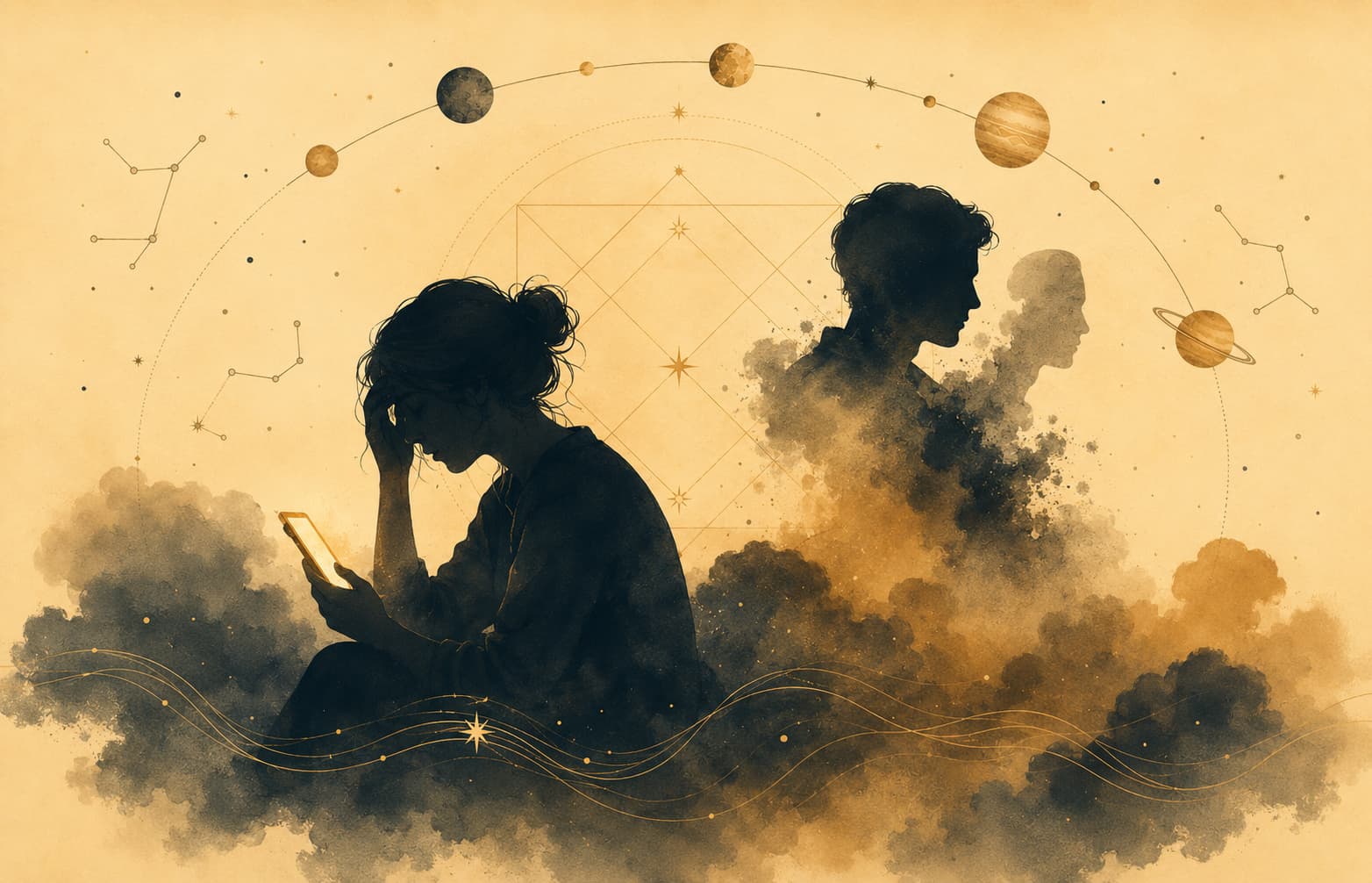
Many people today find themselves in connections that never quite become relationships, end without a single clear conversation, or turn out to have been built on a false identity. The other person stops replying. The bond stays undefined for months. Or the profile, stories and promises gradually reveal themselves as invented. These experiences can feel uniquely modern, yet the questions they raise are ancient: Why does a connection remain incomplete? Why does it vanish without closure? Why does deception or ambiguity keep repeating?
The emotional and behavioral expression of this pattern is explored further in celebrity obsession and parasocial attachment.
Vedic astrology, or Jyotisha, does not treat these situations as random social accidents. It examines them through the houses that govern communication, romance, partnership, sudden endings and loss, through the planets that rule speech, affection, illusion and detachment, and through the finer indicators of relationship promise such as Upapada Lagna and the Navamsha chart. The aim is not to label anyone as doomed or cursed. The aim is to understand whether a painful episode is an isolated event or part of a repeating natal pattern, and whether that pattern points toward unfinished karma that still seeks expression and eventual fulfilment.
This article explains the relevant houses, planets and chart techniques in clear sequence. It shows how an astrologer distinguishes one difficult relationship from a structural tendency, and it places the discussion within the larger framework of karma without reducing human behaviour to fatalism. A complete birth chart is always required for personal interpretation. What follows is a framework for understanding, not a set of fixed predictions.
Key Takeaways
- Ghosting, catfishing and situationships often involve the 3rd, 5th, 7th, 8th and 12th houses working together rather than any single house acting alone.
- Mercury, Venus, Rahu and Ketu are the primary planetary significators for communication breakdowns, affection mixed with illusion, sudden disappearance and fabricated personas.
- An afflicted 7th lord or weak 7th house can increase the likelihood of undefined or unstable partnerships, but the full picture requires aspects, dignity, dashas and the Navamsha.
- Upapada Lagna and its lord reveal the nature of the marital or long-term partnership promise and help explain why some connections never solidify.
- Repeating patterns across multiple relationships usually point to natal conditions rather than temporary transits alone.
- Unfinished karma related to speech, trust, intimacy or detachment may seek expression through these modern forms of incomplete connection until the underlying lessons are integrated.
Understanding Ghosting, Catfishing and Situationships in Everyday Life
Before turning to the chart, it helps to define the three experiences clearly.
Ghosting occurs when one person abruptly ends all communication without explanation. Messages go unanswered. Calls are ignored. The other person simply disappears from daily contact. The lack of closure often leaves the remaining person with unanswered questions and a sense of emotional incompleteness.
Catfishing involves the deliberate creation of a false identity. Someone presents an invented name, appearance, background, profession or life story in order to form a connection, usually online. The deception may last weeks or years before discovery. The emotional impact frequently includes shock, betrayal and a shaken sense of reality.
A situationship is a connection that continues for a significant period without clear definition, mutual commitment or agreed expectations. It may include affection, physical intimacy, regular contact and shared time, yet neither person fully claims the relationship as exclusive or lasting. Ambiguity itself becomes the defining feature.
These behaviours are shaped by technology, dating culture and changing social norms. Vedic astrology does not deny those external factors. It asks a different question: why does a particular person repeatedly attract or participate in such incomplete, deceptive or vanishing connections? The answer is sought in the birth chart’s structure of houses, planets and karmic indicators.
The Core Houses Involved: 3rd, 5th, 7th, 8th and 12th
Relationship experiences of this kind rarely arise from one house in isolation. Several bhavas interact.
The 3rd House: Communication, Courage and Short-term Contacts
The 3rd house, traditionally called Sahaja Bhava, governs courage, siblings, short journeys, writing, speech and the ability to initiate contact. In the modern context it also covers messaging, social media interaction and the first layers of digital conversation.
When the 3rd house or its lord is under pressure, communication can become inconsistent, abrupt or incomplete. A person may start conversations easily yet struggle to sustain them, or may experience others who begin contact and then withdraw. Mercury’s condition becomes especially relevant here because Mercury is the natural karaka for speech and intellect. An afflicted Mercury in relation to the 3rd house can correlate with mixed signals, delayed replies or conversations that never reach resolution.
The 3rd house also rules the courage required to state one’s needs or to end a connection honestly. Weakness here may contribute to avoidance rather than clear closure.
The 5th House: Romance, Speculation and Creative Connection
The 5th house, Putra Bhava, rules romance, creativity, children, intelligence and speculative ventures. In relationship analysis it shows the quality of dating, flirtation and the early romantic phase.
A strong and well-supported 5th house often supports enjoyable, creative and relatively straightforward romantic experiences. When the 5th house or its lord is connected with malefic influences, especially Rahu or Ketu, romance can take on a more experimental, undefined or illusion-tinged quality. Situationships frequently show activity in the 5th house without corresponding strength in the 7th. The connection remains in the realm of pleasure, curiosity or emotional speculation rather than moving into defined partnership.
The 5th house also links to past-life merit (purva punya). Some incomplete romantic experiences are understood as the working out of residual romantic or creative karma that does not necessarily require a formal marital outcome in this life.
The 7th House: Partnership and the Mirror of the Other
The 7th house, Kalatra Bhava, is the primary house of marriage, business partnerships and significant one-to-one relationships. Its condition, the dignity of its lord, and the planets occupying or aspecting it form the foundation of relationship analysis.
An afflicted 7th lord is one of the most common indicators when partnerships repeatedly become unstable, undefined or suddenly terminated. Affliction may arise from conjunction or aspect by Saturn, Mars, Rahu, Ketu or the nodes, from debilitation, from placement in a dusthana, or from severe combustion. The result is not automatic failure. Rather, the native may experience partners who are emotionally distant, inconsistent, deceptive or unable to commit, or the native may themselves struggle to maintain clear relational boundaries.
The 7th house also shows how the person meets the “other.” When Rahu influences the 7th, the partner or the relationship itself can carry an element of foreignness, unconventionality or illusion. Ketu’s influence may bring sudden detachment or a sense that the connection was never fully grounded in ordinary reality.
The 8th House: Sudden Endings, Secrecy and Transformation
The 8th house, Ayush Bhava or Randhra Bhava, rules longevity, inheritance, sudden events, secrets, occult knowledge and transformative crises. In relationship contexts it indicates the hidden dimensions of intimacy, shared resources, and abrupt changes.
Ghosting often carries an 8th-house signature because the ending arrives without warning and leaves the remaining person in a state of emotional upheaval. Catfishing likewise involves secrecy and the eventual revelation of a hidden truth. When the 8th house is strongly activated in the relationship chart or in the dasha periods governing a particular connection, the experience tends to include intensity, privacy, sudden rupture or the uncovering of concealed information.
The 8th house is also the house of shared vulnerability. Incomplete or deceptive relationships can leave residual emotional material that requires later processing, which is one reason these experiences sometimes feel karmically charged.
The 12th House: Loss, Foreign Connections and Dissolution
The 12th house, Vyaya Bhava, rules expenditure, loss, foreign lands, isolation, bed pleasures, spiritual liberation and the dissolution of material forms. In modern relationship life it frequently appears when connections form online across distance, when the relationship exists mainly in a private or hidden sphere, or when the ending involves emotional withdrawal and a sense of something slipping away.
Situationships that never quite materialise into daily shared life often show 12th-house involvement. The connection remains in a liminal space: present yet not fully present, intimate yet not publicly claimed. Ghosting can also express the 12th-house theme of disappearance and the feeling that the other person has become unreachable.
When the 12th house or its lord connects with the 7th or 5th, the relationship may carry a quality of being “almost” real yet ultimately dissolving. This does not mean every 12th-house contact is negative. Many spiritual or compassionate connections also arise here. The distinction lies in whether the dissolution serves growth or merely repeats an unresolved pattern.
The Key Planets: Mercury, Venus, Rahu and Ketu
Mercury: Speech, Messaging and Mental Connection
Mercury governs intellect, speech, writing, commerce and the nervous system. In digital-age relationships it rules the entire layer of texting, emailing, social media interaction and the rapid exchange of information that now precedes most meetings.
A well-placed Mercury supports clear, consistent and thoughtful communication. When Mercury is afflicted by malefics, combust, retrograde in difficult conditions, or poorly placed relative to the relationship houses, communication can become erratic. Messages may be sent impulsively and then regretted, or the person may struggle to articulate emotional needs. Partners with challenging Mercury combinations may themselves be inconsistent in reply or may use language in ways that create confusion rather than clarity.
Mercury also rules the early mental attraction. Many situationships begin with lively conversation that never deepens into emotional or practical commitment. The chart shows whether Mercury’s activity is supported by Venus and the 7th house or remains isolated in the realm of ideas and words.
The wellbeing dimension of this combination is considered more carefully in mental health and Vedic astrology.
Venus: Affection, Harmony and the Desire for Connection
Venus is the natural significator of love, beauty, harmony, pleasure and refined relationship. Its placement, dignity and associations strongly colour the quality of romantic and marital experience.
When Venus is strong and supported, the native tends to seek and attract connections marked by mutual appreciation and relative ease. When Venus is afflicted, especially by Rahu, Saturn or Mars, the expression of affection can become complicated. There may be idealisation followed by disappointment, attraction to unavailable or unconventional partners, or difficulty translating feeling into stable partnership.
In situationships, Venus often shows desire and enjoyment without the corresponding 7th-house structure that would define the bond. In catfishing cases, an afflicted Venus combined with Rahu can correlate with attraction to an image or projected fantasy rather than to a fully known person.
Rahu: Illusion, Foreignness and Amplification
Rahu is the north node of the Moon. It amplifies, obsesses, creates desire for the unconventional and often introduces an element of illusion or foreign influence. In relationship matters Rahu can produce intense attraction that lacks ordinary grounding, fascination with someone from a very different background, or involvement in connections that later prove to have been based on incomplete or false information.
Catfishing frequently carries a Rahu signature because the fabricated identity is itself a form of maya or illusion. The native may be drawn into the story with unusual intensity, only to experience a sudden collapse of the constructed reality. Rahu in or aspecting the 7th, 5th or 12th, or associated with Venus or Mercury, can increase the likelihood of such experiences, particularly during Rahu dasha or antardasha.
Rahu does not only create problems. It can also bring innovative, cross-cultural or highly stimulating relationships. The difference lies in whether the chart contains balancing factors and whether the native develops discrimination over time.
Ketu: Detachment, Sudden Endings and Past-life Residue
Ketu, the south node, signifies detachment, spirituality, sudden separation and the residual material of past lives. In relationships Ketu can produce abrupt withdrawal, a sense that the connection was never fully of this world, or a pattern of leaving or being left without ordinary emotional processing.
Ghosting often shows Ketu’s influence: the other person simply ceases to exist in the native’s daily reality. Ketu connected with the 7th or 8th house, or with Venus, can correlate with partners who are emotionally unavailable in conventional ways or who exit suddenly. Ketu also points toward unfinished business from previous lives. Some connections arise, create intensity, and then dissolve because their purpose was the resolution of specific residual karma rather than the formation of a lasting partnership in the present life.
Afflicted 7th Lord: A Central Indicator
The lord of the 7th house carries the primary responsibility for the expression of partnership. When this planet is afflicted, the native’s experience of committed or defined relationships tends to encounter obstacles.
Affliction can take several forms:
- Conjunction or close aspect by Saturn, Mars, Rahu or Ketu
- Placement in the 6th, 8th or 12th house without cancellation
- Debilitation or severe combustion
- Ownership of additional dusthana houses creating complex functional roles
- Weak dignity in both Rashi and Navamsha
An afflicted 7th lord does not mean the person will never experience stable partnership. It means that the path toward defined relationships often involves greater effort, clearer self-knowledge, and the working through of specific patterns. In the context of ghosting and situationships, the afflicted 7th lord may manifest as partners who cannot or will not define the connection, or as the native’s own difficulty in moving from ambiguity into clarity.
The condition of the 7th lord must always be read together with the house it occupies, the planets aspecting it, its nakshatra, and its placement in the Navamsha. A single affliction is rarely decisive on its own.
Upapada Lagna: The Indicator of Marital Promise
Upapada Lagna is a special lagna calculated from the arudha of the 12th house. It is used extensively in the Jaimini system and in many traditional approaches to marriage timing and quality.
The sign of the Upapada, its lord, the planets placed in it or aspecting it, and the condition of that lord in the Navamsha provide detailed information about the nature of the spouse or long-term partner and the overall quality of the marital experience. When the Upapada or its lord is under heavy affliction, the native may experience partnerships that remain incomplete, that dissolve, or that involve significant discrepancy between appearance and reality.
In cases of repeated situationships or sudden disappearances, examination of the Upapada often reveals why the connections do not stabilise into formal commitment. The Upapada can also show the presence of unusual or non-traditional relationship structures, which in modern life may express as prolonged ambiguity rather than conventional marriage.
Because Upapada calculation requires accurate birth data and careful application of arudha principles, it is best evaluated by an experienced astrologer rather than through simplified online tools.
The Navamsha (D9) Chart: The Deeper Promise of Relationship
The Navamsha is the most important divisional chart for marriage and partnership. While the Rashi chart shows the broad circumstances of life, the Navamsha reveals the inner quality and ultimate fruit of relationship karma.
Key points to examine in the Navamsha include:
- The lagna of the Navamsha and its lord
- The position of Venus and Jupiter
- The 7th house and 7th lord of the Navamsha
- The placement of the Rashi 7th lord in the Navamsha
- Any planets occupying the Navamsha 7th or aspecting it
- The condition of the Upapada lord in the Navamsha
When the Rashi chart shows potential for undefined or unstable connections, the Navamsha often clarifies whether that potential is temporary or structural. A strong Navamsha 7th house and well-placed Venus can mitigate many difficulties visible in the Rashi chart. Conversely, a weak or heavily afflicted Navamsha can indicate that even promising Rashi combinations may not fully deliver stable partnership.
In the analysis of catfishing or repeated ghosting, the Navamsha may show a pattern of illusion (Rahu) or sudden detachment (Ketu) operating at a deeper level. It can also reveal whether the native’s own relationship expectations contain unresolved idealisation or fear of commitment.
Distinguishing One Difficult Relationship from a Repeating Natal Pattern
Not every painful or incomplete connection is evidence of a deep natal pattern. Transits, dashas and the charts of the other people involved all play a role. An astrologer distinguishes isolated events from structural tendencies by examining several layers.
First, the natal promise is assessed through the 7th house, 7th lord, Venus, Upapada and Navamsha. If these factors are reasonably strong and well-supported, a single episode of ghosting or a temporary situationship is more likely to be a transit or dasha effect rather than a lifelong theme.
Second, the timing is checked. If the difficult experience occurs during a dasha of an afflicted relationship planet or during a heavy transit over the 7th or 8th house, the event may be period-specific. Once that period ends, the pattern may not repeat with the same intensity.
Third, the frequency and similarity of experiences are considered. When a person reports multiple relationships across different years that share the same core features (sudden disappearance, prolonged ambiguity, discovery of false identity), the natal chart is more likely to contain a repeating configuration. In such cases the pattern itself becomes the teaching.
Fourth, the native’s own contribution is examined with care and without moral judgement. Sometimes the chart shows a tendency to choose partners who are unavailable, or to remain in undefined connections longer than is healthy. Awareness of this tendency is often the beginning of change.
The goal is not to assign blame. The goal is to see whether the chart contains a structural invitation to develop clearer communication, stronger boundaries, greater discrimination, or a deeper understanding of one’s own relational needs.
Unfinished Karma and Its Fulfilment
Vedic astrology understands many life experiences as the unfolding of karma, the results of actions and tendencies carried from previous lives and shaped by choices in the present. Unfinished karma related to relationships often concerns speech, trust, intimacy, commitment or detachment.
When a connection remains undefined, disappears without closure, or involves fabricated identity, it may be serving the purpose of bringing residual material into awareness. The experience can highlight:
- Patterns of incomplete communication that still seek resolution
- Idealisation of the other that needs to be balanced with realism
- Fear of vulnerability that leads to either clinging or abrupt withdrawal
- Attraction to illusion that must eventually give way to discrimination
- Lessons around self-worth that arise when another person treats the connection as disposable
Fulfilment of such karma does not always require the other person to return or to provide the missing explanation. Fulfilment more often occurs through the native’s own integration of the lesson. Clearer self-knowledge, more honest communication in subsequent connections, and a reduced tendency to repeat the same dynamic are signs that the unfinished material is being worked through.
Some connections are understood as brief but necessary. They arise, create intensity, deliver a specific insight or emotional experience, and then dissolve. The chart may show that the purpose was never long-term partnership. Accepting this possibility can reduce the sense of personal failure that often accompanies ghosting or the end of a situationship.
Karma is not a rigid sentence. Present-life choices, self-awareness and conscious effort modify how residual patterns express. The chart shows tendencies and likely themes. It does not remove human agency.
How to Examine These Themes in a Birth Chart: A Practical Sequence
An orderly approach helps avoid over-interpretation.
- Assess the 7th house, its lord, and Venus in the Rashi chart for overall partnership promise and stability.
- Check the 3rd and 5th houses for communication style and romantic expression.
- Examine the 8th and 12th houses for themes of sudden change, secrecy, loss or liminal connection.
- Evaluate Mercury for clarity and consistency of speech and messaging.
- Note the influence of Rahu and Ketu on the relationship houses and on Venus or Mercury.
- Calculate and analyse the Upapada Lagna and its lord.
- Study the Navamsha chart with special attention to the 7th house, Venus and the placement of key relationship planets.
- Review the current and recent dashas to see whether relationship planets or dusthana lords are active.
- Consider relevant transits, especially of Saturn, Rahu, Ketu and Jupiter over the relationship houses.
- Look for repeating patterns across the native’s relationship history and compare them with the natal indications.
Only after these steps does an astrologer form a reasoned view of whether the experiences of ghosting, catfishing or situationships are likely to be temporary or structural, and what constructive responses the chart itself suggests.
Common Misconceptions
Several misunderstandings frequently arise in discussions of these topics.
One is the belief that a single placement, such as Rahu in the 7th house, guarantees deception or abandonment. No single factor operates in isolation. The same placement can also produce unconventional but sincere partnerships depending on the rest of the chart.
Another misconception is that difficult relationship karma can be completely removed by a simple remedy. Traditional practices can support clarity, emotional steadiness and spiritual perspective. They do not erase the need for self-reflection and healthier choices.
A third error is to treat every incomplete connection as evidence of deep past-life debt. Some experiences are simply the result of incompatible timing, differing intentions, or the ordinary friction of human relating. Over-spiritualising every disappointment can delay practical learning.
Finally, some readers assume that a challenging chart means they should avoid relationships altogether. The more useful response is to understand the specific tendencies and to develop the qualities that balance them: clearer communication, stronger personal boundaries, realistic assessment of others, and greater comfort with both intimacy and solitude.
Traditional Remedies and Practical Guidance
Remedies in Jyotisha are best understood as supportive practices rather than guaranteed solutions. For themes involving communication, affection, illusion and detachment, the following traditional and behavioural approaches are commonly suggested.
For Mercury-related communication difficulties: regular practice of clear and honest speech, writing or journaling to organise thoughts, and charity related to education or communication tools. Recitation of Mercury mantras with proper guidance can be considered when the chart supports it.
For Venus: cultivation of genuine appreciation, acts of kindness without expectation, and care for one’s own sense of beauty and self-worth. Supporting causes related to art, women or harmony is traditionally associated with Venus.
For Rahu and Ketu: practices that strengthen discrimination and reduce compulsive attraction to illusion. Grounding routines, service without fanfare, and spiritual study that emphasises clarity rather than excitement are often recommended. Specific mantras or planetary remedies should be chosen only after full chart analysis.
Behavioural guidance is equally important. Learning to state one’s relational needs early, recognising the difference between chemistry and compatibility, and allowing time for consistency to reveal itself before deep emotional investment can reduce the frequency of undefined or deceptive connections.
No remedy replaces the value of self-knowledge. The chart points to the areas that need attention. Conscious effort in those areas is the most reliable form of remedial work.
Conclusion
Ghosting, catfishing and situationships are contemporary expressions of relational incompleteness, deception and ambiguity. Vedic astrology examines them through the 3rd, 5th, 7th, 8th and 12th houses, through the condition of Mercury, Venus, Rahu and Ketu, through the state of the 7th lord, and through the finer indicators of Upapada Lagna and the Navamsha chart. These factors help distinguish a single painful episode from a repeating natal pattern and place the experience within the larger movement of unfinished karma toward eventual fulfilment.
A closely related partnership pattern is explored in divorce, separation and second marriage.
The chart does not remove free will. It reveals tendencies and likely themes so that the native can meet them with greater awareness. Clearer communication, realistic assessment of others, and willingness to define or release connections according to one’s own values are practical steps that work together with any traditional remedies. A complete birth chart, examined by a knowledgeable astrologer, remains the proper foundation for personal understanding. The framework offered here is a guide to that examination, not a substitute for it.
Frequently Asked Questions
Can Vedic astrology predict whether someone will ghost me? Astrology can indicate the likelihood of sudden communication breakdowns or unstable partnerships based on the 3rd, 7th and 8th houses and the condition of Mercury and the 7th lord. It cannot predict the specific behaviour of another person with certainty because that person’s free will and chart also operate. The focus is better placed on the native’s own patterns and preparedness.
Readers following this theme into intimacy and partnership may also recognize jealousy, possessiveness and controlling behavior.
Does Rahu in the 7th house always mean catfishing or deception? No. Rahu in the 7th can produce unconventional, foreign or intense partnerships. Deception becomes more likely when Rahu is further afflicted, associated with Mercury or Venus in difficult ways, and unsupported by balancing factors in the Navamsha. Many people with this placement experience sincere if non-traditional relationships.
A closely related partnership pattern is explored in transactional relationships and sugar dynamics.
Is a situationship always a sign of weak 7th house? Not necessarily. A situationship can arise from temporary dasha or transit conditions, from mutual choice, or from strong 5th-house activity without corresponding 7th-house commitment. Repeated situationships across different periods more strongly suggest natal involvement of the relationship houses and planets.
How important is the Navamsha for understanding these patterns? Very important. The Navamsha reveals the deeper quality of relationship karma. Difficulties visible in the Rashi chart may be softened or intensified according to the Navamsha condition of Venus, the 7th lord and the Upapada indicators.
Can unfinished relationship karma be resolved in this life? Yes. Awareness, honest communication, healthier choices and the integration of the emotional lessons carried by difficult experiences are the primary means of resolution. Traditional spiritual practices can support the process. Complete resolution is a gradual unfolding rather than a single event.
Should I avoid online dating if my chart shows Rahu or 12th-house influence on relationships? Not automatically. Online platforms simply amplify the expression of whatever relational tendencies already exist. Awareness of one’s vulnerability to illusion or liminal connections allows more careful use of such platforms rather than total avoidance.
What is the difference between a one-time difficult relationship and a natal pattern? A one-time difficulty usually coincides with a specific dasha or transit and does not repeat in similar form. A natal pattern appears as recurring themes across multiple relationships and different time periods, supported by consistent indications in the 7th house, Venus, Upapada and Navamsha.
Are there positive expressions of these same chart factors? Yes. The same combinations that can produce ambiguity or sudden endings can also support unconventional but deeply meaningful connections, rapid intuitive understanding of others, capacity for non-possessive affection, and the ability to release relationships without prolonged bitterness when their purpose is complete.
About the author
Anika Rao
Editor-in-Chief
Anika Rao is the editor-in-chief of Vedic Astrology Space. Her work brings classical Jyotish into conversation with relationships, identity, emotional life and the questions people carry into a modern chart reading. She is especially interested in nakshatras, the Moon, relational patterns and interpretations that create self-understanding without reducing a person to a placement.
Read the full bioContinue reading
Friendship Breakups and Betrayal in Vedic Astrology: 3rd & 11th House Insights

Childfree by Choice or Delayed Parenthood in Vedic Astrology