
Sexual Kinks, BDSM, Fetishes & Hypersexuality vs Asexuality in Vedic Astrology
Explore how the 8th and 12th houses, Venus-Rahu-Mars alignments, and Saturn-Ketu influences shape kinks, hypersexuality, or asexuality in Vedic astrology. Non-judgmental chart insights for self-understanding.
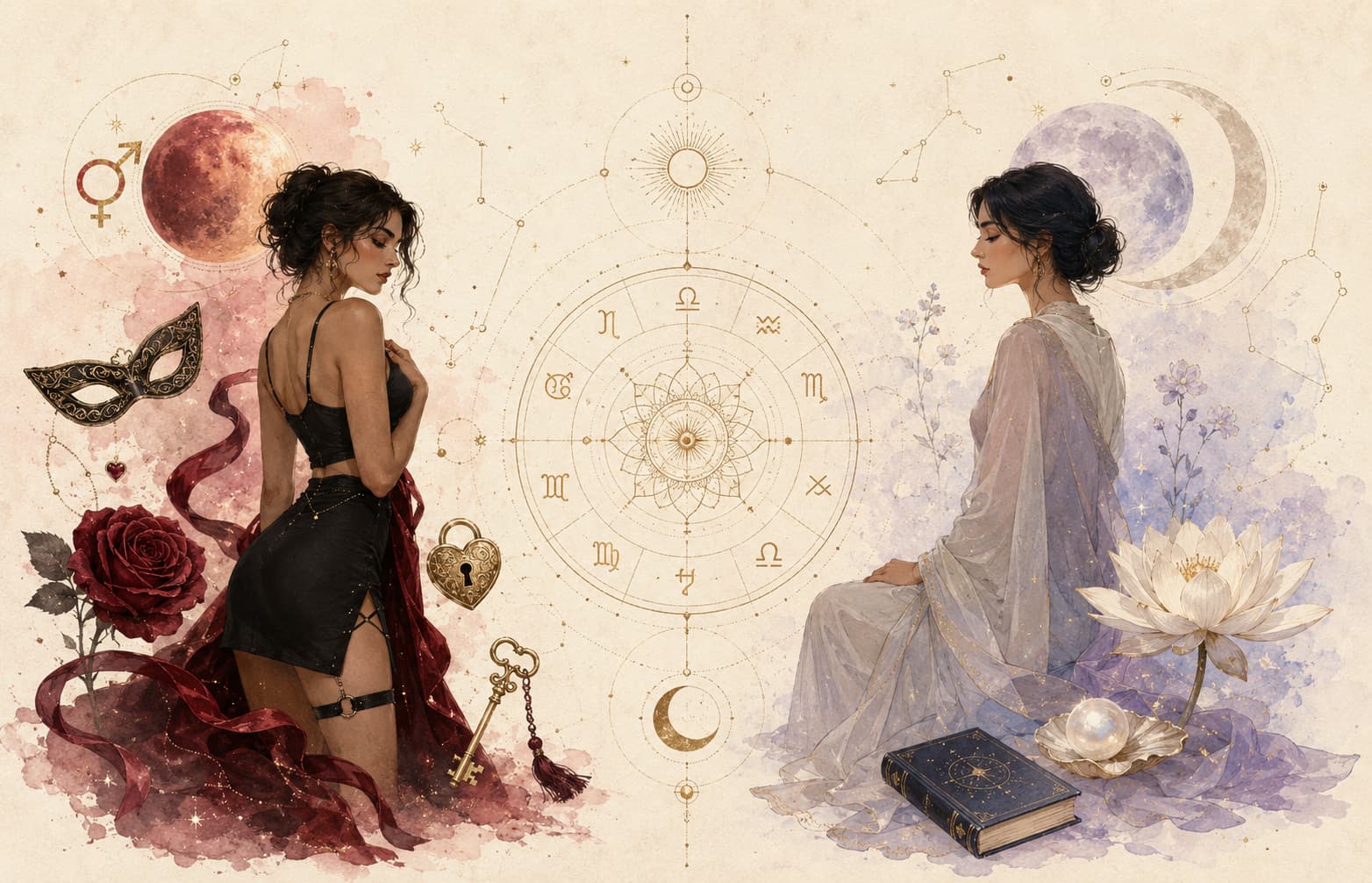
Many people quietly wonder why their intimate desires feel intense, unconventional, or almost absent. Some feel drawn toward power exchange, sensory extremes, or specific fantasies that society often labels as kinks or fetishes. Others experience a persistently high drive that borders on restlessness. Still others notice little or no sexual interest and may identify as asexual or simply feel detached from physical intimacy. In Vedic astrology, or Jyotisha, these patterns are not treated as moral failings or random quirks. They are viewed as expressions of specific planetary energies, house activations, and karmic tendencies visible in the birth chart.
This article examines the traditional associations of the 8th house (Randhra Bhava) with taboo intimacy and transformation, the 12th house with bed pleasures (Shayana Sukha), the amplifying combinations of Venus, Rahu, and Mars that can support intense or unconventional desire, and the restrictive or detaching influence of Saturn and Ketu that may correlate with low libido or asexual expression. The aim is clarity and self-understanding, never judgment. A single placement never tells the full story. The complete Kundli, including Lagna, Moon sign, house lords, aspects, dignity, Nakshatras, Dashas, and relevant divisional charts, must always be examined.
The interpretive method behind this point is developed further in the secrets of the 8th house.
Key Takeaways
- The 8th house relates to deep emotional and sexual merging, secrecy, power dynamics, and transformative intimacy.
- The 12th house indicates private bed pleasures, the quality of physical intimacy, and the capacity for surrender or loss of self in pleasure.
- Strong Venus-Rahu-Mars links, especially involving the 8th or 12th houses, are traditionally associated with heightened, experimental, or obsessive sexual energy.
- Saturn and Ketu influences on Venus, Mars, the 7th, 8th, or 12th houses may correlate with delayed desire, repression, detachment, or genuine lack of sexual interest.
- No placement guarantees hypersexuality, kink orientation, or asexuality. Context, strength, and the rest of the chart decide the expression.
- These themes are best understood as energetic patterns rather than fixed labels.
Understanding Sexuality in the Framework of Vedic Astrology
In classical Jyotisha, sexual energy is not isolated as a single topic. It appears under several headings: the natural significations of Venus (Shukra) for pleasure, attraction, and bodily fluids; Mars (Mangala) for drive, heat, and physical assertion; the 7th house for partnership and sexual relations within marriage or committed bonds; the 8th house for the deeper, often hidden, merging of energies; and the 12th house for the private enjoyment of the bed and the surrender that occurs during intimacy.
The 5th house can show romance and creative desire, yet the more intense, transformative, or private dimensions fall under the 8th and 12th. Traditional texts such as Brihat Parashara Hora Shastra discuss the 12th house in terms of expenses, losses, foreign residence, sleep, and comforts of the bed. Later interpretive traditions and practical chart reading have expanded these significations to include the quality of sexual enjoyment and the capacity for private pleasure.
Importantly, Jyotisha does not moralise these expressions. A chart that shows strong desire is not “bad,” just as a chart that shows detachment is not “superior.” Both are simply patterns of energy seeking expression or sublimation according to the native’s overall karma and life path.
The 8th House: Taboo Intimacy, Transformation, and Power Dynamics
The 8th house is known as Randhra Bhava, the house of the opening or vulnerability, and also as Ayu Bhava, linked with longevity and major life transitions. In the Kalapurusha scheme it is associated with the generative and excretory organs. Classical and modern Jyotisha both recognise its connection with secrecy, inheritance, occult knowledge, sudden change, and the psychological depths that arise when two people share vulnerability.
In the context of intimacy, the 8th house describes the experience of merging that goes beyond surface attraction. It is the house where ego boundaries soften, where trust or control issues surface, and where sexual energy can become a vehicle for psychological or spiritual transformation. When planets occupy or aspect this house strongly, the native often experiences sexuality as intense, private, or emotionally charged rather than purely recreational.
Planets in the 8th house colour the flavour of this intensity:
- Mars here may give assertive or passionate sexual expression, sometimes with themes of dominance or urgency.
- Venus can bring deep sensual bonding and a preference for emotionally charged intimacy.
- Rahu may introduce unconventional, foreign, or obsessive qualities, including attraction to taboo or experimental forms of intimacy.
- Saturn can create caution, delay, or a sense of heaviness around sexual vulnerability.
- Ketu may produce detachment, sudden withdrawal, or a preference for transcendental rather than purely physical merging.
The lord of the 8th house and its placement further refine the picture. When the 8th lord connects with Venus or the 12th house, private and transformative sexual themes often become more prominent in the life story. Afflictions without benefic support can correlate with difficulties around trust, secrecy, or compulsive patterns, while well-supported placements can indicate profound capacity for healing through intimacy.
BDSM and certain kink dynamics, which involve power exchange, trust, and controlled vulnerability, often find their strongest chart indicators in a well-activated 8th house, especially when Mars, Rahu, or Saturn participate. These are not “predictions” of lifestyle but indications of an energetic affinity for intensity and structured surrender or control.
The 12th House: Bed Pleasures and Private Surrender
The 12th house, Vyaya Bhava, is the house of loss, expenditure, isolation, foreign lands, the subconscious, and final liberation (Moksha). It is also classically linked with the bed and the pleasures experienced there. Traditional descriptions speak of “Shayana Sukha,” the comforts and enjoyments of the sleeping place, which practical astrology has long extended to include the quality of physical intimacy.
Benefic influences on the 12th house or its lord, particularly Venus, are associated with the capacity to enjoy private sensual experiences. Malefic influences can indicate restlessness in the bed, difficulty relaxing into pleasure, or a sense of loss connected with intimacy. The 12th house also rules the act of surrender. In sexual experience this can appear as the ability to let go of control, to dissolve temporarily into sensation, or, when afflicted, as feelings of emptiness after physical union.
When the 12th house is strongly linked to the 8th, the private bed becomes a site of deep psychological work. When linked to Rahu, the private sphere may include unconventional or secretive experiences. When Saturn or Ketu dominate, the native may prefer solitude, spiritual practice, or simply feel little pull toward physical pleasure.
Venus, Mars, and Rahu: The Amplifiers of Desire and Experimentation
Venus is the natural karaka for love, beauty, pleasure, and the capacity to attract and enjoy sensual experience. Mars supplies the heat, drive, and physical courage that turn attraction into action. Rahu, the north node, amplifies whatever it touches, often in unconventional, obsessive, or boundary-pushing ways.
Combinations of these three planets, especially when they involve the 1st, 5th, 7th, 8th, or 12th houses, are the most frequently noted indicators of heightened or experimental sexual energy in contemporary Jyotisha practice.
- Venus-Mars conjunction or mutual aspect can produce strong physical chemistry and a lively sexual appetite. In fiery signs or in houses of intensity the expression may feel urgent or passionate.
- Venus-Rahu connections often correlate with attraction to the unusual, the forbidden, or the highly stimulating. The native may seek experiences that feel larger than ordinary romantic love, sometimes leading to patterns of restlessness or experimentation.
- Mars-Rahu can intensify physical drive and, in some charts, introduce themes of aggression, risk, or power in sexual expression.
- When all three factors interact, the chart may show a marked capacity for intense, multi-layered, or unconventional intimate experiences.
These combinations do not automatically produce BDSM or specific fetishes. They increase the volume of sexual energy and the likelihood that the native will explore beyond conventional boundaries. Whether that energy becomes creative, relational, compulsive, or transformative depends on the rest of the chart, the presence of balancing factors such as Jupiter or a well-placed Saturn, and the native’s conscious choices.
Hypersexuality, understood here as a persistently high and sometimes restless drive, is more likely when these planets are strong, poorly aspected by calming influences, and activated by relevant Dashas or transits. The emotional tone is often set by the Moon and the 4th or 5th houses. Without emotional grounding, high physical desire can feel unsatisfying or compulsive.
Saturn and Ketu: Restriction, Detachment, and Asexual Expression
Saturn (Shani) brings structure, delay, coldness, and the weight of consequence. Ketu (the south node) brings detachment, past-life completion, and a turning away from material or sensory engagement. When these planets strongly influence Venus, Mars, the 7th, 8th, or 12th houses, the natural flow of sexual energy is often slowed, redirected, or diminished.
Common patterns associated with lower libido or asexual orientation in chart analysis include:
- Saturn aspecting or conjunct Venus, which can cool attraction, create performance anxiety, or delay the awakening of sensual interest.
- Ketu conjunct Venus or occupying the 7th or 12th house, which may produce a sense of “been there, done that” regarding physical intimacy, or a preference for spiritual rather than bodily connection.
- Saturn or Ketu in the 8th house, sometimes correlating with difficulty opening to vulnerability or a preference for controlled, minimal, or absent sexual expression.
- Strong Saturn or Ketu influence on the Moon in relation to the houses of desire, which can create emotional distance from physical needs.
Asexuality, in the modern sense of experiencing little or no sexual attraction, finds its closest traditional parallels in charts where desire significators are either heavily restricted by Saturn or largely transcended by Ketu. Not every such chart produces asexual identification. Some natives experience temporary or situational low desire during specific Dashas; others channel the energy into creative, intellectual, or spiritual pursuits. The distinction between repression (Saturn-heavy, often accompanied by frustration) and genuine detachment (Ketu-supported, often peaceful) is important and can only be assessed through the full chart and the native’s lived experience.
How Astrologers Examine These Themes in a Birth Chart
A practical sequence for exploring sexual expression patterns might look like this:
- Note the Lagna and its lord for overall vitality and self-expression.
- Examine Venus and Mars for strength, dignity, house placement, and aspects.
- Assess the 7th, 8th, and 12th houses, their lords, and any planets occupying them.
- Check Rahu and Ketu for involvement with the above factors.
- Look at Saturn’s relationship to Venus, Mars, and the relevant houses.
- Consider the Navamsha (D9) for the deeper promise of relationships and the quality of Venus.
- Note relevant Dashas. Venus, Mars, Rahu, 8th-lord, or 12th-lord periods often activate these themes.
- Review current transits for temporary intensification or quieting of desire.
Hypothetical example (not a real chart): Suppose a chart has Venus conjunct Rahu in the 8th house, Mars aspecting that conjunction from the 5th, and Saturn placed in the 12th. The combination may indicate strong capacity for intense, private, and experimental intimacy, yet Saturn in the 12th could introduce periods of withdrawal or a need for solitude after deep merging. The actual life expression would still depend on the signs involved, the strength of the Moon, the overall chart balance, and the native’s choices.
This same symbolism can affect inner life in ways examined in fertility and sexual health indicators.
Positive and Constructive Expressions
When these planetary patterns are well integrated they can support:
- Deep capacity for trust and transformative bonding.
- Creative exploration of sensuality within consensual relationships.
- Ability to hold intensity without being overwhelmed.
- Sublimation of strong desire into artistic, athletic, or spiritual discipline.
- Peaceful acceptance of a low or absent sexual drive without self-judgment.
Challenges and Imbalanced Expressions
Without awareness or balancing factors the same energies may appear as:
- Compulsive seeking of intensity that never feels enough.
- Difficulty with ordinary affectionate intimacy.
- Secrecy or shame around desires.
- Sudden withdrawal or emotional coldness after closeness.
- Confusion between genuine asexual orientation and temporary repression.
These are possibilities, not certainties. The chart shows tendencies; life, maturity, and free will shape the outcome.
Factors That Modify the Results
Dignity of the planets, combustion, retrogression, benefic or malefic aspects, functional nature according to Lagna, strength in Shadbala, Nakshatra lords, and the condition of the Moon all alter the expression. A strong Jupiter can bring wisdom and ethical boundaries to intense desire. A well-placed Saturn can add patience and structure rather than mere restriction. The Navamsha and other divisional charts often refine or contradict the Rashi-chart indications, which is why isolated placements should never be taken as final.
Common Misconceptions
One frequent misunderstanding is that the 8th house alone “causes” kinks or BDSM interest. Intensity and power themes may be present, yet the specific form of expression depends on many other factors and on personal choice. Another misconception is that Saturn or Ketu always produce lifelong asexuality. They more often indicate periods of low interest, delayed awakening, or a preference for non-physical forms of connection. Finally, no planetary combination makes a person “doomed” to addiction or “guaranteed” spiritual superiority. Both high desire and low desire can be lived skillfully or unskillfully.
Traditional Remedies and Practical Guidance
Remedies in Jyotisha are offered as supportive spiritual and behavioural practices, not guaranteed cures.
For excess intensity or restlessness linked to Venus-Rahu-Mars patterns, traditional suggestions include disciplined physical exercise, creative outlets, mantra practice for Venus or Mars with proper guidance, and charity connected with the relevant planets. Strengthening Jupiter through study, teaching, or ethical conduct can provide needed perspective.
For Saturn or Ketu related detachment or repression that feels burdensome, practices that gently reconnect body and mind, such as mindful movement, service to elders or the underprivileged (Saturn), or meditation and self-inquiry (Ketu), are often recommended. Respect for one’s own natural rhythm is itself a form of remedy.
Gemstones, elaborate rituals, or severe fasting should never be undertaken without full chart analysis and consideration of health. Simple, consistent practices that build self-awareness usually prove more useful than dramatic interventions.
Conclusion
Sexual kinks, BDSM dynamics, fetishes, hypersexuality, and asexuality appear in Vedic astrology as varied expressions of the same underlying life force filtered through the 8th house of transformative intimacy, the 12th house of private pleasure and surrender, and the interplay of Venus, Mars, Rahu, Saturn, and Ketu. These patterns invite curiosity rather than fear or shame. A birth chart can illuminate why certain desires feel strong, unusual, or absent, yet it cannot replace self-knowledge, consent, and personal responsibility. The most useful approach is to study the complete Kundli with an experienced and non-judgmental astrologer, combine the insights with honest self-reflection, and allow the energy, whatever its volume or flavour, to find a constructive path.
The same combination can take another relational form in transactional relationships and sugar dynamics.
Frequently Asked Questions
Can a single planet determine whether someone is hypersexual or asexual? No. Sexual expression is a multi-factor indication involving Venus, Mars, the 7th, 8th, and 12th houses, Rahu, Ketu, Saturn, the Moon, and the overall chart strength. One planet may colour the picture but never decides it alone.
Does the 8th house always mean interest in BDSM or kinks? Not necessarily. The 8th house indicates capacity for intensity, vulnerability, and transformative merging. Whether that capacity expresses through conventional intimacy, power exchange, or psychological depth depends on other chart factors and personal choice.
Is asexuality always caused by Saturn or Ketu? Saturn and Ketu are the most common classical indicators of reduced or redirected sexual interest, yet the full picture includes the condition of Venus and Mars and the native’s lived experience. Some people simply have low desire without heavy affliction.
Readers following this theme into intimacy and partnership may also recognize LGBTQ+ orientation and relationship signatures.
Do Dashas change sexual desire significantly? Yes. Periods of Venus, Mars, Rahu, the 8th lord, or the 12th lord frequently activate or intensify these themes. Saturn or Ketu Dashas may quiet them. Transits can produce temporary shifts as well.
Should someone with strong Rahu-Venus avoid relationships? No. Such combinations often indicate rich capacity for unconventional or intense bonding. Awareness, communication, and ethical boundaries help the energy remain constructive.
Can remedies completely change a person’s sexual orientation or drive? Traditional remedies support balance and self-awareness. They do not rewrite the fundamental chart promise. They may ease compulsion or reduce unnecessary repression, allowing the native to live more comfortably with their natural pattern.
Is it necessary to consult an astrologer for these topics? Self-study of the basic house and planet meanings can provide useful insight. A competent Jyotisha practitioner who approaches sexuality without moral judgment can help integrate the full chart context and avoid over-interpretation of isolated factors.
About the author
Anika Rao
Editor-in-Chief
Anika Rao is the editor-in-chief of Vedic Astrology Space. Her work brings classical Jyotish into conversation with relationships, identity, emotional life and the questions people carry into a modern chart reading. She is especially interested in nakshatras, the Moon, relational patterns and interpretations that create self-understanding without reducing a person to a placement.
Read the full bioContinue reading

Friendship Breakups and Betrayal in Vedic Astrology: 3rd & 11th House Insights

Childfree by Choice or Delayed Parenthood in Vedic Astrology