
Dharma Artha Kama Moksha Houses in Vedic Astrology: The Four Aims of Life in Your Chart
Discover how Dharma, Artha, Kama and Moksha houses in your Vedic birth chart show the balance of purpose, livelihood, desire and liberation. Learn to identify dominant aims and areas needing development through house lords, yogas, elemental balance and Ashtakavarga scores.
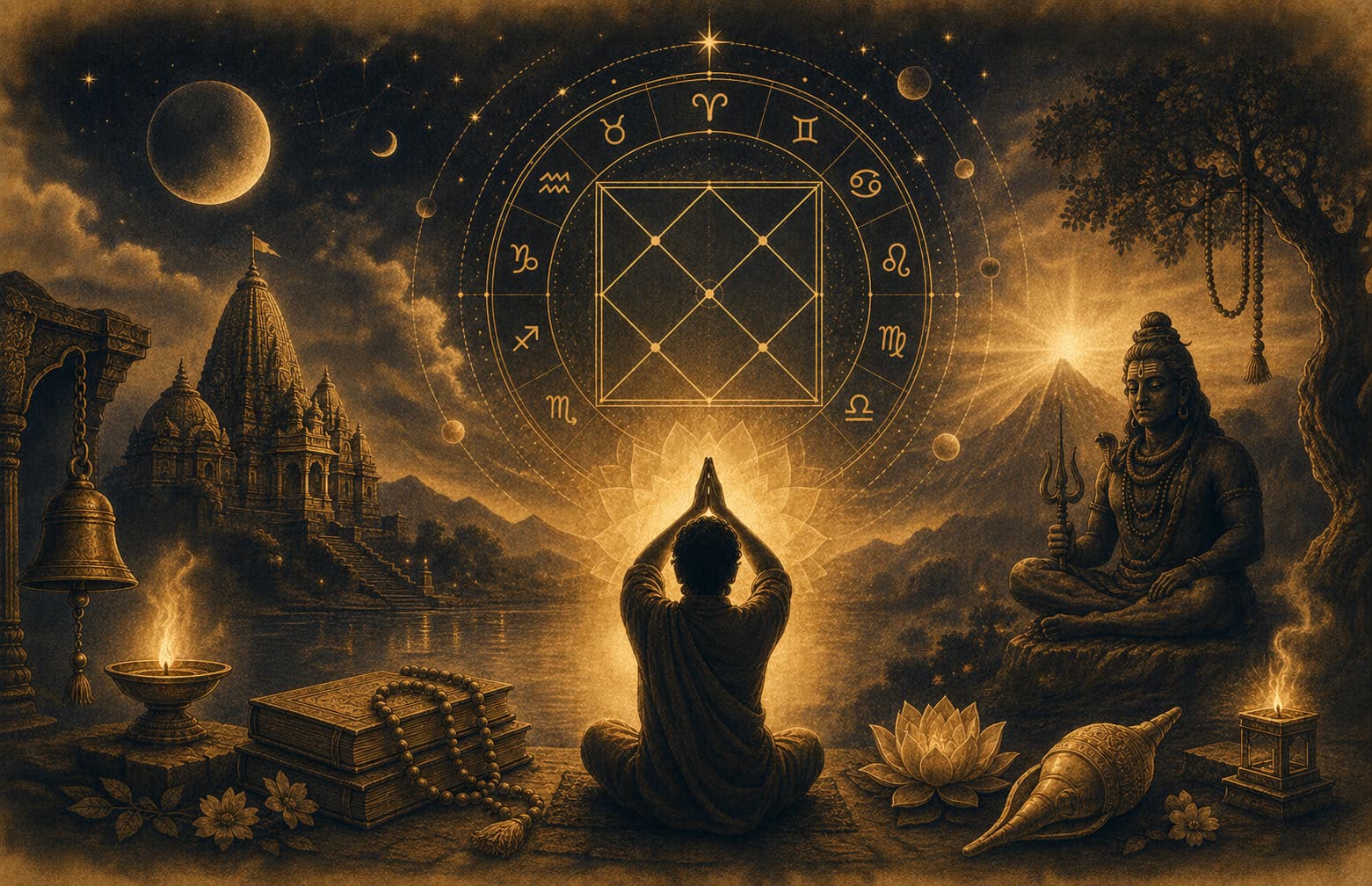
Many people look at their birth chart and ask a quiet question: Why does one area of life feel naturally strong while another always needs extra effort? One person may build a successful career with ease yet struggle to find inner peace. Another may feel deep spiritual inclination but face repeated financial pressure. A third may enjoy rich relationships and creative expression yet sense a lack of lasting purpose. These patterns are not random. Classical Jyotish maps them onto four groups of houses that correspond to the four aims of human life, known as the Purusharthas.
This principle gains another level of precision through Nakshatra padas.
The four aims are Dharma (righteous purpose and duty), Artha (material security and livelihood), Kama (desire, pleasure and relationships), and Moksha (liberation, detachment and inner freedom). In the birth chart these aims are expressed through specific houses: Dharma houses 1, 5 and 9; Artha houses 2, 6 and 10; Kama houses 3, 7 and 11; Moksha houses 4, 8 and 12. When the planets, house lords, yogas and Ashtakavarga scores connected with these groups are examined together, a clear picture emerges of which aim already receives natural support and which may require conscious development for a more balanced life.
This article explains the meaning of each group, shows how to assess relative strength, and offers practical ways to read the chart without reducing a person’s life to a single dominant theme. The complete birth chart always remains the final authority; the house groups simply provide a useful lens for understanding life direction.
Key Takeaways
- Dharma houses (1, 5, 9) relate to identity, creativity, higher learning, ethics and the sense of purpose.
- Artha houses (2, 6, 10) govern resources, daily work, service, career status and material security.
- Kama houses (3, 7, 11) cover courage, partnerships, desires, social networks and fulfilment of wishes.
- Moksha houses (4, 8, 12) indicate emotional foundations, transformation, solitude, loss of ego and spiritual release.
- Relative strength is judged through planets placed in the houses, condition of the house lords, relevant yogas, elemental balance and combined Ashtakavarga bindu scores of each trio.
- A chart rarely shows perfect equality; the goal is awareness and conscious cultivation of the weaker aims rather than forced equalisation.
- Interpretation always requires the full chart context, including Lagna, Moon, dashas and current transits.
The Four Aims of Life: A Brief Foundation
In classical Indian thought the human journey is guided by four legitimate goals. Dharma is the pursuit of ethical living, duty, and alignment with one’s nature and social role. Artha is the honest acquisition and management of resources needed to sustain life and fulfil responsibilities. Kama is the enjoyment of desires, sensory pleasure, relationships and creative expression within the bounds of Dharma. Moksha is the eventual release from compulsive cycles of attachment and the recognition of lasting inner freedom.
These aims are not ranked in a rigid hierarchy for every person at every stage. A young adult may rightly emphasise Artha and Kama while establishing livelihood and relationships. Later life often brings greater attention to Dharma and Moksha. The birth chart shows the innate inclination and the areas where support or resistance is likely. When one aim is heavily emphasised and another is poorly supported, the person may experience repeated friction until the neglected area receives attention.
Jyotish does not treat the four aims as abstract philosophy. It locates them in concrete houses of the birth chart so that an astrologer can observe their relative vitality through planetary placement, lordship, aspects, dignity and numerical strength measures such as Ashtakavarga.
Dharma Houses: 1, 5 and 9 – Purpose, Ethics and Higher Direction
The first, fifth and ninth houses form the Dharma trikona, or trine of righteous purpose. They are associated with the fire element and with the quality of initiative, vision and moral direction.
House 1 (Tanu Bhava) represents the self, body, temperament, vitality and the overall life approach. It is the foundation of personal Dharma – the way a person naturally expresses identity and takes responsibility for life. A strong first house or its lord supports self-awareness, physical resilience and the capacity to act from inner conviction.
House 5 (Putra Bhava) covers intelligence, creativity, children, speculative ability, mantra, past-life merit and the capacity for joyful self-expression. It shows how a person generates new ideas, educates others or finds pleasure in pure learning. When the fifth house is well supported, the native often experiences a natural sense of purpose through teaching, creative work, or guiding the next generation.
House 9 (Dharma Bhava) is the primary house of higher knowledge, fortune, long-distance travel, teachers, father, ethics and spiritual inclination. It indicates the guiding philosophy that shapes decisions. Benefic influence here often brings teachers, protective fortune and a felt sense of meaning. Difficult conditions may produce questioning of belief systems or delays in finding a stable ethical framework.
When planets occupy these houses or the lords of 1, 5 and 9 are strong, well-placed and mutually related, the chart tends to emphasise purpose, ethical action and higher learning. The person may feel most alive when engaged in work that has meaning beyond personal gain. Yogas such as Dharma-Karmadhipati Yoga (connection between ninth and tenth lords) further reinforce the sense that professional life and higher purpose support each other.
Elementally, the fire quality of these houses favours initiative, enthusiasm and the ability to inspire. Excess fire without balancing influences can produce restlessness, moral rigidity or a tendency to preach rather than practise. Weak fire may leave the person searching for direction or adopting the values of others without deep conviction.
Artha Houses: 2, 6 and 10 – Livelihood, Resources and Status
The second, sixth and tenth houses form the Artha trikona. They relate to the earth element and to the practical work of building and maintaining material security.
House 2 (Dhana Bhava) governs accumulated wealth, family resources, speech, food and early values. It shows the capacity to gather and preserve resources. A strong second house or lord supports financial stability and clear communication of values. Challenges here may appear as fluctuating income, family financial pressure or speech-related difficulties.
House 6 (Shatru Bhava) covers daily work, service, competition, debts, health routines and the ability to overcome obstacles. It is the house of sustained effort. When well-supported it gives skill in problem-solving, service professions and the discipline to handle opposition. When weak or afflicted it can indicate chronic health concerns, workplace conflict or ongoing financial drains.
House 10 (Karma Bhava) is the house of career, public status, authority and the contribution one makes to society. It shows how the person is seen in the professional sphere and the nature of their main work. Strong tenth-house factors often bring recognition, leadership opportunities or steady professional growth. Difficult conditions may produce instability in career direction or conflict with authority.
Planets in the Artha houses, strong lords of 2, 6 and 10, and supportive aspects tend to produce a chart that is comfortable with structure, responsibility and material achievement. The native often feels secure when finances are organised, work is productive and social contribution is visible. Yogas such as Dhana Yogas (wealth combinations involving second and eleventh lords or Jupiter with the second lord) or Raja Yogas involving the tenth house further strengthen the Artha emphasis.
Earth element dominance here favours patience, practicality and the ability to build lasting structures. Excess earth without balancing fire or air can create rigidity, over-attachment to status or difficulty releasing outdated career patterns. Weak earth may produce inconsistent resources or a sense that material life is always under pressure.
Kama Houses: 3, 7 and 11 – Desire, Relationships and Fulfilment
The third, seventh and eleventh houses form the Kama trikona. They are linked with the air element and with movement, exchange and the pursuit of what one wants.
House 3 (Sahaja Bhava) represents courage, younger siblings, short journeys, communication skills, writing, hobbies and the initiative to take calculated risks. It shows how a person asserts personal will and develops skills through effort. Strong third-house factors support entrepreneurial spirit, media work, sports or any field requiring self-motivation.
House 7 (Jaya Bhava) is the house of marriage, business partnerships, open enemies and the significant other. It indicates the quality of one-to-one relationships and the capacity for mutual exchange. Benefic influence supports harmonious partnerships; challenging conditions may produce delay, conflict or repeated lessons through relationships.
House 11 (Labha Bhava) covers gains, elder siblings, social networks, fulfilment of desires, income from career and large organisations. It shows how wishes materialise and how the person benefits from community. A strong eleventh house or lord often brings helpful friends, steady gains and the ability to turn ideas into tangible results.
When the Kama houses are emphasised, the chart tends to highlight desire, social connection, creative collaboration and the pursuit of personal goals. The native may feel most alive in relationships, group activities, communication fields or any setting where exchange and mutual benefit are possible. Yogas linking the seventh and eleventh houses, or Venus and Jupiter in supportive positions, further enhance the capacity for fulfilling relationships and material gains through desire.
Air element qualities favour adaptability, curiosity and networking. Excess air can produce scattered desires, restlessness in relationships or difficulty committing to one path. Weak air may leave the person isolated, hesitant to express needs or unsure how to turn wishes into reality.
Moksha Houses: 4, 8 and 12 – Emotional Roots, Transformation and Liberation
The fourth, eighth and twelfth houses form the Moksha trikona. They are associated with the water element and with the inner journey of feeling, release and transcendence.
House 4 (Sukha Bhava) governs home, mother, emotional foundations, vehicles, land and the sense of inner peace. It shows the quality of early nurturing and the capacity to create a secure emotional base. Strong fourth-house factors support contentment, property and a settled inner life. Difficult conditions may indicate emotional restlessness or unsettled domestic circumstances.
House 8 (Ayur Bhava) covers longevity, transformation, hidden knowledge, inheritance, sudden events and the deeper psychological processes that strip away superficial identity. It is the house of crisis that can lead to profound insight. Benefic influence supports research, occult study, healing professions or the ability to regenerate after loss. Affliction may bring sudden upheavals or difficulty processing intense experiences.
House 12 (Vyaya Bhava) represents expenditure, isolation, foreign residence, sleep, charity, losses and the final release of ego boundaries. It is the house of surrender and transcendence. Strong twelfth-house factors can support meditation, spiritual retreat, creative imagination or work in hospitals, prisons or distant lands. Challenging conditions may appear as chronic expenditure, escapism or a sense of isolation.
When Moksha houses are strong, the chart often shows an innate pull toward inner experience, psychological depth and eventual detachment from purely worldly goals. The person may feel most at peace in solitude, contemplative practice, healing work or any setting that allows release of ordinary social identity. Yogas involving the eighth and twelfth houses, or strong placements of Ketu, can intensify the Moksha orientation.
This distinction becomes easier to apply after reading modern meanings of houses and signs.
Water element qualities favour empathy, intuition and the capacity to feel deeply. Excess water without balancing earth or fire can produce emotional overwhelm, withdrawal or difficulty maintaining practical boundaries. Weak water may leave the person disconnected from feeling, resistant to necessary endings or unable to find lasting inner rest.
Assessing Relative Strength: House Lords, Yogas and Elemental Balance
Identifying which aim dominates begins with a systematic survey of the four groups.
First examine planetary occupation. Count the number of planets in each trio of houses. A cluster of planets in one group immediately draws attention to that aim. Note whether the planets are natural benefics or malefics, and whether they are in dignity, exaltation, own sign, friendly sign or debilitation.
Next evaluate the house lords. The lords of 1, 5 and 9 for Dharma; 2, 6 and 10 for Artha; 3, 7 and 11 for Kama; 4, 8 and 12 for Moksha. Observe their sign placement, house placement, aspects received, conjunctions and overall strength. A lord placed in a house of the same group (for example, ninth lord in the first or fifth) strengthens the aim. A lord placed in a house of a different group creates a bridge between aims. A weak or heavily afflicted lord reduces the easy expression of that aim.
Yogas provide further clarity. Dharma-Karmadhipati Yoga links purpose and career. Dhana Yogas support Artha. Raja Yogas involving the seventh or eleventh can amplify Kama. Combinations of the fourth, eighth and twelfth lords or strong Ketu placements often heighten Moksha themes. The presence of multiple yogas in one group, especially if activated by current dasha, points to a dominant life theme during that period.
Elemental balance is assessed by noting the signs occupied by the relevant planets and lords. Fire signs (Aries, Leo, Sagittarius) reinforce Dharma. Earth signs (Taurus, Virgo, Capricorn) support Artha. Air signs (Gemini, Libra, Aquarius) favour Kama. Water signs (Cancer, Scorpio, Pisces) emphasise Moksha. A chart with many planets in fire signs and strong Dharma lords will naturally lean toward purpose and initiative. A chart heavy in water signs and Moksha houses will feel the pull of inner transformation more strongly.
Ashtakavarga Combined Scores for the Four Aims
Ashtakavarga offers a numerical method for comparing the relative strength of the four house groups. In the standard Sarvashtakavarga each house receives a certain number of bindus (points) ranging from zero to eight, based on the contributions of the seven planets and the Lagna. The theoretical maximum for any house is 56, though practical scores are lower.
The spiritual and ethical dimension of this question is developed further in finding the Ishta Devata from a birth chart.
To assess the aims, simply add the Sarvashtakavarga scores of the three houses in each group:
- Dharma total = bindus of house 1 + house 5 + house 9
- Artha total = bindus of house 2 + house 6 + house 10
- Kama total = bindus of house 3 + house 7 + house 11
- Moksha total = bindus of house 4 + house 8 + house 12
The group with the highest combined score tends to receive the most natural support. The group with the lowest score may require more conscious effort. Differences of ten or more points are usually noticeable in lived experience. A very high score in one group combined with a very low score in another often appears as a life pattern in which one aim is pursued almost automatically while another feels chronically underdeveloped.
It is important to remember that Ashtakavarga is a supportive tool, not a complete judgement. A high score does not guarantee success if the house lords are weak or the relevant dasha is unfavourable. A low score does not mean failure; it simply indicates that greater awareness and deliberate cultivation will be needed. Always read the numerical picture together with planetary dignity, aspects and the overall chart promise.
Practical Steps to Examine the Four Aims in a Birth Chart
- Note the Lagna and the Moon sign; both colour the expression of every house group.
- List the planets occupying houses 1, 5, 9 (Dharma), 2, 6, 10 (Artha), 3, 7, 11 (Kama) and 4, 8, 12 (Moksha).
- Examine the condition of the three lords of each group – their sign, house, aspects, dignity and strength.
- Identify any yogas that link houses within the same group or create bridges between groups.
- Observe the elemental distribution of the planets and lords involved.
- Calculate or obtain the Sarvashtakavarga scores and add the three houses of each Purushartha.
- Consider the current Mahadasha and Antardasha; the period of a planet connected with a strong group will activate that aim more vividly.
- Look at major transits of Jupiter, Saturn, Rahu and Ketu over the key houses or their lords for timing of opportunities or challenges.
- Integrate the findings: which aim is already well supported, which is moderately supported, and which shows clear need for conscious development.
- Reflect on lived experience. Does the chart pattern match the areas of natural ease and recurring difficulty? Adjust interpretation if major chart factors (such as a powerful Yoga or a strong Lagna lord) modify the simple group totals.
A hypothetical example may illustrate the method. Suppose a chart has Sun, Mars and Jupiter in the first, fifth and ninth houses respectively, the ninth lord exalted, and a Dharma Ashtakavarga total of 42. The Artha total is 28, Kama 31 and Moksha 25. The chart strongly emphasises purpose, teaching and ethical action. Career and resources may still function, yet the native is likely to feel most fulfilled when work carries meaning. Emotional rest and release may require deliberate practices of solitude or contemplative study because the Moksha houses and their lords are relatively quiet.
When One Aim Dominates and Another Needs Development
A dominant Dharma emphasis often produces a person who lives by principles, seeks teachers, and feels restless without a sense of higher direction. The developmental task may be to ground ideals in practical Artha so that purpose does not remain abstract, and to allow healthy Kama so that relationships and simple pleasures are not neglected.
Strong Artha without balancing factors can create excellent providers who later wonder why success feels empty. Conscious attention to Dharma restores meaning; attention to Moksha prevents burnout and over-identification with status.
Heavy Kama emphasis may bring rich social and sensual experience, yet leave the person searching for lasting fulfilment. Strengthening Dharma supplies ethical boundaries; strengthening Moksha supplies the capacity to enjoy without clinging.
A pronounced Moksha orientation can produce deep inner life, healing ability or spiritual insight, yet may also bring material insecurity or difficulty sustaining ordinary relationships. Conscious cultivation of Artha and Kama helps the person remain effective in the world while pursuing inner freedom.
Balance is not achieved by forcing equal planetary strength. It is achieved by recognising the natural emphasis and deliberately nourishing the quieter aims through lifestyle, study, relationships and spiritual practice appropriate to the individual chart.
Common Misconceptions
One frequent misunderstanding is that the strongest group predicts the only important area of life. In reality every chart contains all four aims; the groups simply show relative ease and resistance.
Another misconception is that a low Ashtakavarga score condemns a person to permanent weakness in that area. Scores indicate natural support, not fixed destiny. Effort, dasha timing and conscious remedies can improve expression.
Some readers assume that Moksha houses are purely spiritual and therefore always positive. In practice, poorly supported Moksha houses can produce isolation, chronic loss or difficulty completing projects. Strength and dignity still matter.
Finally, the four aims are sometimes treated as sequential stages that must be completed in order. Classical thought presents them as concurrent and mutually supportive. A healthy life integrates all four according to the person’s nature and stage of life.
Traditional Guidance for Cultivating Balance
When a particular aim appears weak, classical tradition offers behavioural and spiritual practices rather than guaranteed solutions.
For underdeveloped Dharma: study of ethical texts, service to teachers, regular reflection on personal values, and honest alignment of daily actions with stated principles.
For weak Artha: disciplined management of resources, skill development in one’s field of work, service that improves practical efficiency, and respect for the labour of others.
For limited Kama: cultivation of healthy relationships, creative hobbies, clear communication of needs, and enjoyment of sensory experience within ethical bounds.
For quiet Moksha: periods of solitude, contemplative practice, charity without expectation of return, and willingness to release outdated identities or possessions.
Gemstones, specific mantras or elaborate rituals should be considered only after a full chart analysis and with attention to the person’s health and circumstances. Simple, consistent practices that strengthen the constructive qualities of the relevant planets and houses are generally safer and more sustainable.
Conclusion
The Dharma, Artha, Kama and Moksha houses offer a clear map of the four aims that shape a human life. By examining planetary occupation, house lords, yogas, elemental distribution and combined Ashtakavarga scores, a reader can see which aims already receive natural support and which may benefit from deliberate attention. The goal is not rigid equality but conscious integration. Purpose without resources becomes impractical; resources without desire become dry; desire without ethical direction becomes restless; liberation without grounding becomes escapist. When the four groups are understood in relation to the whole chart, the birth chart becomes a practical guide for living with greater awareness and balance.
These natal signatures become easier to time when read alongside Dasha Sandhi.
A complete interpretation always requires the Lagna, Moon, planetary strengths, dashas and current transits. The house groups supply a valuable organising lens, yet they never replace the living complexity of an individual Kundli.
Frequently Asked Questions
What are the Dharma houses in Vedic astrology? The Dharma houses are the first, fifth and ninth. They relate to self, creativity, intelligence, higher knowledge, ethics and the sense of life purpose. Their combined strength shows how readily a person experiences direction and moral clarity.
How do I know which of the four aims is strongest in my chart? Count planets in each house group, evaluate the strength and placement of the three lords of each group, note relevant yogas, observe elemental balance, and add the Sarvashtakavarga scores of the three houses. The group that scores highest on most of these measures is usually the dominant aim.
Can Ashtakavarga scores alone decide my life purpose? No. Ashtakavarga provides useful numerical comparison but must be read with planetary dignity, aspects, house lordship, dashas and the overall chart. A high score increases ease; it does not override a weak or afflicted lord.
Is it bad if Moksha houses are stronger than Artha houses? Not inherently. Strong Moksha houses often support inner depth, healing capacity or spiritual inclination. The practical task is to ensure that material responsibilities and relationships receive enough attention so that inner life remains sustainable.
Do the four aims change with age or dasha? The natal emphasis remains, yet different dashas and life stages bring different aims into focus. A period ruled by a planet connected with Kama houses may heighten relationship and desire themes even if Dharma is the overall strongest group.
Should I try to make all four groups equal? Perfect equality is rare and unnecessary. Awareness of the natural pattern and conscious cultivation of the quieter aims produces healthier results than attempts to force equal planetary strength.
Where can I find my Ashtakavarga scores? Most reliable Jyotish software and many traditional calculation methods provide Sarvashtakavarga tables. Once the individual house scores are known, simply add the three houses belonging to each Purushartha.
Does a strong tenth house always mean career success? A strong tenth house supports professional visibility and contribution, yet results still depend on the tenth lord’s condition, aspects, dashas and the support of other Artha houses. The full chart context remains essential.
About the author
Vikram Iyer
Contributing Editor, Spirituality and Society
Vikram Iyer writes about spirituality, belief, remedies and the social expression of planetary symbolism. His interests include Jupiter and Rahu, the ninth house, political life, public authority and the ethics of spiritual practice. He approaches Jyotish as a tradition that can illuminate faith and collective behavior without demanding conformity or surrendering critical thought.
Read the full bioContinue reading
Astrology vs Free Will: Can Bad Planetary Placements Be Completely Overcome?
Black Magic Abhichara Evil Eye and Tantric Afflictions in Vedic Astrology Causes