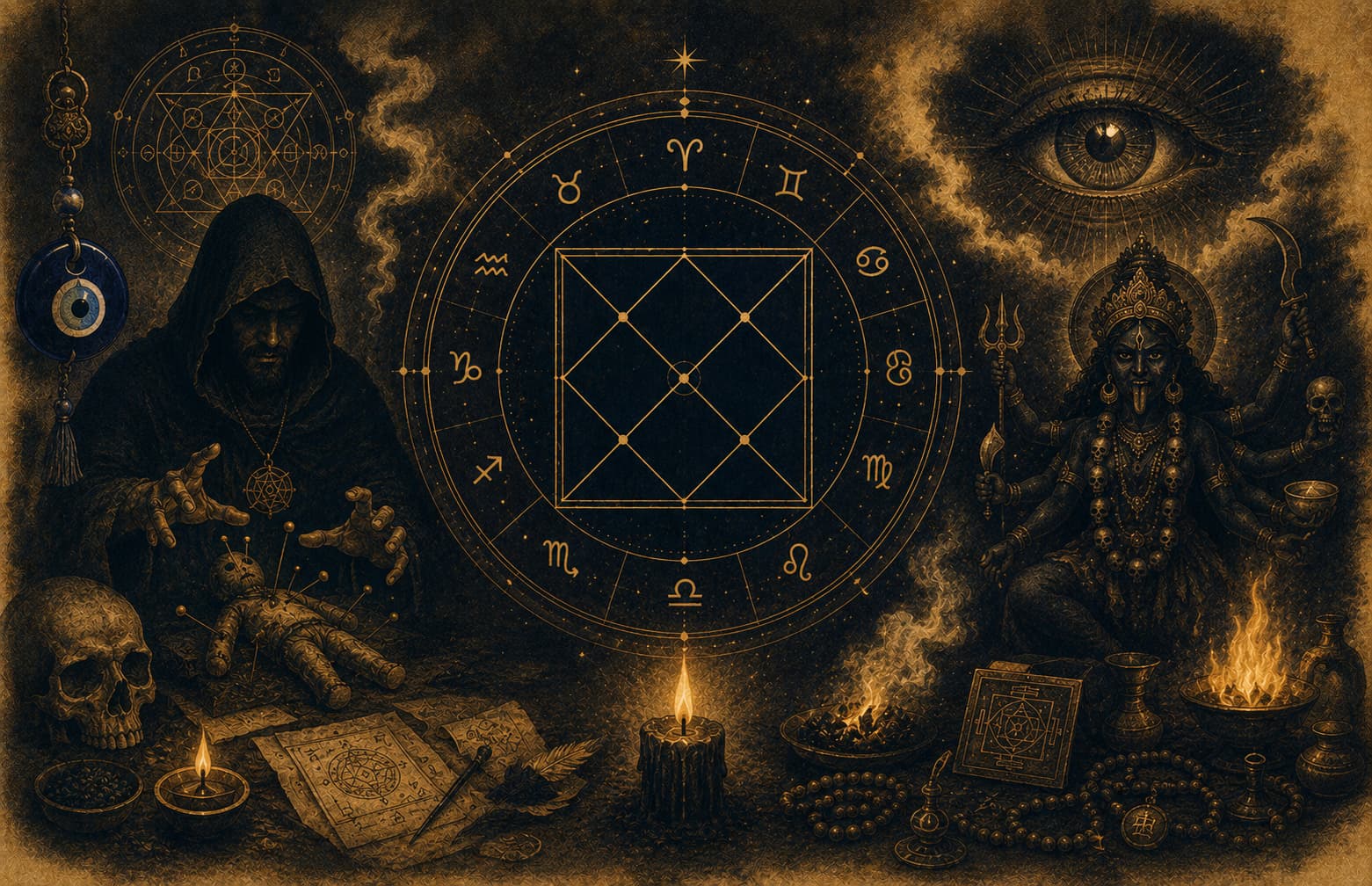
How Vedic Astrology Shapes Beliefs in God: From Blind Faith to Atheism
Discover how Vedic astrology maps the spectrum of belief from blind faith to atheism through the 9th house, Jupiter, Ketu and related factors. A clear, chart-based guide.

Many people notice that siblings raised in the same household develop strikingly different relationships with faith. One follows every ritual with unquestioning devotion. Another attends festivals out of cultural respect yet keeps personal distance. A third meditates or studies philosophy without belonging to any formal tradition. Someone else remains politely indifferent to the entire subject, while another actively rejects the idea of a higher power. Family upbringing and life experience clearly matter, yet the pattern often feels deeper than environment alone.
Vedic astrology, or Jyotisha, offers a structured way to examine such differences. It does not claim that planets force anyone into belief or disbelief. Instead, classical principles describe natural inclinations through the strength, placement and relationships of certain houses and grahas. The 9th house, traditionally called the Dharma Bhava, Jupiter as the natural significator of dharma and wisdom, the 12th house of moksha, Ketu’s capacity for detachment, and the condition of Mercury and Saturn all participate in this picture. When these factors are read together with the Lagna, Moon, dashas and overall chart strength, they can suggest why one person experiences faith as solid and unquestioned while another experiences it as optional, personal or absent.
At a collective level, similar symbolism appears in left-wing and right-wing political inclinations.
This article explores five broad orientations: blindly religious, moderately religious, spiritual without rigid affiliation, secular, and atheistic or strongly sceptical. For each, it outlines the traditional astrological associations, the constructive and difficult expressions, the factors that modify results, and how a reader can begin examining these themes in a birth chart. The discussion remains within classical Jyotisha logic and avoids deterministic language. A complete chart, current dashas and the individual’s free will always shape the final expression.
Key Takeaways
- The 9th house and its lord form the primary indicator of organised religion, higher philosophy and inherited or cultural faith.
- Jupiter, as the natural karaka of dharma, expands or contracts the capacity for trust in higher principles.
- Strong Ketu or an emphasised 12th house often supports personal, non-institutional spirituality or direct experiential insight.
- A well-developed Mercury combined with a weak or afflicted 9th house and Jupiter can favour analytical, secular or sceptical outlooks.
- No single placement creates rigid faith or complete disbelief. Dignity, aspects, house lordships, divisional charts and dasha timing all modify the result.
- Belief itself is not fixed by the chart; the chart describes tendencies that life experience, education and conscious choice can refine or redirect.
The Foundational Concept: Dharma, Faith and the Birth Chart
In classical Jyotisha the 9th house is described as the house of dharma, fortune (bhagya), long-distance travel, higher learning, the father and sacred places. Brihat Parashara Hora Shastra lists dharma among its core significations. Dharma here does not mean only ritual observance. It includes the sense of right conduct, the philosophical framework through which a person understands life, and the degree of trust placed in tradition or a higher order.
Jupiter is the natural significator of this domain. As guru it represents expansion of awareness, ethical guidance, teachers and the capacity to accept principles larger than the immediate self. When Jupiter is strong by sign, house, aspects and shadbala, the native often experiences an inherent ease with faith, whether that faith is expressed through temple worship, scriptural study or ethical living. When Jupiter is weak, combust, afflicted by malefics or poorly placed relative to the 9th house, the native may need to construct belief through effort, experience or intellectual conviction rather than receiving it as a natural inheritance.
This pattern also has a contemplative expression, explored in fake gurus and spiritual manipulation.
The 12th house and Ketu bring a different quality. The 12th relates to loss of ego boundaries, solitude, foreign residence and moksha. Ketu, the south node, carries the imprint of past-life detachment and can produce sudden insight that bypasses organised doctrine. Together they often support a spiritual orientation that feels personal rather than institutional.
Mercury governs discrimination, analysis and communication. When Mercury is strong and Jupiter is comparatively weak, the native may approach questions of God and religion through logic, evidence and debate. Saturn can either deepen orthodoxy through discipline or introduce doubt and detachment from emotional forms of faith, depending on its relationship with the 9th house and Jupiter.
These are the main building blocks. The rest of the article examines how their combinations tend to express across the spectrum of belief.
Blindly Religious Tendencies in the Chart
A blindly religious orientation is characterised by strong attachment to tradition, ritual and authority without significant internal questioning. Faith feels solid, inherited and self-evident. Doubt may be experienced as disloyalty rather than healthy inquiry.
Astrological Indicators
Several patterns traditionally support this expression:
- A strong, well-placed Jupiter in a kendra or trikona, especially if it rules or occupies the 9th house.
- Benefic influence on the 9th house and 9th lord without heavy Mercury involvement that would introduce analysis.
- Moon closely connected with Jupiter or the 9th house, creating emotional devotion (bhakti) that does not require intellectual justification.
- Saturn supporting the 9th house through ownership, aspect or placement, adding discipline and respect for established order.
- Limited affliction from Rahu or a weak Mercury that might otherwise stimulate independent thinking.
When these factors combine, the native often feels most secure within clear religious structures. Rituals, pilgrimages, scriptural recitation and guidance from a recognised guru provide comfort and meaning.
Constructive Expression
At its best this orientation produces steady ethical behaviour, community service through religious institutions, and a reliable moral compass. The person may become a sincere temple volunteer, a careful keeper of family traditions or a teacher of basic dharma to younger generations. Faith here functions as an organising principle that reduces anxiety and supports social cohesion.
Difficult Expression
The same pattern can become rigid. The native may dismiss other viewpoints as inferior, treat ritual form as more important than inner attitude, or experience crisis when life events contradict the expected rewards of piety. If Mars or Rahu aspects the 9th without tempering influences, the devotion can take on a combative or exclusive quality.
Hypothetical Example
Consider a chart with Leo Lagna, Jupiter in the 9th house in Aries, Moon in Sagittarius aspecting Jupiter, and Mercury in the 6th house under Saturn’s influence. The strong 9th-house Jupiter and Moon-Jupiter link favour emotional, tradition-based faith. Mercury’s weaker position reduces the drive for independent philosophical inquiry. Such a native may feel most at home within a clear religious framework and may experience doubt as unsettling rather than clarifying.
Moderately Religious Tendencies
A moderately religious orientation balances respect for tradition with personal judgement. The person may observe major festivals, visit places of worship on important occasions, and draw comfort from cultural practices without treating every rule as absolute.
Astrological Indicators
- Jupiter and the 9th house of moderate strength rather than extreme dignity or extreme affliction.
- Beneficial aspect or exchange between Jupiter and Mercury, allowing faith and reason to coexist.
- 9th lord placed in a neutral or mixed house (for example the 3rd, 6th or 11th) rather than purely trikona or purely dusthana.
- Venus or Moon supporting the 9th without overwhelming it, adding warmth and aesthetic appreciation of ritual.
- Saturn providing structure without excessive restriction.
This combination often produces a practical, lived religiosity. The native keeps what feels meaningful and quietly sets aside what does not.
Constructive and Challenging Sides
The constructive side includes cultural continuity without fanaticism, the ability to participate in family rituals while maintaining individual boundaries, and a flexible ethical sense. The challenging side appears when the balance tips: either into mild hypocrisy (outer observance without inner conviction) or into vague cultural attachment that offers little real guidance during difficulty.
Chart Examination Note
When assessing moderate religiosity, look at the relative strength of Jupiter versus Mercury and the condition of the 9th lord in both the Rashi chart and the Navamsha. A 9th lord that is functional benefic and receives mild benefic aspects frequently supports this middle path.
Spiritual Orientation Beyond Organised Religion
Many charts show a clear interest in higher meaning that does not settle comfortably inside formal religion. The person may meditate, study comparative philosophy, practise yoga, or seek direct experience of the sacred while remaining unaffiliated or only loosely connected to any tradition.
Astrological Indicators
- Strong Ketu, especially in the 9th, 12th, 1st or 5th house, or aspecting the Moon or Lagna.
- Emphasis on the 12th house through occupation by benefics, ownership by the Lagna lord, or aspect from Jupiter.
- Jupiter in the 12th or connected with the 12th lord, expanding the theme of renunciation and inner wisdom.
- Moon in a watery sign or nakshatra associated with intuition, receiving aspect from Ketu or Jupiter.
- Relatively quieter 9th house compared with the 12th, so that personal insight outweighs institutional loyalty.
Ketu’s influence often produces a sense that conventional religious language feels incomplete. The native may respect traditions yet feel drawn toward silence, contemplation or unconventional teachers.
Positive Possibilities
This pattern can support genuine contemplative practice, compassion that crosses religious boundaries, and the capacity to hold paradox. Many sincere sadhakas, independent philosophers and quiet seekers show such combinations.
Potential Challenges
Without grounding factors (for example a strong Lagna or Saturn), the native may drift between practices without depth, romanticise detachment while neglecting practical responsibilities, or experience periods of existential emptiness when the sought-after direct experience does not arrive on demand.
Practical Application
When examining a chart for this orientation, compare the strength and activation of the 9th versus the 12th. If the 12th and Ketu are more prominent in the natal chart and in the current dasha, personal spirituality is more likely to take precedence over organised forms.
Secular Tendencies in Vedic Astrology
Secularism here means a primary focus on worldly life, ethics derived from human reason and social contract, and limited emotional or philosophical investment in questions of God or afterlife. The person may be culturally respectful yet personally indifferent.
Astrological Indicators
- Strong Mercury as the dominant intellectual force, especially if it aspects or rules the Lagna or 10th house.
- Weak or neutral 9th house and Jupiter, so that higher philosophy does not demand attention.
- Emphasis on the 2nd, 6th, 10th or 11th houses, directing energy toward livelihood, duty, status and material goals.
- Saturn well-placed in kendras or the 10th, supporting disciplined worldly effort without strong dharmic colouring.
- Rahu in a position that favours innovation, foreign ideas or material ambition rather than traditional faith.
Such charts often produce competent professionals, administrators, scientists or practical problem-solvers who see religion as a private or historical matter rather than a living necessity.
Constructive Expression
The native can contribute to society through clear thinking, ethical professionalism and tolerance of diverse beliefs. Because faith is not a central emotional need, the person may remain calm during religious controversies and focus on shared human concerns.
Difficult Expression
If the 9th house is heavily afflicted, the indifference can harden into quiet contempt for those who do find meaning in faith. In some cases the absence of a larger philosophical framework leaves the native vulnerable to cynicism or purely transactional relationships when material goals are blocked.
Atheistic or Strongly Sceptical Orientations
Complete rejection of the idea of God or any transcendent order is less common as a pure chart signature than the previous categories, yet certain combinations increase its likelihood. Scepticism here ranges from quiet non-belief to active critique of religious institutions.
Astrological Indicators Traditionally Discussed
- Jupiter severely afflicted by conjunction or aspect from Mars, Saturn, Rahu or Ketu, especially if Jupiter rules or occupies the 9th.
- 9th house occupied or aspected by multiple malefics without benefic cancellation.
- Strong Mercury in a sign or house that favours critical analysis, combined with a weak or combust Jupiter.
- Rahu influencing the 9th house or Jupiter, introducing unconventional or rebellious attitudes toward received tradition.
- Lagna or Moon receiving hard aspects from Saturn or Rahu, creating a temperament that questions authority and emotional consolations.
Classical texts do not use the modern word “atheism,” yet they describe conditions under which dharma is obstructed, fortune is delayed, or the native turns away from traditional paths. Modern Jyotisha practitioners often read such charts as supporting a rationalist or materialist worldview.
Constructive Possibilities
A clear-eyed scepticism can protect the native from exploitation by false teachers, encourage rigorous ethical standards based on observable consequences, and support scientific or philosophical inquiry. Many constructive social reformers have shown strong analytical Mercury with challenging 9th-house conditions.
Challenges
The same pattern may produce chronic dissatisfaction, difficulty trusting any guiding principle, or a tendency to dismiss the subjective experiences of others. When the 12th house is also weak, the native may lack an inner refuge during periods of loss or illness.
Important Caveat
Even charts with multiple indicators of scepticism can produce spiritual openings later in life, especially during Jupiter or Ketu periods if those planets gain strength through transit or dasha. The birth chart describes inclination, not a fixed destiny of belief or non-belief.
Factors That Modify Every Category
No orientation is determined by one or two planets alone. The following factors regularly alter the picture:
- Functional nature of planets. Jupiter is a natural benefic, yet for certain Lagnas it becomes a functional malefic. Its results then change accordingly.
- Dignity and strength. An exalted or own-sign Jupiter supports faith more reliably than a debilitated or combust one.
- Aspects and conjunctions. Benefic aspects can rehabilitate an afflicted 9th house. Malefic aspects can disturb an otherwise strong Jupiter.
- Navamsha and other divisional charts. The condition of the 9th lord and Jupiter in the Navamsha often reveals the deeper, more lasting orientation.
- Dasha and Antardasha. A person may live most of life in a moderately religious mode and then encounter a strong Ketu or Jupiter period that shifts the inner experience toward deeper spirituality or renewed questioning.
- Gochar (transits). Major transits of Jupiter, Saturn or the nodes over the natal 9th house or Jupiter can temporarily intensify or challenge existing beliefs.
- Overall chart promise. A chart with many raja yogas and strong kendras may channel even a weak 9th house into worldly success with only mild philosophical interest, while a chart oriented toward moksha will amplify spiritual themes regardless of moderate 9th-house strength.
How to Examine These Themes in a Birth Chart
A practical sequence helps avoid over-interpretation:
- Note the Lagna and the natural temperament it suggests.
- Assess the 9th house: planets occupying it, aspects it receives, and the dignity of its lord.
- Evaluate Jupiter’s sign, house, aspects, combustion status and relationship with the 9th house.
- Compare the relative strength and activation of the 9th versus the 12th house and Ketu.
- Examine Mercury’s condition and its relationship with Jupiter.
- Check Saturn’s role: does it support structure within faith or introduce detachment and doubt?
- Look at the Navamsha positions of the same factors.
- Consider the current and upcoming dashas to see which themes are likely to become prominent.
- Weigh the overall balance of the chart rather than isolating one house or planet.
This method keeps the analysis grounded and prevents any single placement from being treated as conclusive.
Common Misconceptions
Several misunderstandings regularly appear in discussions of astrology and belief:
- “A strong Jupiter always makes a person religious.” Jupiter expands whatever it touches. In a materialistic chart it may expand ambition or generosity without producing conventional piety.
- “Afflicted 9th house means the person will be an atheist.” Affliction more often indicates struggle, delay or unconventional expression of dharma rather than total absence of faith.
- “Ketu makes everyone spiritual.” Ketu can also produce confusion, sudden losses or mechanical detachment if poorly supported.
- “Astrology itself is a religion.” Jyotisha is a technical interpretive system used by people of many different beliefs, including those who remain personally secular.
- “The chart forces belief or disbelief.” Free will, education, trauma, inspiring teachers and personal inquiry all remain powerful. The chart describes the soil; the person and environment decide what grows.
Traditional Guidance and Practical Reflection
Classical Jyotisha offers behavioural and reflective practices rather than guaranteed remedies for matters of belief. Useful approaches include:
- Honest self-observation during different dasha periods to notice how faith or doubt naturally rises and falls.
- Study of ethical texts or philosophy that matches the native’s temperament (scriptural for strong 9th-house types, analytical for Mercury-dominant charts, contemplative for Ketu-influenced charts).
- Acts of service connected with the 9th-house significations: supporting teachers, educational causes, or places of learning.
- Cultivation of viveka (discrimination) through regular reflection, so that neither blind acceptance nor automatic rejection becomes the default.
- Respect for the diversity of paths, recognising that the same solar system produces many different orientations.
Gemstones, elaborate rituals or expensive ceremonies are not required for clarifying one’s relationship with faith. Simple, consistent practices aligned with the chart’s stronger themes usually prove more sustainable.
Conclusion
Vedic astrology maps the spectrum of human relationship with the sacred through the 9th house of dharma, Jupiter’s capacity for expansion and trust, Ketu’s detachment, Mercury’s analysis and the supporting network of aspects, dignity and timing. Blindly religious, moderately religious, spiritual, secular and atheistic tendencies each find recognisable signatures in the birth chart. Yet none of these signatures operates in isolation. The full chart, the unfolding of dashas, and the individual’s choices together shape how belief or non-belief is actually lived.
A stronger technical foundation for this factor can be found in Vedic and Western astrology.
Understanding these patterns does not reduce a person to a set of planetary placements. It offers a language for noticing natural inclinations, recognising periods of change, and approaching questions of God and religion with greater self-knowledge and less judgement of others. The sky describes tendencies. The human being remains free to respond.
Frequently Asked Questions
Can a strong 9th house make someone blindly religious?
A strong 9th house and Jupiter often support ease with tradition and faith. Whether that faith becomes rigid or remains open depends on the presence or absence of Mercury’s analytical influence, the nature of aspects, and the overall chart balance. Strength alone does not equal blindness.
Does an afflicted Jupiter always produce atheism?
No. Affliction more commonly indicates struggle, delayed understanding, or the need to construct belief through personal effort. Many people with challenged Jupiter placements develop deep, hard-won faith later in life, especially during favourable dashas.
How does Ketu influence spirituality versus organised religion?
Ketu tends to weaken attachment to external forms and strengthen interest in direct experience or silence. When the 9th house is secondary to Ketu and the 12th, the native often prefers personal practice over institutional belonging.
Can someone with secular indicators still become religious later?
Yes. A major Jupiter or 9th-lord dasha, a significant transit, or a life event that activates the 9th house can open previously quiet themes of faith. The natal chart shows inclination, not a permanent ceiling.
Is there a single yoga for atheism in classical texts?
Classical texts do not name a specific “atheism yoga.” They describe combinations that obstruct dharma, reduce fortune, or turn the mind away from traditional paths. Modern interpreters sometimes read heavy affliction to Jupiter and the 9th house in this light, always with the reminder that the full chart must be judged.
Should remedies be performed to increase or decrease religious feeling?
Traditional guidance focuses on strengthening overall clarity and ethical living rather than artificially manufacturing belief or disbelief. Practices that improve discrimination, reduce fear, and support the constructive qualities of Jupiter and the 9th house are generally considered helpful regardless of the starting orientation.
Does the Navamsha matter for questions of faith?
Yes. The condition of the 9th lord and Jupiter in the Navamsha often reveals the more enduring orientation, especially regarding the quality and depth of belief that develops over a lifetime.
Can two people with similar 9th-house placements have very different beliefs?
Absolutely. Lagna, Moon, Mercury, dashas, upbringing and personal inquiry all introduce variation. Similar placements describe similar raw material; life shapes the final form.
Disclaimer:
This article presents traditional Jyotisha interpretations for educational purposes and does not claim that planetary placements determine or limit any individual’s actual beliefs, spiritual experiences or life choices.
About the author
Vikram Iyer
Contributing Editor, Spirituality and Society
Vikram Iyer writes about spirituality, belief, remedies and the social expression of planetary symbolism. His interests include Jupiter and Rahu, the ninth house, political life, public authority and the ethics of spiritual practice. He approaches Jyotish as a tradition that can illuminate faith and collective behavior without demanding conformity or surrendering critical thought.
Read the full bioContinue reading
Dharma Artha Kama Moksha Houses in Vedic Astrology: The Four Aims of Life in Your Chart
Astrology vs Free Will: Can Bad Planetary Placements Be Completely Overcome?