
Black Magic Abhichara Evil Eye and Tantric Afflictions in Vedic Astrology Causes
Explore how Vedic astrology identifies causes of Abhichara, Nazar and tantric afflictions through Gulika, Mandi, Badhaka lords, Rahu-Ketu and chart factors that distinguish energetic interference from ordinary distress.
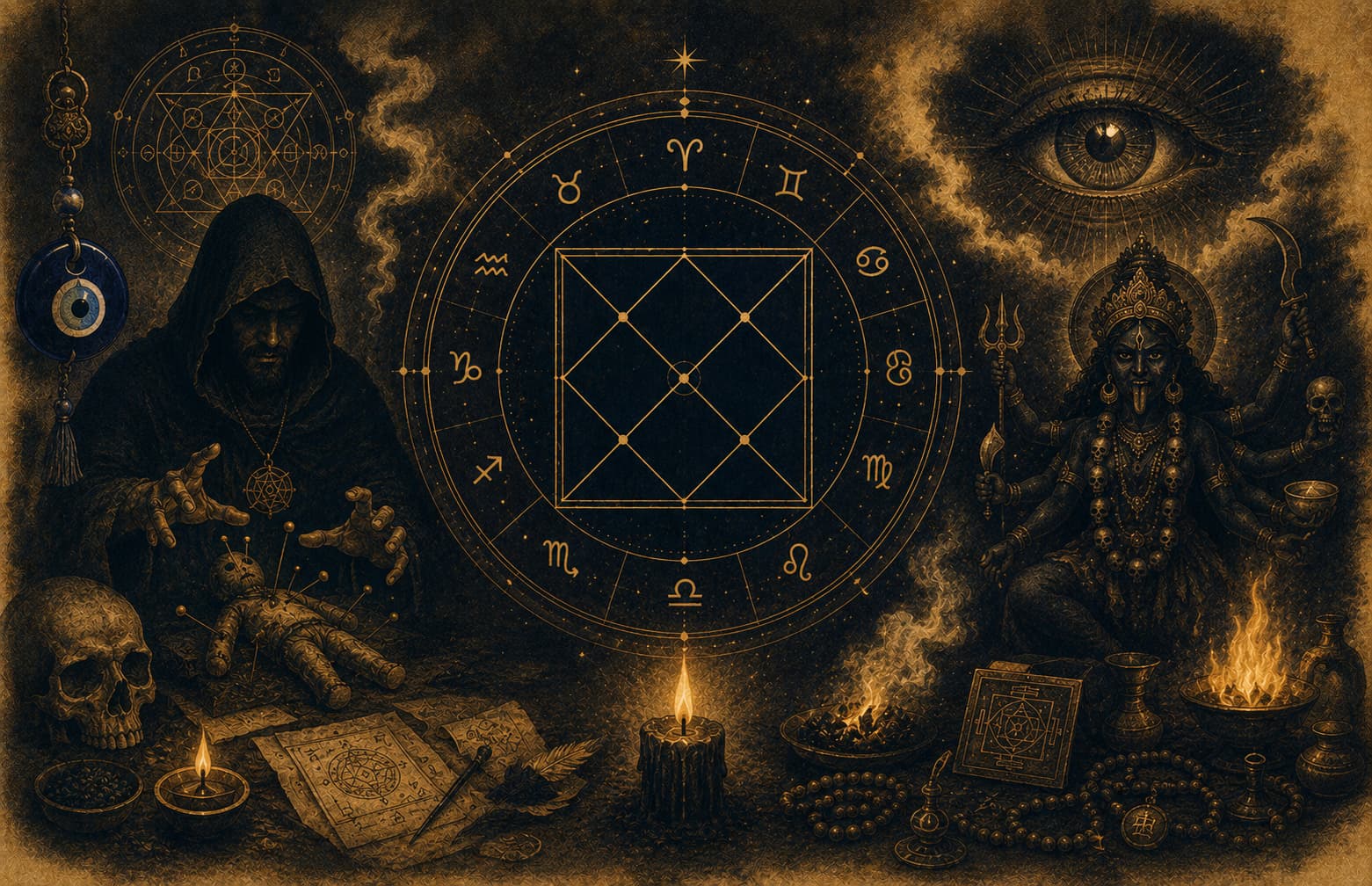
Many people who face sudden professional collapse, repeated financial losses that defy ordinary explanation, chronic symptoms that medical tests cannot fully account for, or a persistent feeling of being watched or undermined begin to wonder whether an energetic interference is at work. In Indian cultural and spiritual life these experiences are often discussed under the names Abhichara, Nazar and various tantric afflictions. Vedic astrology, or Jyotisha, does not treat every misfortune as the result of black magic. It does, however, contain a body of traditional indicators that astrologers examine when a chart and the timing of events raise the possibility of external energetic pressure.
This article explains those indicators in clear language. It focuses on the placements of Gulika and Mandi, the condition of the Badhaka house lord especially when it occupies the eighth or twelfth house, Rahu and Ketu influences on the first and fifth houses, and the practical task of distinguishing ordinary psychological distress from patterns that traditional Jyotisha associates with Abhichara. The discussion remains within the framework of classical and later Jyotisha practice. It avoids guaranteed predictions and emphasises that every chart must be read as a whole.
Key Takeaways
- Abhichara refers to intentional harmful ritual or occult action directed at another person. Nazar, or evil eye, is a more diffuse form of energetic impact arising from envy or intense gaze. Tantric afflictions cover a wider range of ritual and spirit-related disturbances.
- Gulika and Mandi, two upagrahas linked with Saturn, are examined for their house placement, conjunctions and aspects when questions of sudden ruin or unexplained illness arise.
- The Badhaka lord placed in the eighth or twelfth house, especially when connected with the sixth house or its lord and with malefics, is traditionally watched for hidden obstacles and possible occult interference.
- Rahu or Ketu strongly affecting the Lagna or the fifth house can indicate vulnerability to psychic or ritual pressure, particularly when the Moon and the lagna lord are also weakened.
- Sudden onset, failure of ordinary remedies, and activation of specific combinations during relevant dashas or transits are among the factors that lead astrologers to consider Abhichara more carefully than chronic psychological patterns alone.
- A complete birth chart, current dasha periods and the timing of events remain essential. No single placement proves black magic.
Understanding Abhichara, Nazar and Tantric Afflictions
Abhichara is the Sanskrit term commonly translated as black magic or harmful occult ritual. In classical literature the word appears in contexts of intentional action aimed at harming an enemy through ritual means. Jyotisha texts and later regional traditions treat Abhichara as one possible cause among many for disease, loss of peace, sudden enmity or unexplained decline. It is not regarded as the default explanation for every hardship.
Nazar, also called Drishti Dosha or evil eye in popular speech, describes a subtler form of energetic impact. It is often linked to the intense gaze or unspoken envy of another person. In chart analysis Nazar is associated more with sensitivity of the Moon, the lagna and the protective capacity of the chart than with elaborate ritual combinations.
Tantric afflictions form a broader category. They may include residual effects of incomplete or improperly performed rituals, spirit-related disturbances, or the activation of certain upagrahas and nodal influences. In practice, astrologers look for overlapping indicators rather than treating these three categories as completely separate.
The common thread is the idea of an external or semi-external energetic factor that interacts with the native’s own chart. Jyotisha does not claim that such factors override free will or medical reality. It simply records traditional combinations that have been observed to coincide with experiences of this kind.
Why These Questions Arise in Modern Life
A person who has always managed ordinary stress may suddenly find that projects collapse without clear cause, that relationships turn hostile without provocation, or that a sense of heaviness and paranoia settles in. Medical investigations return normal results. Counselling helps only partially. At this point many turn to astrology for a different framework.
Jyotisha approaches the situation by first examining whether the chart itself contains vulnerability indicators and whether the timing of the difficulty matches the dasha or transit of those indicators. Only then does the question of Abhichara or Nazar become relevant. The same chart that shows susceptibility may also show protective yogas that limit the duration or intensity of the experience.
Gulika and Mandi: The Upagrahas Linked with Sudden and Occult Influences
Gulika and Mandi are two of the upagrahas, or secondary mathematical points, used in Vedic astrology. Both are calculated from the division of the day or night into eight equal parts and are associated with Saturn. In many South Indian and Kerala traditions Mandi is treated as closely related to or sometimes identical with Gulika, though some calculation methods distinguish them slightly.
Because they carry Saturn’s significations of restriction, poison, hidden karma and sudden events, their placement is routinely examined when questions of Abhichara arise. Classical and later texts associate certain configurations of Mandi or Gulika with disease arising from kshudra or minor occult practices.
A frequently cited traditional indication is the presence of Ketu in the first, fourth or tenth house together with Mandi occupying a kendra. In such cases the text states that the resulting illness may be connected with Abhichara. Another combination mentions Mercury conjoined with Mandi or Gulika and aspected by Mars while occupying the Badhaka sthana. The native is said to become vulnerable to black-magic effects during the relevant planetary periods.
In practical chart reading the astrologer notes:
- Whether Gulika or Mandi occupies the lagna, the eighth house or the twelfth house.
- Whether either upagraha is conjoined with or aspected by Mars, Rahu, Saturn or the sixth lord.
- Whether the upagraha falls in a fire sign (Aries, Leo, Sagittarius) in certain traditional lists that heighten the indication.
- The dasha and antardasha of the planets connected with the upagraha at the time the difficulties began.
Gulika or Mandi alone does not prove Abhichara. Their influence is interpreted only in combination with the rest of the chart and the actual life events. When the upagraha is well-placed or supported by benefics the same point may simply indicate a capacity for deep research, occult knowledge or protective ritual work rather than victimhood.
The Badhaka House and Its Lord
Badhaka means obstacle or hindrance. The Badhaka sthana is determined by the nature of the lagna sign:
- For movable lagna signs (Aries, Cancer, Libra, Capricorn) the eleventh house is the Badhaka sthana.
- For fixed lagna signs (Taurus, Leo, Scorpio, Aquarius) the ninth house is the Badhaka sthana.
- For dual lagna signs (Gemini, Virgo, Sagittarius, Pisces) the seventh house is the Badhaka sthana.
The lord of this house is called the Badhakesh. Traditional teaching holds that the Badhakesh can create significant obstacles when it is itself afflicted or when it occupies dusthana houses, particularly the sixth, eighth or twelfth.
When the Badhakesh occupies the eighth or twelfth house the indication of hidden enemies, sudden losses or occult interference becomes stronger, especially if the Badhakesh is further linked with the sixth house or its lord. Several later authorities note that the conjunction or mutual aspect of the Badhakesh and the sixth lord, particularly when Mars, Saturn or Rahu also participates, intensifies the possibility of Abhichara-type effects.
Interestingly, many traditional sources state that the least troublesome placement for the Badhakesh is the twelfth house, provided it is not further afflicted. In that position the obstructing energy is said to be more easily diverted or exhausted. The eighth-house placement tends to be more difficult because the eighth house already signifies longevity challenges, sudden events and hidden matters.
In chart analysis the astrologer therefore checks:
- The identity of the Badhakesh according to the lagna.
- Its house placement, especially eighth or twelfth.
- Its association with the sixth house, sixth lord, Mars, Rahu or the lagna.
- Whether the Badhakesh is under the influence of Gulika or Mandi.
- The periods when the Badhakesh or its dispositor becomes active in the dasha sequence.
These factors together form part of the traditional picture of susceptibility rather than a standalone proof.
Rahu and Ketu Afflictions on the First and Fifth Houses
Rahu and Ketu, the lunar nodes, are central to discussions of psychic and occult influences. Their natural significations include sudden events, foreign or unconventional forces, detachment, and the capacity to operate outside ordinary perception.
When Rahu or Ketu strongly influences the lagna (first house), the physical body and the sense of self become more permeable to external energies. Ketu in the lagna is sometimes linked with a feeling of being cut off or attacked from unseen quarters. Rahu in the lagna can produce intense paranoia, unusual fears or attraction to occult practices that later turn harmful.
The fifth house represents the mind’s creative and discriminative capacity, as well as the capacity for mantra and protective ritual. Affliction of the fifth house by Rahu or Ketu, especially when the fifth lord is weak or the Moon is also under nodal influence, is traditionally associated with disturbance of mental clarity and vulnerability to psychic intrusion.
Combinations that appear repeatedly in discussions of Abhichara include:
- Ketu in the first, fourth or tenth house with Mandi in a kendra.
- Rahu or Ketu aspecting or conjoining the lagna lord.
- The nodes occupying or aspecting the fifth house while the Moon is debilitated, combust or under Saturn’s influence.
- Nodal axis falling across the first and seventh houses or the fifth and eleventh houses during a period of sudden hostility.
Again, the presence of these factors must be weighed against the overall strength of the chart. A strong Jupiter, a well-placed lagna lord, or protective yogas can moderate the expression considerably.
Distinguishing Genuine Psychological Distress from Energetic Interference
One of the most important tasks for any responsible astrologer is to avoid attributing every mental or emotional difficulty to Abhichara. Many patterns that feel like external attack are in fact the expression of natal Moon afflictions, Mercury disturbances, or the activation of sixth and eighth house karmas during their dashas.
Traditional indicators that lean toward psychological rather than primarily energetic causation include:
- Chronic Moon affliction by Saturn without strong Abhichara yogas.
- Mercury under heavy malefic influence producing over-thinking and suspicion.
- Sixth-house emphasis without involvement of Badhakesh, Gulika or the nodes in the specific combinations listed above.
- Difficulties that have been present since childhood or that follow a clear psychological trigger.
- Improvement with ordinary counselling, lifestyle change or medical support.
Indicators that traditionally raise the possibility of energetic interference include:
- Sudden onset coinciding with the dasha or transit of planets linked to Gulika, Mandi, Badhakesh or the nodes in the combinations described.
- Symptoms that move from one area of life to another without ordinary causal links.
- Failure of standard medical and psychological approaches accompanied by activation of the relevant planetary periods.
- Presence of multiple classical Abhichara combinations rather than a single weak factor.
- Supporting evidence from a carefully cast prashna (horary) chart when the birth time is uncertain.
Even when energetic interference is considered possible, Jyotisha still regards the native’s own chart as the field in which the interference operates. Strengthening the lagna, the Moon and the protective planets remains central.
How Astrologers Examine These Factors in a Birth Chart
A systematic examination usually follows these steps:
- Confirm the accuracy of the birth data and calculate the lagna, Moon and relevant upagrahas including Gulika and Mandi.
- Identify the Badhaka sthana and its lord according to the lagna type.
- Note the house positions, aspects and conjunctions of Gulika, Mandi, the Badhakesh, Rahu, Ketu, the sixth lord, Mars and the Moon.
- Check the strength of the lagna and lagna lord in the rashi and navamsha charts.
- Examine the current and recent mahadasha and antardasha to see whether the planets involved in the combinations are active.
- Review major transits of Saturn, Rahu, Ketu and Mars over the sensitive points.
- Consider the overall promise of the chart: protective yogas, strength of Jupiter, presence of Viparita Raja Yoga or other cancelling factors.
- Correlate the chart findings with the actual timing and nature of the reported difficulties.
Only after this multi-layered review does the astrologer form a tentative view about the relative contribution of natal vulnerability, current planetary periods and possible external energetic factors.
Factors That Modify the Results
Several conditions can strengthen, weaken or redirect the expression of these combinations:
- Dignity of the planets involved. A Badhakesh in its own sign or exaltation behaves differently from one in debilitation.
- Aspects from Jupiter or a strong Venus can protect the lagna and Moon even when nodal or upagraha influences are present.
- The presence of cancelling yogas such as Neecha Bhanga Raja Yoga or the association of dusthana lords with kendras and trikonas in beneficial ways.
- The native’s own conduct, spiritual practices and social support, which traditional texts regard as powerful modifiers.
- The use of appropriate remedial measures timed to the relevant planetary periods.
No combination operates in isolation. The complete chart always takes precedence over any single indicator.
Common Misconceptions
Several misunderstandings circulate widely:
- Any placement of Rahu or Ketu automatically means black magic. This is incorrect. The nodes have many constructive expressions including research ability, spiritual insight and unconventional success.
- Gulika or Mandi in any house guarantees Abhichara. Their effects depend on the full configuration and the dasha periods.
- Badhakesh in the twelfth house is always disastrous. Many authorities regard it as one of the milder placements.
- Every chronic illness or financial loss is caused by someone performing tantric rituals. Most difficulties arise from ordinary planetary periods and personal choices.
- A single online chart reading can confirm Abhichara. Serious assessment requires accurate birth data, timing of events and preferably a follow-up consultation.
Clearing these misconceptions helps readers approach the subject with greater discrimination.
Traditional Remedies and Practical Guidance
When chart indicators and life events together suggest the possibility of Abhichara or strong Nazar influence, traditional Jyotisha recommends a combination of spiritual, behavioural and ritual measures. These are presented as supportive practices, not guaranteed solutions.
This pattern also has a contemplative expression, explored in Rudraksha, gemstones and crystals.
Commonly advised approaches include:
- Strengthening the lagna and Moon through regular worship of the family deity or Ishta Devata according to the native’s tradition.
- Recitation of protective mantras such as the Hanuman Chalisa, the Narayana Kavacham or specific Rahu-Ketu mantras under proper guidance, with attention to correct pronunciation.
- Charity related to the afflicted planets: for Saturn and Gulika, service to the elderly or workers; for Rahu, help to those in difficult circumstances; for the Moon, support for mothers or care of water sources.
- Maintaining ethical conduct, truthful speech and avoidance of unnecessary conflict, since traditional texts regard personal integrity as a primary protection.
- Simple household practices such as keeping the home clean, lighting a lamp at dusk, and using traditional protective items like turmeric, rock salt or specific yantras according to family custom.
- Consulting a qualified medical professional for any physical or mental symptoms and continuing prescribed treatment alongside spiritual measures.
Expensive gemstones, complex fire rituals or severe fasting are not recommended without a full chart assessment and consideration of the native’s health and circumstances. Fear-based pressure to spend large sums is contrary to the spirit of responsible Jyotisha.
Practical Application Through a Hypothetical Example
Consider a hypothetical chart with Cancer lagna. The Badhaka sthana is the eleventh house (Taurus) and its lord is Venus. Suppose Venus occupies the eighth house in Aquarius, conjoined with Rahu, while Ketu sits in the second house. Mandi falls in the lagna and is aspected by Mars from the tenth house. The Moon is in the sixth house under Saturn’s aspect.
In such a configuration traditional indicators of vulnerability are present: Badhakesh in the eighth with Rahu, Mandi in lagna aspected by Mars, and a pressured Moon. If the native enters the mahadasha of Venus or the antardasha of Rahu or Mandi’s dispositor and simultaneously experiences sudden professional sabotage, unexplained health decline and intense paranoia, an astrologer would note the alignment of chart factors with the timing. The same chart might also contain a strong Jupiter in the ninth house casting an aspect on the lagna, suggesting that protective measures and spiritual practice could limit the duration of the difficulty.
Its timing layer becomes clearer when the chart is compared with Rahu Mahadasha and dominant Rahu behavior.
This example is purely illustrative. Real charts contain many more layers and must be judged individually.
Conclusion
Vedic astrology approaches the questions of Abhichara, Nazar and tantric afflictions through a careful study of specific chart factors rather than through blanket attribution of every misfortune to external forces. Gulika and Mandi placements, the condition of the Badhaka lord especially in the eighth or twelfth house, and Rahu-Ketu influences on the first and fifth houses form the core traditional indicators. These factors gain significance only when they combine with one another, become active in the dasha sequence, and coincide with sudden or unexplained life events.
The emotional and behavioral expression of this pattern is explored further in addiction patterns in the birth chart.
Equally important is the distinction between ordinary psychological distress arising from natal Moon or Mercury afflictions and patterns that classical and later Jyotisha associate with energetic interference. A complete birth chart, accurate timing and a balanced assessment remain indispensable. When vulnerability is indicated, traditional remedies focus on strengthening the protective capacity of the chart and the native’s own conduct rather than on fear or costly rituals.
Readers who recognise elements of their experience in these descriptions are encouraged to consult a knowledgeable Jyotisha practitioner for a personalised reading and, where health is concerned, to continue working with qualified medical professionals. The chart reveals tendencies and timings; the living person remains free to respond with discrimination, courage and appropriate support.
Frequently Asked Questions
1. Can a single planetary placement prove that black magic has been performed? No. Traditional analysis requires multiple supporting combinations, activation by dasha or transit, and correlation with actual events. One isolated factor is never considered conclusive.
2. Is Gulika the same as Mandi? In many traditions the two terms are used interchangeably or refer to closely related Saturnian upagrahas. Some calculation methods distinguish them slightly, but both are examined for similar significations of sudden and occult influence.
3. Does Badhakesh in the twelfth house always cause severe problems? Many classical and later authorities regard the twelfth house as one of the milder placements for the Badhakesh, provided it is not further afflicted by malefics or linked strongly with the sixth house.
4. How can one tell whether symptoms are psychological or related to Abhichara? Sudden onset coinciding with specific planetary periods, multiple classical combinations, and limited response to ordinary psychological support raise the possibility of energetic factors. Chronic patterns present from early life without those combinations more often point to natal psychological indicators.
5. Are Rahu and Ketu always negative when they affect the lagna or fifth house? No. The nodes can also confer research ability, spiritual insight, foreign connections and unconventional success. Their expression depends on the full chart context and the periods in which they operate.
6. Should expensive rituals or gemstones be used as remedies? Suitability depends on the complete chart, the native’s health and financial circumstances. Traditional guidance favours low-risk practices such as mantra, charity, ethical conduct and simple protective observances. Costly measures should never be undertaken under fear or pressure.
7. Can Abhichara effects appear even if the birth chart looks strong? A strong chart generally offers greater resistance. When effects do appear they tend to be shorter or milder, and protective yogas often become active to restore balance.
8. Is it necessary to know the exact birth time to assess these factors? Accurate lagna and house placements are important. When the birth time is uncertain, a carefully cast prashna chart is sometimes used as a supplementary tool, though it cannot fully replace the natal chart.
About the author
Vikram Iyer
Contributing Editor, Spirituality and Society
Vikram Iyer writes about spirituality, belief, remedies and the social expression of planetary symbolism. His interests include Jupiter and Rahu, the ninth house, political life, public authority and the ethics of spiritual practice. He approaches Jyotish as a tradition that can illuminate faith and collective behavior without demanding conformity or surrendering critical thought.
Read the full bioContinue reading

Dharma Artha Kama Moksha Houses in Vedic Astrology: The Four Aims of Life in Your Chart
Astrology vs Free Will: Can Bad Planetary Placements Be Completely Overcome?