Finding Your Ishta Devata Through the Birth Chart
Learn the classical Jaimini method to identify your Ishta Devata from the birth chart using Atmakaraka, Karakamsha in the Navamsa, the 12th house, and supporting insights from the D20 chart. Cultivate devotion with clarity and humility.
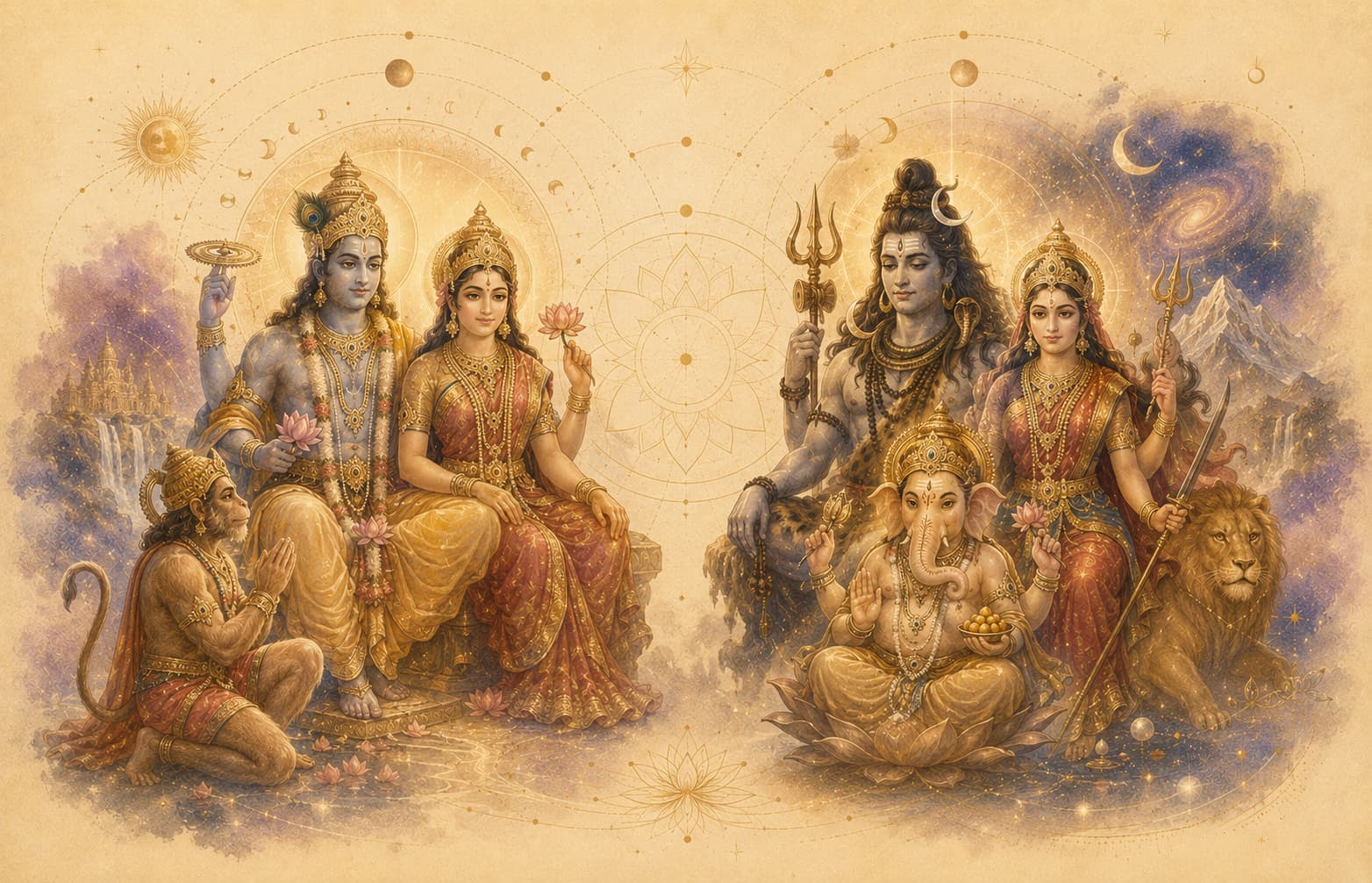
Many people who turn to Jyotish eventually ask a quiet but important question: is there a particular form of the Divine that feels natural for me to approach? Not the family deity inherited by birth, not the popular deity of the moment, but the one that resonates with the deeper current of the soul. In classical Vedic astrology this form is called the Ishta Devata, the chosen or preferred deity. The traditional method for identifying it does not rely on personal preference alone or on popular lists of gods and goddesses. It works through a precise sequence involving the Atmakaraka, its placement in the Navamsa chart, and the twelfth house counted from that point.
This article explains that sequence in clear steps, places it within its spiritual purpose, and shows why the practice is meant to deepen devotion rather than create fear or a sense of sectarian superiority. It also examines the supporting role of the Vimsamsa or D20 chart. The method requires a complete and accurate birth chart. Approximate or incomplete data will not give a reliable indication.
Quick Key Takeaways
- The classical Jaimini method begins with the Atmakaraka, the planet that has attained the highest degree in the natal chart.
- The sign occupied by the Atmakaraka in the Navamsa (D9) is called the Karakamsha.
- The twelfth house from the Karakamsha, known as the Jivanmuktamsa, points to the Ishta Devata through the planet placed there or, if empty, through the lord of that house.
- The Vimsamsa (D20) chart offers supporting insight into the quality and style of spiritual practice that suits the individual.
- The purpose of identifying the Ishta Devata is to cultivate steady, personal devotion that leads toward inner freedom, not to claim one form of divinity as superior to another.
- The complete birth chart, planetary strength, aspects, and overall spiritual promise must always be considered. Isolated rules do not produce a final answer.
What Ishta Devata Means and Why It Matters
Ishta Devata is a Sanskrit compound. “Ishta” means desired, chosen or preferred. “Devata” means a divine being or form of the Divine. Together the term refers to the particular form through which an individual finds it most natural to offer worship, meditation or silent remembrance. In the broader Indian spiritual landscape a person may have a Kula Devata (family deity), a Grama Devata (village deity) and an Ishta Devata (personal deity). The last of these is intimately connected with the individual’s inner temperament and the direction of the soul’s evolution.
From the standpoint of Jyotish the Ishta Devata is not chosen by the mind alone. It is indicated by the chart because the chart reflects the accumulated impressions and the latent spiritual orientation carried by the soul. When the indicated form is approached with sincerity, the practice tends to feel less forced and more sustaining. The relationship becomes a quiet companionship rather than a distant obligation.
The spiritual purpose is straightforward. The twelfth house from the Karakamsha is traditionally linked with liberation or jivanmukti, the state in which the soul is freed while still embodied. The deity associated with that house is therefore regarded as the form that can most readily help the individual move toward that freedom. The practice is meant to soften the sense of separation, not to harden identity around a particular name or form.
The spiritual and ethical dimension of this question is developed further in Dharma, Artha, Kama and Moksha houses.
The Traditional Method: Step by Step
The method most widely accepted among practitioners of Jaimini principles and supported by chapters on Karakamsha in Brihat Parasara Hora Shastra proceeds as follows.
1. Identify the Atmakaraka
Atmakaraka means “indicator of the soul.” Among the seven classical planets (Sun, Moon, Mars, Mercury, Jupiter, Venus and Saturn), the planet that has travelled the highest number of degrees within its sign is the Atmakaraka. Some modern practitioners include Rahu by taking the degree from the end of the sign, but the classical seven-planet approach remains the most common starting point.
The calculation is simple in principle yet requires accurate planetary longitudes. Open the birth chart in any reliable software or ephemeris that uses the sidereal zodiac with an accepted ayanamsha. Note the degrees and minutes of each of the seven planets. The planet with the largest figure is the Atmakaraka. For example, if Venus stands at 28 degrees 41 minutes and no other planet exceeds that figure, Venus is the Atmakaraka.
The Atmakaraka shows the core lessons the soul is working through in this lifetime. Its sign, house and dignity in the natal chart already reveal much about temperament and priorities. Its further examination in the Navamsa takes the analysis into the realm of the soul’s deeper orientation.
2. Locate the Karakamsha
The Navamsa chart, also called D9, divides each sign into nine equal parts of 3 degrees 20 minutes. The Navamsa position of the Atmakaraka is of special importance. The sign occupied by the Atmakaraka in the Navamsa is called the Karakamsha. In other words, if the Atmakaraka falls in Gemini Navamsa, Gemini becomes the Karakamsha lagna for this purpose.
Karakamsha is sometimes described as the lagna of the soul’s desire or the amsa that carries the imprint of the Atmakaraka. From this point the chart is read for spiritual indicators in a manner parallel to the way the ordinary lagna is read for worldly life.
3. Examine the Twelfth House from the Karakamsha
Count twelve signs from the Karakamsha. That twelfth sign is the critical field. Classical texts refer to it as the Jivanmuktamsa, the portion related to liberation while living. The planet that occupies this twelfth house, or the lord of the house if it is empty, becomes the primary indicator of the Ishta Devata.
If more than one planet occupies the twelfth house, the strongest among them by dignity, aspect or overall chart strength is usually given priority, though sensitive practitioners consider the combined influence. Aspects on the twelfth house or its lord also modify the final indication and should not be ignored.
4. Translate the Planetary Indicator into a Deity
Traditional associations link each planet with certain forms of the Divine. These associations are not rigid dogma. They reflect the natural qualities of the planet and the forms through which those qualities have been worshipped across generations. Common classical and traditional correspondences are:
- Sun: Shiva or Rama
- Moon: Gauri (Parvati) or Krishna
- Mars: Skanda (Kartikeya or Subrahmanya), Narasimha or Hanuman
- Mercury: Vishnu or the Buddha form of Vishnu
- Jupiter: Vishnu, Hayagriva, Dattatreya or Indra
- Venus: Lakshmi or Parvati
- Saturn: Vishnu or Brahma
- Rahu: Durga or Narasimha
- Ketu: Ganesha
When the twelfth house is empty, the lord of that house is taken and the same list is applied. The resulting deity is regarded as the Ishta Devata indicated by the chart.
It is important to remember that these names represent living currents of devotion rather than competing brands. A person whose indicator points to Shiva is not barred from approaching Vishnu, nor is a Krishna devotee prevented from offering respect to the Divine Mother. The chart simply highlights the form that is likely to feel most natural and effective for the individual.
The Supporting Role of the Vimsamsa (D20) Chart
While the Karakamsha method is rooted in the Navamsa, the Vimsamsa or D20 chart provides valuable supporting context. The D20 is the chart of spiritual practice, upasana and the quality of devotion. It shows how the individual approaches the sacred, the obstacles that may arise in sadhana, and the style of worship that tends to suit the temperament.
Some contemporary researchers examine the Atmakaraka’s position in the D20 and the twelfth house from that point as an additional layer. Others look at the lagna lord of the D20 and the deities traditionally associated with the planets influencing the D20 lagna or its twelfth house. The classical texts give primary weight to the Navamsa-based Karakamsha method, yet experienced practitioners find that the D20 clarifies the practical flavour of devotion. A chart that shows a strong, peaceful D20 lagna may indicate that the indicated Ishta Devata is best approached through quiet japa and meditation. A more fiery or intense D20 may suggest that the same deity is better approached through vigorous ritual or service.
In short, the Karakamsha method identifies the form. The D20 helps describe the manner of relating to that form. Both layers together give a more complete picture than either alone.
Spiritual Purpose of the Practice
The identification of the Ishta Devata is not an end in itself. It is a practical aid for the cultivation of bhakti, the loving orientation of the heart toward the Divine. Classical Indian thought recognises that the Absolute is beyond name and form, yet it also recognises that the human mind and heart need a concrete focus. The Ishta Devata supplies that focus in a way that matches the soul’s existing imprint.
When practice is guided by the chart indication, several beneficial shifts often occur. The sense of effort decreases because the form feels familiar. Emotional turbulence finds a stable reference point. The ordinary tendency to compare one’s path with another person’s path gradually softens. The practitioner begins to experience the deity not as an external object of petition but as an intimate presence that accompanies daily life.
The ultimate orientation of the twelfth house from Karakamsha is liberation. Therefore the relationship with the Ishta Devata is meant to loosen the grip of limited identity rather than strengthen it. When this understanding is kept alive, the practice remains free of fear. There is no threat that the wrong deity has been chosen, nor any suggestion that other forms are inferior. The chart simply points to the doorway that is already nearest to the individual.
Why the Practice Must Cultivate Devotion Rather Than Fear or Sectarian Superiority
Two distortions commonly appear when the idea of Ishta Devata enters popular conversation. The first is fear: the belief that failure to worship the indicated form will result in spiritual loss or misfortune. The second is superiority: the quiet or open claim that one’s own Ishta is higher, purer or more effective than another person’s.
Both distortions contradict the spirit of the tradition. The method itself is diagnostic, not punitive. It describes an existing orientation. It does not impose a new obligation under threat of penalty. A person who already feels deep love for a particular form is free to continue that relationship even if the chart points elsewhere. The chart indication is a helpful suggestion, not a binding decree.
Sectarian superiority is equally foreign to the classical understanding. The same Absolute is approached through many names and forms according to temperament, cultural background and the needs of the moment. Shiva and Vishnu, Devi and Ganesha, Rama and Krishna are not rival candidates competing for votes. They are different faces of the one Reality. When the Ishta Devata practice is correctly understood, it deepens respect for every sincere path rather than narrowing it.
In practical terms this means that once the indicated form is known, the devotee approaches it with affection, regularity and humility. Mantra, simple ritual, silent remembrance or service offered in the name of the deity become natural expressions. There is no need to announce the discovery to the world, nor to judge those whose charts point in a different direction. The relationship remains private, steady and free of comparison.
How to Examine the Indication in a Complete Birth Chart
A reliable reading never stops at the single rule of the twelfth house from Karakamsha. Several additional factors refine the result.
First, examine the strength and dignity of the indicating planet. A planet in its own sign, exalted or well-aspected carries more clarity than one that is debilitated, combust or heavily afflicted. Second, note any aspects to the twelfth house or its lord. A benefic aspect may soften the expression; a malefic aspect may introduce intensity or obstacles that must be worked through in the practice itself. Third, consider the overall spiritual promise of the chart: the ninth house, the twelfth house from the natal lagna, the condition of Jupiter, and the strength of the D9 and D20 lagnas. A chart that already shows strong spiritual indicators will usually support a clear and fruitful relationship with the Ishta Devata.
Its lunar and nakshatra context is developed further in Gandanta births.
Fourth, observe the current and upcoming dashas. The periods of the Atmakaraka, the lord of the Karakamsha, or the planet indicating the Ishta Devata often bring opportunities for deeper practice or outer events that reinforce the inner connection.
A hypothetical illustration may help. Suppose the Atmakaraka is Jupiter at 27 degrees in the natal chart. In the Navamsa Jupiter falls in Scorpio. Scorpio therefore becomes the Karakamsha. The twelfth house from Scorpio is Libra. If Venus occupies Libra in the Navamsa, Venus becomes the primary indicator and the Ishta Devata is traditionally associated with Lakshmi or Parvati. If Libra is empty, the lord of Libra (Venus) is still taken, though the absence of a planet may suggest a quieter or more internal form of the practice. Further examination of Venus in both the Rasi and Navamsa charts, together with the condition of the D20, would refine the guidance.
Such an example is only illustrative. Every chart must be judged on its own terms.
Common Misconceptions
Several misunderstandings circulate widely and deserve clear correction.
One common error is to treat the Ishta Devata as a fixed label that never changes. The chart indication itself is stable, yet the relationship itself evolves. A devotee may begin with outer ritual and gradually move toward formless awareness while still retaining affection for the original form.
Another error is to confuse the Ishta Devata with the family or village deity. The two may coincide, but they need not. The chart method speaks to the individual soul’s orientation, not to social or ancestral custom.
A third misconception is that the method guarantees rapid spiritual progress or protects against every difficulty. The Ishta Devata relationship supports the path. It does not remove the need for ethical living, self-discipline or ordinary human effort.
A fourth error is to believe that only one planet or one deity can ever be relevant. Multiple planets in the twelfth house, strong aspects, or a powerful D20 may point toward a blended or sequential approach. Sensitivity and humility remain more useful than rigid insistence on a single name.
A stronger technical foundation for this factor can be found in Parashari, Jaimini, Nadi and KP astrology.
Practical Guidance Once the Indication Is Known
When the chart has been carefully examined and a clear indication emerges, the next step is simple, respectful practice. Traditional approaches include daily remembrance of the deity’s name or form, recitation of a short mantra associated with that form, offering of light, water or flowers according to one’s capacity, and acts of service performed in the spirit of the deity.
There is no requirement for expensive materials or elaborate ceremonies. Consistency and sincerity matter far more than external display. Many practitioners find that a few minutes of quiet sitting before an image or symbol of the Ishta Devata, followed by silent repetition of the name, gradually establishes an inner atmosphere of trust and warmth.
If health, age or circumstances make formal ritual difficult, the same devotion can be expressed through ethical conduct, kindness in speech, and the willingness to see the Divine in ordinary encounters. The chart has pointed to a doorway. Walking through it remains a matter of the heart.
Conclusion
The classical method of finding the Ishta Devata through the Atmakaraka, the Karakamsha and the twelfth house from it offers a coherent and time-tested way to recognise the form of the Divine that most naturally supports the individual soul. When this indication is approached with understanding of its spiritual purpose, the practice becomes a source of quiet strength rather than anxiety. The additional perspective of the Vimsamsa chart further clarifies the style of devotion that suits the temperament.
This pattern also has a contemplative expression, explored in Brahma Muhurta.
The ultimate aim is not to collect another astrological label. It is to establish a living relationship that softens the sense of separation and orients the heart toward freedom. In that spirit the method remains free of fear and free of the claim that one form stands higher than another. Different charts point to different doorways. All doorways open onto the same Reality.
A complete and accurate birth chart, careful calculation, and a willingness to hold the result lightly are the essential requirements. When these are present, the traditional technique becomes a genuine aid to spiritual life.
Frequently Asked Questions
1. Can the Ishta Devata change during life?
The chart indication itself remains stable because it is based on natal positions. The lived relationship, however, can deepen, simplify or expand. Many practitioners begin with outer forms and gradually experience the same presence in a more formless way while still retaining affection for the original deity.
2. What if two planets occupy the twelfth house from Karakamsha?
Both influences are considered. The stronger planet by dignity, aspect and overall chart strength usually receives primary attention, yet the combined qualities often appear in the nature of the devotion. Further examination of the D20 and the dashas helps clarify the practical emphasis.
3. Is the Moon nakshatra deity the same as the Ishta Devata?
No. The presiding deity of the Moon’s nakshatra is sometimes used as a simpler or complementary indication, especially when birth time is uncertain. The classical Jaimini method based on Atmakaraka and Karakamsha is considered more specific to the soul’s orientation toward liberation.
4. Does everyone need to worship the indicated form exclusively?
No. The indication is a helpful pointer, not a restriction. Existing devotion to another form can continue. The chart simply highlights the form that is likely to feel most natural and supportive for the deeper journey.
5. How important is exact birth time for this calculation?
Very important. The Navamsa positions and therefore the Karakamsha depend on accurate planetary longitudes and the rising sign. An uncertain birth time can shift the Navamsa lagna and the twelfth house from Karakamsha, altering the result. Rectification may be needed in such cases.
6. Can Rahu or Ketu be Atmakaraka?
Classical practice usually takes the seven planets from Sun to Saturn. Some modern schools include Rahu by measuring its degree from the end of the sign. When Rahu or Ketu appear as strong influences on the twelfth house from Karakamsha, their traditional associations (Durga or Narasimha for Rahu, Ganesha for Ketu) are taken into account.
7. What role does the D20 chart play if the Navamsa method is primary?
The D20 clarifies the quality and practical style of spiritual practice. It shows how the individual tends to approach the sacred and what supports or hinders steady devotion. Used together with the Karakamsha method, it gives a fuller picture of both the form and the manner of relating to it.
8. Is this method found only in Jaimini texts?
The detailed application through Karakamsha appears in the Jaimini tradition and in the chapters on Karakamsha found in many editions of Brihat Parasara Hora Shastra. The broader idea that the chart can indicate a suitable form of the Divine is consistent with the larger Indian understanding that temperament and spiritual orientation differ from person to person.
About the author
Vikram Iyer
Contributing Editor, Spirituality and Society
Vikram Iyer writes about spirituality, belief, remedies and the social expression of planetary symbolism. His interests include Jupiter and Rahu, the ninth house, political life, public authority and the ethics of spiritual practice. He approaches Jyotish as a tradition that can illuminate faith and collective behavior without demanding conformity or surrendering critical thought.
Read the full bioContinue reading
Dharma Artha Kama Moksha Houses in Vedic Astrology: The Four Aims of Life in Your Chart
Astrology vs Free Will: Can Bad Planetary Placements Be Completely Overcome?