Brahma Muhurta: How to Use This Sacred Pre-Dawn Time for Clarity and Growth
Learn what Brahma Muhurta means, how to calculate its exact timing from local sunrise, why it is considered sattvic, and practical ways to use this 48-minute window for meditation, study, yoga and intentional living.
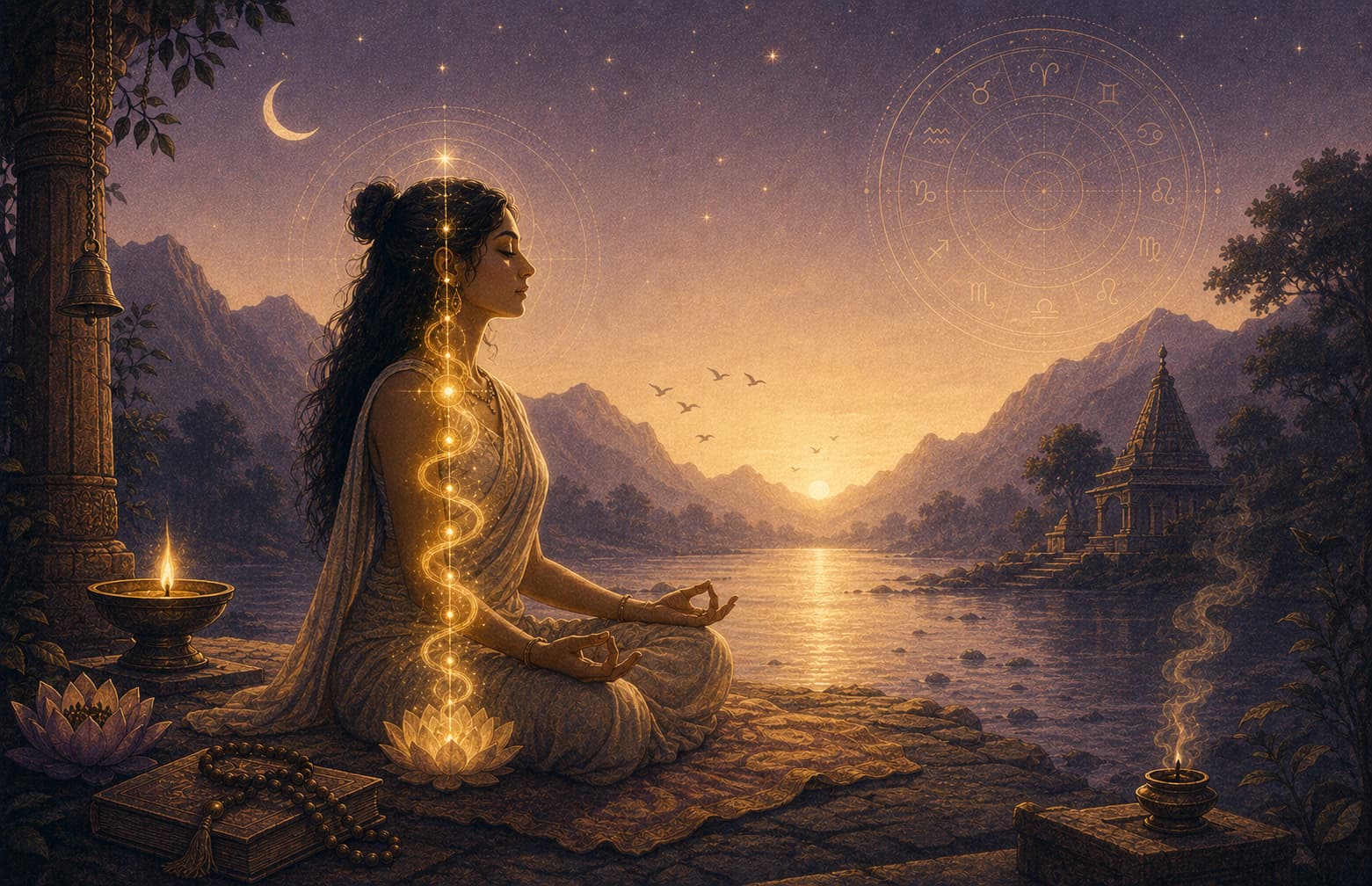
Many people who begin exploring Indian spiritual traditions quickly encounter the phrase Brahma Muhurta. Some hear that waking during this period transforms the day. Others are told it is the only time worth meditating. Still others feel discouraged because their work schedule or family responsibilities make a fixed 4 a.m. alarm impossible. The reality is simpler and more flexible than popular claims suggest.
Brahma Muhurta is a specific segment of the pre-dawn hours, calculated from local sunrise. It lasts approximately 48 minutes and is traditionally regarded as the most sattvic, or pure and balanced, portion of the day. Classical Ayurvedic and yogic texts recommend rising then for health, clarity and spiritual practice. The period is not a rigid clock time, nor is it a guarantee of instant enlightenment. It is a natural window when the external environment is quiet, the mind is relatively free of residual impressions from the previous day, and the body’s rhythms favour alertness without agitation.
This article explains what Brahma Muhurta means, how to calculate it accurately for any location, why the tradition values it, and practical ways to use the time according to your circumstances. The guidance remains within the framework of Vedic timekeeping, Ayurveda and classical recommendations while acknowledging modern life constraints.
Quick Answer and Key Takeaways
Brahma Muhurta begins 96 minutes before local sunrise and ends 48 minutes before sunrise. It is one muhurta, lasting 48 minutes, and is considered the 14th muhurta of the night.
Key points for readers:
- The exact clock time changes every day and depends on your geographic location and the season.
- Classical texts such as the Ashtanga Hridaya advise healthy people to rise during this window to protect longevity and mental clarity.
- The period falls within the Vata-dominant phase of the night, associated with lightness and mental receptivity.
- Highest-value activities include meditation, gentle pranayama, mantra japa, study of sacred texts, and quiet reflection.
- Consistency matters more than perfect timing. Even a shorter window of focused practice near this period can support the same qualities.
- The complete birth chart is not required to benefit from the practice, although planetary periods and current transits can colour individual experience.
Meaning and Basic Concept
The Sanskrit term Brahma Muhurta combines two words. Brahma refers both to the creator aspect of the divine and, more broadly, to Brahman, the underlying consciousness. Muhurta is a traditional unit of time equal to 48 minutes. Together the phrase means the time of Brahma or the creator’s hour.
In the classical division of the day, a full 24-hour period contains 30 muhurtas. The night is generally counted as 15 muhurtas. Brahma Muhurta is identified as the 14th muhurta of the night, the penultimate segment before sunrise. Because the length of night varies with latitude and season, the absolute clock time shifts. The reliable method is always to work backwards from the local time of sunrise.
A simple modern formula used by most Panchang calculators is:
- Start = local sunrise minus 96 minutes
- End = local sunrise minus 48 minutes
For example, if sunrise occurs at 6:00 a.m., Brahma Muhurta runs from 4:24 a.m. to 5:12 a.m. If sunrise is at 5:30 a.m. in summer, the window moves earlier, to approximately 3:54 a.m. to 4:42 a.m. In winter, when sunrise is later, the window shifts accordingly.
Some traditional calculations divide the entire night duration into four equal parts and place Brahma Muhurta in the second half of the final quarter. For practical daily use the fixed 96-minute and 48-minute offsets from sunrise remain the most widely followed standard.
Astrological and Traditional Significance
Although Brahma Muhurta is not a planetary yoga formed in a birth chart, it belongs to the larger science of Muhurta, the electional branch of Jyotisha that selects favourable moments for action. The same principle that guides the choice of a wedding time or the start of a journey applies to the daily choice of when to engage the mind in spiritual or intellectual work.
Classical Ayurvedic texts place special emphasis on the period. The Ashtanga Hridaya opens its chapter on daily routine with the instruction that a healthy person should rise in Brahma Muhurta for the protection of life span. The Charaka Samhita similarly links early rising with the maintenance of health and intellect. These statements are not presented as magical guarantees. They rest on observation of natural rhythms: the predominance of sattva guna before the full activation of rajas and tamas that accompanies daylight activity, the relative stillness of the external environment, and the body’s own hormonal and digestive cycles.
From the Ayurvedic viewpoint of doshas, the hours roughly from 2 a.m. until sunrise fall under Vata influence. Vata is light, mobile and associated with the mind and nervous system. When balanced, this quality supports clarity, creativity and receptivity. When disturbed, it can produce restlessness. Practising during Brahma Muhurta is traditionally said to harness the balanced expression of Vata rather than its agitated form.
Yogic literature regards the same window as ideal for meditation because the mind has not yet accumulated the sensory impressions of the new day. The stomach and intestines are relatively quiet after the night’s rest. The air is cooler and often cleaner before traffic and industrial activity increase. These conditions are practical rather than mystical, yet they create an atmosphere in which concentration arises with less effort.
How to Calculate Brahma Muhurta Accurately
Because sunrise time changes daily, a fixed alarm set for 4:00 a.m. will be correct only on certain dates and in certain latitudes. The reliable method is:
- Obtain the local sunrise time for your city on the desired date. Reliable sources include government meteorological services, reputable Panchang apps that use accurate ephemeris data, or astronomical calculators that account for your exact latitude and longitude.
- Subtract 1 hour and 36 minutes to find the start.
- Subtract 48 minutes to find the end.
The resulting interval is your Brahma Muhurta for that day.
Seasonal variation is significant. In northern India, winter sunrise may occur after 7:00 a.m., pushing Brahma Muhurta into the 5:00 a.m. range. In midsummer the same location may see sunrise near 5:30 a.m., moving the window earlier. Near the equator the variation is smaller. People living at higher latitudes experience even greater seasonal swings.
A practical tip: many digital Panchang services now display Brahma Muhurta start and end times automatically once the user enters a location. Cross-checking against an independent sunrise calculator is still advisable for precision.
Why the Tradition Values This Window
Several overlapping reasons appear across texts and living practice.
First, the external environment is quiet. Fewer vehicles, fewer conversations, and less artificial light reduce sensory input. The mind therefore encounters less competition for attention.
Second, the body has completed most of its overnight repair processes. Digestion of the previous evening’s meal is usually finished. The natural rise in cortisol that prepares the body for waking has begun, yet the full intensity of daytime stress hormones has not yet arrived.
Third, the quality of awareness is described as sattvic. Sattva is the guna associated with clarity, balance and lightness. Spiritual practices performed when sattva predominates are said to leave deeper and more lasting impressions than the same practices performed later when rajas (activity and restlessness) or tamas (inertia) dominate.
Fourth, the junction of night and day is considered a sandhya, a transitional period. Sandhya times (dawn and dusk) have long been regarded as especially suitable for prayer, mantra and contemplation because the boundary between darkness and light mirrors the boundary between ordinary and expanded awareness.
These reasons are observational and traditional. They do not require belief in a particular deity or cosmology, although many practitioners experience the period through a devotional lens.
Practical Ways to Use Brahma Muhurta
The value of the period lies in how it is used rather than in merely being awake. Classical and contemporary guidance converges on a few high-yield activities.
Meditation and Silent Sitting
Even fifteen to twenty minutes of quiet sitting can be more effective at this hour than a longer session later in the day. The mind tends to settle with less struggle. Simple breath awareness, mantra repetition, or open awareness of the pre-dawn silence are all suitable. Those who follow a specific lineage method should continue their established practice. Beginners may start with counting the breath or silently repeating a short mantra such as Om or a personal ishta mantra.
Pranayama
Gentle breathing practices support the transition from sleep to waking. Nadi Shodhana (alternate-nostril breathing), Ujjayi, and slow Bhramari are frequently recommended. Stronger techniques such as Kapalabhati or Bhastrika may be introduced later if the constitution and training allow, but the early morning is generally better suited to calming and balancing practices.
Mantra Japa and Prayer
The recitation of Gayatri Mantra, personal deity mantras, or simply the name of the chosen form of the divine is traditionally assigned high value at this time. The quiet atmosphere supports sustained attention. Many households begin the day with a short sandhya vandana sequence that includes achamana, pranayama and Gayatri.
Study of Sacred Texts or Focused Learning
Students preparing for examinations, scholars working with Sanskrit texts, or anyone engaged in deep reading often report superior retention during Brahma Muhurta. The mind is relatively free of the residual chatter of the previous day. A short period of svadhyaya (self-study) can set a clear intellectual tone for the hours that follow.
This distinction becomes easier to apply after reading Shukla Paksha and Krishna Paksha.
Gentle Yoga or Movement
Light asanas, joint movements, or a short sequence of Surya Namaskar performed mindfully prepare the body without generating heat or strain. The emphasis is on awakening rather than intense physical training.
Intention Setting and Reflection
A few minutes spent reviewing the previous day’s lessons and forming a clear, realistic intention for the coming day can be surprisingly powerful. The clarity of the hour supports honest self-assessment without harsh judgement.
What to Avoid
Heavy physical exercise, intense debate, consumption of stimulating media, and large meals are traditionally avoided. The digestive fire is still gentle. The nervous system is receptive and therefore best protected from agitation.
Building a Sustainable Routine
Not everyone can rise at the calculated start of Brahma Muhurta every day. Shift workers, parents of young children, people with certain health conditions, and those living in extreme latitudes face real constraints. The tradition itself acknowledges that the instruction applies primarily to healthy individuals. For others, the spirit of the practice matters more than rigid adherence.
Practical adjustments include:
- Rising as close as possible to the window and using whatever quiet time is available.
- Creating a mini-routine of five to ten minutes of silence or mantra even if the full 48 minutes cannot be protected.
- Gradually shifting bedtime earlier so that sufficient sleep is maintained. Chronic sleep deprivation undermines the benefits the practice is meant to provide.
- Using seasonal variation consciously. In winter, when the window is later, many people find it easier to participate.
Consistency over months produces more noticeable results than occasional perfect adherence followed by long gaps.
Benefits Observed Across Traditions
Ayurvedic and yogic sources link regular observance with improved digestion, clearer thinking, greater emotional stability, and a sense of alignment with natural rhythms. Modern observations often note better focus during the early hours, reduced tendency toward late-night overstimulation, and a calmer start to the working day.
These outcomes are probabilistic, not guaranteed. Individual results depend on overall lifestyle, sleep quality, diet, stress levels, and the sincerity of the practice itself. The period amplifies whatever quality of attention is brought to it.
Common Misconceptions
Several misunderstandings circulate widely.
One is that Brahma Muhurta is fixed between 3:30 a.m. and 5:30 a.m. regardless of location or season. This approximation works only near certain latitudes and at certain times of year. Accurate calculation from local sunrise is essential.
The interpretive method behind this point is developed further in Rahu Kaal.
Another is that missing the exact window nullifies all spiritual progress. The tradition values the qualities of the hour; it does not declare other times worthless. Evening sandhya, midday contemplation, and consistent practice throughout the day remain valuable.
A third misconception treats the period as a magical cure for every planetary difficulty or health complaint. While meditation and disciplined living can support overall well-being, they do not replace medical care or the careful study of an individual birth chart when specific astrological questions arise.
Finally, some presentations claim that every action performed during Brahma Muhurta is automatically a thousand times more effective. Classical sources speak of greater receptivity and fewer obstacles, not of numerical multiplication of results.
Factors That Modify Individual Experience
Even within the same household, two people may experience the period differently. Sleep quality the previous night, the state of digestion, current emotional load, and the planetary periods operating in the birth chart all influence receptivity. A person running a difficult Saturn or Rahu period may find the early morning quieter yet still encounter residual mental restlessness. Someone in a supportive Jupiter period may find the same hour especially expansive.
Current transits can also colour the collective atmosphere. When major planets change signs or form significant aspects, the quality of early morning awareness may feel more charged or more subdued. These influences are secondary. The primary recommendation remains practical: use the quiet hours for the practices that matter most to you.
The interpretive method behind this point is developed further in Lahiri and other ayanamsa systems.
How to Begin If You Are New
Start modestly. Choose one week in which you will rise 30 to 45 minutes earlier than usual. Sit quietly for ten minutes, perhaps with a simple breath practice or a short mantra. Observe the quality of the mind and the tone of the day that follows. Adjust bedtime so that total sleep remains adequate. After a week, extend the quiet period if the experiment feels supportive.
Those who already have an established sadhana can simply shift its timing into the calculated window and notice any change in depth or ease.
Conclusion
Brahma Muhurta is a gift of natural timing rather than a rigid rule. It offers a daily opportunity to meet the mind when it is relatively clear, the environment is quiet, and the body is prepared for gentle awakening. Whether used for meditation, study, prayer or simple silent sitting, the period supports the qualities of clarity, calm and intentional living that many spiritual traditions seek to cultivate.
Accurate calculation from local sunrise, respect for individual health and circumstances, and consistent but non-obsessive practice form the practical foundation. The tradition does not demand perfection. It invites participation in a rhythm that has been observed and valued for centuries. Used wisely, the 48 minutes before the full light of day can quietly shape the hours that follow.
Frequently Asked Questions
What is the exact duration of Brahma Muhurta? It is one muhurta, lasting 48 minutes, beginning 96 minutes before local sunrise and ending 48 minutes before sunrise.
Does the timing change every day? Yes. Because sunrise time changes with the seasons and location, the clock time of Brahma Muhurta shifts daily.
Is Brahma Muhurta the same as Amrit Vela? In many popular usages the two terms overlap. Amrit Vela often refers more broadly to the ambrosial pre-dawn period, while Brahma Muhurta has a more precise 48-minute definition. In practice the recommendations are similar.
Can I practise if I cannot wake at the calculated start time? Yes. Use whatever portion of the quiet pre-dawn hours is available. Consistency and quality of attention matter more than exact minutes.
Is this practice only for people following a particular religion? No. While the terminology and classical sources are rooted in Indian traditions, the practical benefits of quiet early morning practice are accessible to anyone who values mental clarity and disciplined routine.
Should children or people with health conditions rise during Brahma Muhurta? Classical texts address the instruction primarily to healthy adults. Children, the elderly, pregnant people, and those recovering from illness should prioritise adequate rest and medical guidance.
Does using Brahma Muhurta require knowledge of astrology? No. The daily practice itself does not depend on chart analysis. Those interested in deeper Jyotisha study may later examine how current dashas and transits interact with their early morning experience.
What if my work schedule makes early rising impossible? Protect whatever quiet time you can find, even if it falls later. The spirit of reducing distraction and cultivating focused awareness can be applied at other hours, though the traditional sources regard the pre-dawn window as especially supportive.
Three Internal-Link Anchor Suggestions:
- how to read a daily Panchang
- understanding the three gunas in daily life
- basic pranayama techniques for beginners
Two Related-Article Suggestions:
- The Science of Muhurta: Choosing Auspicious Moments for Important Actions
- Dinacharya: Building an Ayurvedic Daily Routine Around Natural Rhythms
Important Factual Statements Requiring Editorial Verification:
- Exact classical verse citations from Ashtanga Hridaya and Charaka Samhita should be confirmed against standard editions.
- Sunrise-based calculation method should be cross-checked with current Panchang software for sample cities.
Sources Consulted: Classical Ayurvedic references as commonly cited (Ashtanga Hridaya, Charaka Samhita), standard muhurta definitions in contemporary Panchang practice, and established explanations of night muhurta division.
Disclaimer: This article presents traditional understandings of Brahma Muhurta within Vedic and Ayurvedic frameworks for educational purposes. It is not medical, psychological or spiritual advice. Individuals with health concerns should consult qualified professionals. Results of any practice vary according to personal circumstances.
About the author
Vikram Iyer
Contributing Editor, Spirituality and Society
Vikram Iyer writes about spirituality, belief, remedies and the social expression of planetary symbolism. His interests include Jupiter and Rahu, the ninth house, political life, public authority and the ethics of spiritual practice. He approaches Jyotish as a tradition that can illuminate faith and collective behavior without demanding conformity or surrendering critical thought.
Read the full bioContinue reading
Dharma Artha Kama Moksha Houses in Vedic Astrology: The Four Aims of Life in Your Chart
Astrology vs Free Will: Can Bad Planetary Placements Be Completely Overcome?