Panchang Explained: The Five Limbs of Vedic Astrology
Discover what Panchang means in Vedic astrology, why the five limbs matter, and how to read Tithi, Vara, Nakshatra, Yoga and Karana for daily life and Muhurta.
Many people glance at a daily Panchang on their phone or in a printed almanac and see a string of Sanskrit terms – Shukla Tritiya, Pushya Nakshatra, Siddha Yoga – without fully knowing what each one contributes. Yet these five pieces of information together form the practical backbone of Vedic timekeeping. They decide festival dates, guide the selection of Muhurta for marriage or business, shape the rhythm of religious observances, and even influence how an astrologer calculates a birth chart.
Panchang, also written as Panchanga, literally means “five limbs.” It is the traditional lunisolar almanac of Jyotisha that records the quality of every day and every moment through five astronomical relationships between the Sun, the Moon and the Earth. Understanding these five limbs gives you a working knowledge of how time is measured and evaluated in Vedic astrology. This article explains each limb in clear language, shows why they matter, and offers a practical method for reading a Panchang entry.
Key Takeaways
- Panchang consists of five elements: Tithi (lunar day), Vara (weekday), Nakshatra (lunar mansion), Yoga (Sun-Moon combination) and Karana (half-Tithi).
- These five factors together describe the energetic quality of any given time and form the basis of Muhurta selection.
- Tithi and Nakshatra are the most frequently consulted for festivals and important beginnings.
- A complete reading always considers the transition times of each element, not only the names listed for the civil date.
- Panchang is location-sensitive; sunrise, sunset and the exact ending moments of Tithi or Nakshatra change with geography.
- The full birth chart remains essential for personal predictions; Panchang supplies the timing framework, not the individual destiny.
What Panchang Means
The Sanskrit word Panchanga is formed from pancha (five) and anga (limb or part). In classical Jyotisha it refers to the five measurable attributes of time that depend primarily on the relative positions of the Sun and the Moon. These attributes are:
- Tithi – the lunar day
- Vara – the weekday
- Nakshatra – the lunar mansion occupied by the Moon
- Yoga – the combined longitude of the Sun and the Moon
- Karana – half of a Tithi
Together they create a multi-layered description of any moment. Unlike a simple Gregorian calendar that tracks only the solar day, the Panchang is lunisolar. It records both the Moon’s phase relative to the Sun and the Moon’s position among the fixed stars, while still acknowledging the seven-day planetary cycle of the week.
In practical use the word “Panchang” also refers to the printed or digital almanac that lists these five values for every day of the year, along with sunrise, sunset, moonrise, Rahu Kaal and other useful windows. The almanac is therefore both a calculation tool and a cultural document that has guided Indian life for centuries.
Why Panchang Matters in Vedic Astrology
Panchang is foundational for three main reasons.
First, it supplies the astronomical data required for accurate chart calculation. The exact Tithi, Nakshatra and Yoga at the moment of birth help determine the starting point of certain dasha systems and the strength of the Moon. Without reliable Panchang data an astrologer cannot place the Moon correctly or compute the proper lunar day for annual charts such as Tithi Pravesh.
Second, it is the primary instrument of Muhurta, the selection of an auspicious moment to begin an important activity. Classical texts treat the beginning of any action as carrying the imprint of the cosmic conditions present at that instant. A favourable combination of the five limbs is believed to support smoother progress and reduce avoidable obstacles.
Third, Panchang determines the dates of almost every Hindu festival, fast and ritual. Ekadashi, Purnima, Amavasya, Navratri, Diwali and countless regional observances are fixed by specific Tithis, often refined by Nakshatra or the presence of a particular Yoga. Without Panchang there would be no shared calendar for religious life across the subcontinent.
In daily life many households still consult the Panchang before scheduling travel, medical procedures, property transactions or even routine tasks such as oil baths and haircuts. The practice is not about fear of inauspiciousness; it is about aligning action with the natural rhythms that the tradition has observed for generations.
The Five Limbs Explained
1. Tithi – The Lunar Day
Tithi is the most fundamental limb. It measures the angular distance between the Moon and the Sun. Each time the Moon gains 12 degrees of longitude on the Sun, one Tithi is completed. Because the Moon’s speed varies, a Tithi can last anywhere from roughly 19 to 26 hours. Consequently a single solar day may contain parts of two different Tithis.
There are 30 Tithis in a lunar month, divided into two pakshas (fortnights):
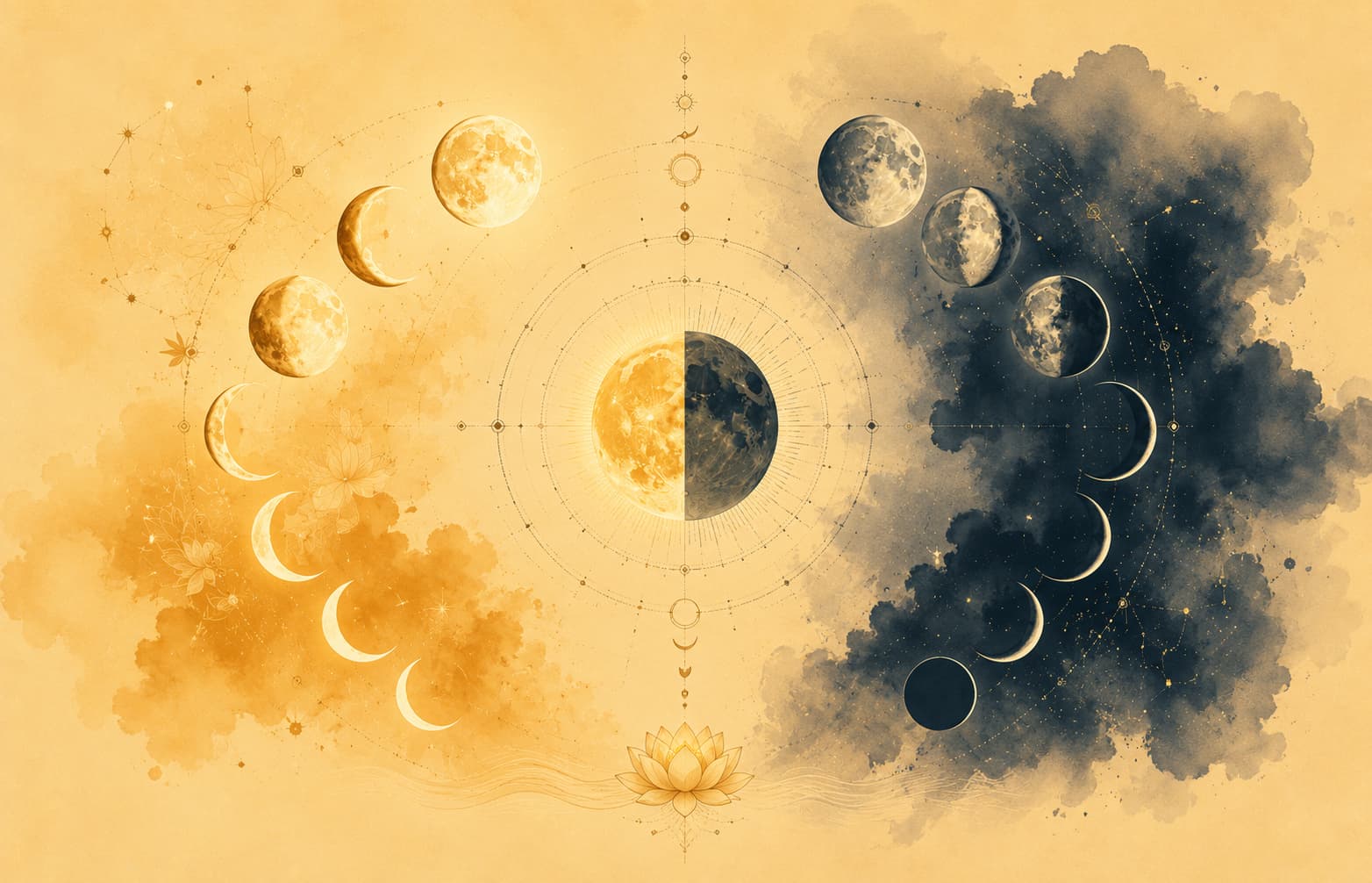
- Shukla Paksha (waxing phase) – from Pratipada after Amavasya to Purnima
- Krishna Paksha (waning phase) – from Pratipada after Purnima to Amavasya
The 15 Tithis of each paksha are named identically: Pratipada, Dwitiya, Tritiya, Chaturthi, Panchami, Shashthi, Saptami, Ashtami, Navami, Dashami, Ekadashi, Dwadashi, Trayodashi, Chaturdashi and the 15th (Purnima or Amavasya).
Traditional classification groups them by quality:
- Nanda (1, 6, 11) – joyful, suitable for celebrations
- Bhadra (2, 7, 12) – auspicious for beginnings
- Jaya (3, 8, 13) – victorious, good for competitive efforts
- Rikta (4, 9, 14) – empty, generally avoided for new ventures
- Purna (5, 10, 15) – complete, favourable for finishing work
Certain Tithis carry special religious weight. Ekadashi is observed as a fasting day dedicated to Vishnu. Purnima is ideal for many pujas and full-moon rituals. Amavasya is reserved for ancestral offerings (Pitru Tarpan) and is usually avoided for auspicious beginnings.
When reading a Panchang, always note the ending time of the current Tithi. If you plan an activity at 4 p.m. and the Tithi changes at 2 p.m., the later Tithi governs that moment.
2. Vara – The Weekday
Vara is the solar day of the week. In the Vedic system the day begins at sunrise, not at midnight. Each of the seven days is ruled by one of the classical planets in the order of their distance from Earth as understood in traditional astronomy:
- Ravivara (Sunday) – Sun
- Somavara (Monday) – Moon
- Mangalavara (Tuesday) – Mars
- Budhavara (Wednesday) – Mercury
- Guruvara or Brihaspativara (Thursday) – Jupiter
- Shukravara (Friday) – Venus
- Shanivara (Saturday) – Saturn
The planetary lord of the day colours the general energy available. Sunday supports activities connected with authority, government and vitality. Monday favours emotional and family matters. Tuesday is traditionally linked with courage and competitive efforts, though many avoid new beginnings on this day. Wednesday suits communication, learning and commerce. Thursday is preferred for education, spiritual practices and financial contracts. Friday supports artistic work, relationships and beauty-related activities. Saturday is associated with discipline, service and long-term projects; new starts are often postponed.
Vara also determines the sequence of Choghadiya (eightfold division of the day) and the timing of Rahu Kaal, Yamaganda and Gulika. These inauspicious windows shift according to the weekday and local sunrise.
3. Nakshatra – The Lunar Mansion
Nakshatra is the segment of the ecliptic occupied by the Moon. The zodiac is divided into 27 Nakshatras, each spanning 13 degrees 20 minutes. The Moon takes approximately one day to transit each Nakshatra, though the exact duration varies with its speed.
Every Nakshatra has a ruling planet, a presiding deity, a symbol and a set of traditional qualities. For Muhurta purposes the Nakshatras are often classified as:
- Fixed (Dhruva) – Rohini, Uttara Phalguni, Uttara Ashadha, Uttara Bhadrapada – excellent for permanent activities such as foundation laying or property purchase
- Soft (Mridu) – Mrigashira, Chitra, Anuradha, Revati – favourable for artistic and gentle work
- Light (Laghu) – Ashwini, Pushya, Hasta – good for travel, medicine and quick results
- Sharp (Tikshna) – Ardra, Ashlesha, Jyeshtha, Mula – used carefully for sharp or decisive actions
- Movable (Chara) – Swati, Punarvasu, Shravana, Dhanishta, Shatabhisha – suitable for journeys and change
Certain Nakshatras are considered especially supportive for almost any activity (Pushya is the classic example). Others, known as Gandanta or Gandmool Nakshatras (the junctions of water and fire signs), require extra care and sometimes specific remedies when they appear in a birth chart or an important Muhurta.
The Moon’s Nakshatra at birth becomes the Janma Nakshatra and plays a central role in naming, compatibility assessment (Guna Milan) and the calculation of certain dashas.
4. Yoga – The Luni-Solar Combination
Yoga is formed by adding the sidereal longitudes of the Sun and the Moon and dividing the sum by 13 degrees 20 minutes. There are 27 Yogas, each lasting for that angular span. The sequence begins with Vishkambha and ends with Vaidhriti.
Some Yogas are traditionally regarded as auspicious (Siddha, Amrita, Shubha, Brahma, Indra and others). A few are considered difficult (Vyatipata, Vaidhriti, Parigha, Atiganda). The quality of the Yoga adds a subtle layer to the day’s overall tone. An otherwise good Tithi and Nakshatra can be moderated by an unfavourable Yoga, while a strong Yoga can support a borderline combination.
Yoga is particularly useful in fine-tuning Muhurta. Classical electional texts advise checking that the Yoga is not one of the more challenging ones when the activity is of lasting importance.
5. Karana – Half of a Tithi
Karana is simply half a Tithi. Because there are 30 Tithis, there are 60 Karanas in a lunar month. Only 11 distinct names are used. Seven of them (Bava, Balava, Kaulava, Taitila, Gara, Vanija, Vishti) cycle repeatedly. The remaining four (Shakuni, Chatushpada, Naga, Kimstughna) appear only once each near the end of Krishna Paksha and the beginning of Shukla Paksha.
Most of the movable Karanas are considered favourable for ordinary work. Vishti (also called Bhadra) is the one most commonly avoided for new beginnings. The fixed Karanas have more specialised traditional associations and are generally not chosen for auspicious ceremonies.
Because a Karana lasts only half a Tithi, it provides a finer resolution of time. When two people are choosing between morning and afternoon for a short ritual or a business meeting, the change of Karana can become the deciding factor.
How the Five Limbs Work Together
No single limb is absolute. A highly favourable Nakshatra can compensate for a moderately difficult Tithi. An excellent Yoga can soften the effect of a Rikta Tithi. Conversely, a combination of Vishti Karana, an inauspicious Yoga and a sharp Nakshatra may advise postponement even if the Tithi looks acceptable.
A practical way to evaluate a day is to ask four questions in sequence:
- Is the Tithi suitable for the nature of the activity (beginning, completion, spiritual practice, ancestral work)?
- Does the Vara support the planetary energy required?
- Is the Nakshatra among those traditionally recommended for this type of work?
- Are the Yoga and Karana free from major classical prohibitions?
If three or more limbs are supportive and no strongly unfavourable factor is present, the time is generally considered usable. For the most important life events (marriage, major business launch, surgical procedures) classical texts recommend a more rigorous checklist that also includes the positions of the planets, the Lagna of the Muhurta chart, and the absence of certain doshas.
How to Read a Daily Panchang Step by Step
Most modern digital Panchangs and printed almanacs present information in a similar format. Here is a reliable sequence for reading any entry:
- Note the civil date and the local sunrise and sunset times. All other calculations are anchored to sunrise for that location.
- Identify the current Tithi and its ending time. Record whether it belongs to Shukla or Krishna Paksha.
- Record the Vara (weekday). This immediately tells you the planetary ruler and the sequence of Choghadiya and Rahu Kaal.
- Note the Nakshatra and the exact time it ends. If the activity crosses the transition, the later Nakshatra applies.
- Check the Yoga and its ending time.
- Check the Karana and its ending time.
- Look at the listed inauspicious windows (Rahu Kaal, Yamaganda, Gulika) and the favourable windows (Abhijit Muhurta, Amrit Kaal, Brahma Muhurta).
- If a festival or vrata is mentioned, note the specific rule (sunrise Tithi, pradosha, madhyahna, etc.) because festival dates can differ by location and convention.
A short worked example (illustrative only):
Suppose the Panchang for a given city shows:
Shukla Panchami until 16:42, Thursday, Rohini Nakshatra until 21:15, Saubhagya Yoga until 11:30, then Shobhana, Bava Karana until 16:42.
For a housewarming planned at 10 a.m., all five limbs are supportive. The morning Yoga is auspicious, the Nakshatra is fixed and highly regarded, the Tithi is of the Purna group, the day is Jupiter’s, and the Karana is favourable. The combination would traditionally be considered excellent for a permanent domestic beginning.
Common Misconceptions
Several misunderstandings circulate about Panchang.
One is that any day with a “good” Tithi is automatically auspicious. Tithi is only one limb. Ignoring Nakshatra or Yoga can produce disappointing results.
Another is that the Panchang listed for Delhi or Mumbai applies everywhere. Because Tithi, Nakshatra and Yoga are calculated from the exact positions of the luminaries, their ending times shift with longitude. A Tithi that ends at 3 p.m. in Kolkata may end at 2:30 p.m. or 3:30 p.m. elsewhere. Always use a location-specific Panchang.
A third misconception is that Panchang replaces the birth chart. Panchang describes the quality of time; the birth chart describes the individual who experiences that time. The same favourable Muhurta will unfold differently for two people according to their Lagna, current dasha and planetary strengths.
Its lunar and nakshatra context is developed further in Nakshatra padas.
Finally, some believe that every traditional prohibition is absolute. Classical texts themselves provide exceptions and cancellation rules. A skilled Muhurta astrologer weighs the entire picture rather than rejecting a day for a single minor factor.
Practical Guidance for Everyday Use
For routine decisions a simple approach is sufficient. Check that the Tithi is not Rikta or Amavasya (unless the activity is ancestral), that the Nakshatra is not among the more challenging ones for your purpose, and that you avoid the listed Rahu Kaal. For travel, many people prefer days ruled by the Moon, Mercury or Jupiter and soft or movable Nakshatras.
For important life events the traditional recommendation is to consult a knowledgeable Jyotisha practitioner who can prepare a full Muhurta chart. That chart examines not only the five limbs but also the Lagna rising at the chosen moment, the strength of the relevant house lords, and the absence of major afflictions.
Even without professional help, the discipline of consulting the Panchang cultivates awareness of time. It reminds us that not every moment is equal and that beginnings carry lasting influence.
Conclusion
Panchang is far more than a list of Sanskrit names. It is a living system that translates the continuous motion of the Sun and Moon into five practical measures of time quality. Tithi records the lunar phase, Vara the planetary weekday, Nakshatra the lunar mansion, Yoga the combined solar-lunar longitude, and Karana the half-day division. Together they form the foundation on which Muhurta, festival calendars and much of classical Jyotisha rest.
Its relationship with belief and spiritual practice becomes clearer in Brahma Muhurta.
Learning to read these five limbs does not require advanced mathematical skill. It requires only careful attention to the ending times and a willingness to see time as multi-dimensional. Once that habit is formed, the daily Panchang becomes a quiet companion that helps align important actions with the larger rhythms observed by the tradition for centuries.
The complete birth chart remains the deeper map of individual potential. Panchang supplies the timing framework within which that potential is expressed. Used together, they offer a balanced approach to both destiny and choice.
Frequently Asked Questions
What are the five elements of Panchang?
The five elements are Tithi (lunar day), Vara (weekday), Nakshatra (lunar mansion), Yoga (Sun-Moon combination) and Karana (half-Tithi). Together they describe the quality of any given moment in the Vedic calendar system.
Is Panchang the same as the Hindu calendar?
Panchang is the detailed astronomical almanac that underlies the Hindu calendar. The calendar itself is the sequence of months, fortnights and festival dates derived from Panchang calculations.
Why do festival dates sometimes differ between regions?
Festival dates depend on the exact Tithi prevailing at a specific moment (sunrise, pradosha, midnight, etc.). Different Panchang conventions and local sunrise times can shift the civil date by one day.
Can I use any online Panchang?
Prefer a source that calculates for your exact city and uses a recognised Ayanamsha. Location and calculation method both affect the ending times of Tithi, Nakshatra and Yoga.
Does a good Panchang guarantee success?
No. Panchang indicates supportive or challenging conditions for beginning an activity. Results still depend on the individual’s chart, effort, circumstances and many other factors. It is a traditional guide, not a guarantee.
What is the most important limb for daily decisions?
For most people Tithi and Nakshatra provide the quickest practical guidance. For refined Muhurta all five limbs are examined together with the planetary positions.
How is Panchang connected to the birth chart?
The Moon’s Nakshatra and the Tithi at birth become part of the natal data. Annual charts such as Tithi Pravesh are calculated from the return of the birth Tithi. Accurate Panchang data is therefore essential for precise chart work.
Should children or beginners start with Panchang?
Yes. Learning the five limbs is one of the most accessible entry points into Vedic astrology. It builds familiarity with lunar rhythms and the language of Jyotisha without requiring immediate mastery of houses, aspects or dashas.
About the author
Anika Rao
Editor-in-Chief
Anika Rao is the editor-in-chief of Vedic Astrology Space. Her work brings classical Jyotish into conversation with relationships, identity, emotional life and the questions people carry into a modern chart reading. She is especially interested in nakshatras, the Moon, relational patterns and interpretations that create self-understanding without reducing a person to a placement.
Read the full bioContinue reading
Shukla Paksha and Krishna Paksha Explained
Parashari vs Jaimini vs Nadi vs KP Astrology: Complete Comparison Guide