Shukla Paksha and Krishna Paksha Explained
Learn the meaning of Shukla Paksha and Krishna Paksha, their 15 Tithis, role in Panchang, Muhurta, festivals, and Vedic astrology. A clear guide for beginners and students of Jyotisha.
Shukla Paksha and Krishna Paksha: Everything You Wanted to Know
Most people who follow a Hindu calendar or glance at a Panchang notice two repeating phrases: Shukla Paksha and Krishna Paksha. They appear next to Tithi names, festival dates, and Muhurta recommendations. Yet many readers are not entirely sure what these terms mean, why they matter, or how they influence daily decisions and traditional practices.
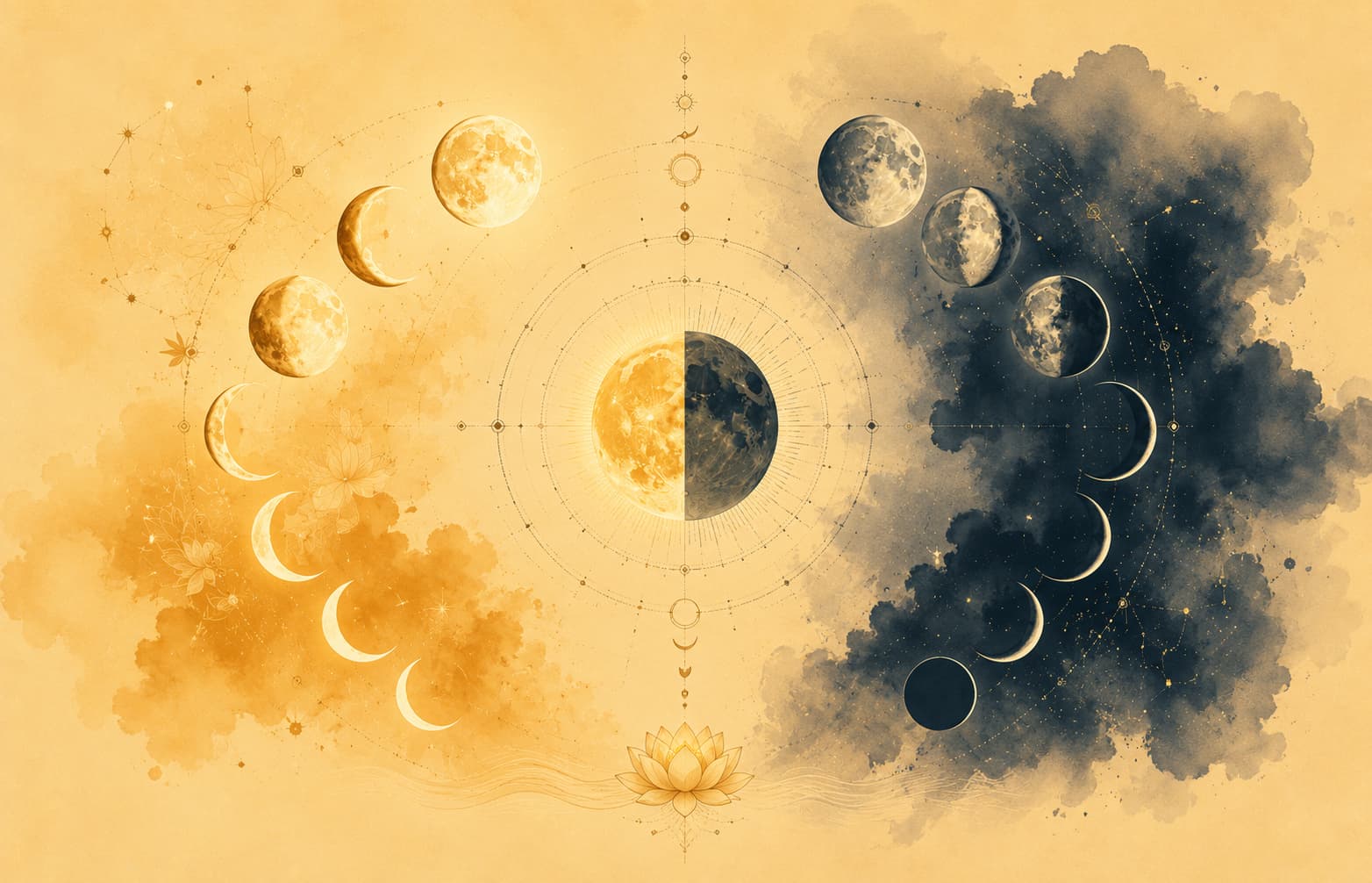
In simple terms, Shukla Paksha is the bright fortnight of the lunar month, the period when the visible portion of the Moon increases from new Moon to full Moon. Krishna Paksha is the dark fortnight, the period when the visible portion decreases from full Moon to new Moon. These two halves together form one lunar month in the traditional Hindu calendrical system.
Understanding them helps you read a Panchang correctly, choose suitable days for important activities, follow festival timings, and place certain classical references in context. The complete birth chart still remains the primary tool for personal interpretation, but the Paksha framework is foundational for time measurement in Jyotisha and Indian cultural life.
This article explains the meaning, calculation, Tithi sequence, cultural use, astrological associations, common misconceptions, and practical ways to apply the knowledge. It is written for readers who may know only basic terms such as Rashi, Kundli, or Nakshatra, while still offering depth for those already familiar with Panchang details.
Quick Key Takeaways
- Shukla Paksha begins the day after Amavasya and ends on Purnima. The Moon appears to grow.
- Krishna Paksha begins the day after Purnima and ends on Amavasya. The Moon appears to shrink.
- Each Paksha contains fifteen Tithis, or lunar days.
- Many festivals and Vratas are fixed to a specific Tithi within one of these two Pakshas.
- Traditional Muhurta texts often prefer Shukla Paksha for auspicious beginnings, though exceptions exist.
- The Paksha itself does not determine personal destiny. It is a measure of lunar time that interacts with the natal chart, current transits, and other factors.
- Regional Panchang conventions and sunrise rules can shift the observed start or end of a Tithi, so local calendars matter for exact observance.
Meaning and Basic Concept
The Sanskrit word Paksha means a side or a fortnight. In the lunar calendar, it refers to each half of the synodic month measured from one new Moon or full Moon to the next.
Shukla means bright or white. Shukla Paksha is therefore the bright fortnight. During this period the illuminated portion of the Moon visible from Earth steadily increases. The sequence runs from Pratipada (the first lunar day after Amavasya) through the successive Tithis up to Purnima, the full Moon.
Krishna means dark or black. Krishna Paksha is the dark fortnight. During this period the illuminated portion steadily decreases. It runs from the Pratipada after Purnima through the successive Tithis down to Amavasya, the new Moon.
Together the two Pakshas form one lunar month, often called a Masa. The names of the months themselves (Chaitra, Vaishakha, Jyeshtha, and so on) are usually counted from one Amavasya or Purnima to the next, depending on the regional system (Amanta or Purnimanta).
This division is not arbitrary. It reflects the actual astronomical cycle of the Moon’s phases as observed from Earth. The average length of a Tithi is roughly 24 hours, though the exact duration varies because the Moon’s motion is not uniform. A complete Paksha therefore lasts approximately fifteen days, and a lunar month approximately twenty-nine and a half days.
Astrological and Calendrical Significance
In Vedic astrology and traditional Indian timekeeping, the Moon is the fastest of the classical Grahas and the primary indicator of the mind, emotions, and daily fluctuations. The Paksha system organises the Moon’s monthly journey into two clear halves that carry different qualitative associations.
Shukla Paksha is traditionally linked with growth, expansion, clarity, and the building phase of activities. Many classical texts and regional customs regard the bright fortnight as more favourable for beginnings that require steady increase: starting education, initiating business, performing certain Samskaras, or undertaking journeys whose purpose is constructive.
Krishna Paksha is linked with reduction, release, introspection, and the dissolving phase. Certain observances, ancestral rites, and practices aimed at letting go or purifying are placed in the dark fortnight. Amavasya itself, the culmination of Krishna Paksha, is especially associated with Pitru Karya and reflection.
These associations are general tendencies, not absolute rules. A skilled Jyotishi always examines the specific Tithi, the Nakshatra, the weekday, the Lagna at the chosen moment, and the overall chart of the person involved. A well-chosen Muhurta in Krishna Paksha can still support success if other factors are strong. Conversely, a poorly chosen moment in Shukla Paksha can face obstacles.
The Paksha also appears in classical timing techniques. Some Dasha systems and transit analyses note whether a planet is operating during a bright or dark fortnight, though this is a secondary consideration compared with sign, house, and aspect strength.
How the Pakshas Are Calculated
The calculation rests on the angular relationship between the Sun and the Moon.
A Tithi is defined as the time required for the longitude difference between the Moon and the Sun to increase by twelve degrees. There are thirty Tithis in a complete lunar cycle of 360 degrees.
The nakshatra layer adds useful nuance here, particularly in Nakshatras and zodiac signs.
- When the Moon is moving from conjunction with the Sun (Amavasya) toward opposition (Purnima), the difference increases through the first fifteen Tithis. This is Shukla Paksha.
- When the Moon is moving from opposition back toward the next conjunction, the difference continues through the next fifteen Tithis. This is Krishna Paksha.
The exact moment a Tithi begins or ends is the same worldwide in terms of celestial longitude, but the civil day on which it is observed depends on local sunrise. Most traditional Panchangs in India follow the sunrise rule: the Tithi prevailing at sunrise is considered the Tithi of that day for most ritual purposes. Overlaps and Kshaya (lost) or Adhika (extra) Tithis can occur, which is why printed or digital Panchangs sometimes list two Tithis on the same civil day or skip one.
Modern ephemerides and software calculate the longitudes using standard astronomical algorithms and apply a chosen Ayanamsha for sidereal placement. For pure calendrical purposes the tropical or sidereal distinction is less critical than for Rashi placement, because the Paksha depends on the relative angle between Sun and Moon rather than their absolute zodiacal signs.
The Fifteen Tithis of Each Paksha
Each Paksha contains the same sequence of fifteen named Tithis. The difference lies only in whether the Moon is waxing or waning.
Shukla Paksha Tithis (waxing):
- Pratipada
- Dwitiya
- Tritiya
- Chaturthi
- Panchami
- Shashthi
- Saptami
- Ashtami
- Navami
- Dashami
- Ekadashi
- Dwadashi
- Trayodashi
- Chaturdashi
- Purnima
Krishna Paksha Tithis (waning):
- Pratipada
- Dwitiya
- Tritiya
- Chaturthi
- Panchami
- Shashthi
- Saptami
- Ashtami
- Navami
- Dashami
- Ekadashi
- Dwadashi
- Trayodashi
- Chaturdashi
- Amavasya
Some texts and regional calendars number the Krishna Paksha Tithis as 16 through 30, but the traditional names remain the same.
Certain Tithis carry special cultural weight regardless of Paksha:
- Ekadashi is widely observed as a fasting day in both halves.
- Chaturdashi and Ashtami appear in many Vratas and festival combinations.
- Purnima and Amavasya mark the turning points and host major observances.
The qualitative character of a Tithi is sometimes described in classical Muhurta literature. For example, certain Tithis are classified as Nanda, Bhadra, Jaya, Rikta, or Purna, and these classifications interact with the Paksha when selecting auspicious moments.
Role in Festivals and Religious Observance
Most Hindu festivals are fixed to a specific Tithi within a named month and Paksha. This is why the same festival can fall on different Gregorian dates each year.
Examples include:
- Rama Navami on Chaitra Shukla Navami
- Krishna Janmashtami on Shravana Krishna Ashtami (or nearby, depending on the tradition)
- Diwali related observances around Kartika Amavasya and the following Shukla Pratipada
- Holi on Phalguna Purnima
- Guru Purnima on Ashadha Purnima
- Mahashivaratri on Magha Krishna Chaturdashi
Because the lunar month is shorter than the solar month, intercalary months (Adhika Masa) are inserted roughly every two and a half to three years so that festivals remain aligned with the seasons. The Paksha structure itself stays intact during an Adhika Masa.
Regional differences matter. Some communities follow the Amanta system (month ends on Amavasya), others the Purnimanta system (month ends on Purnima). The name of the month attached to a given Tithi can therefore differ between North and South India or between different Panchang publishers, even when the astronomical Tithi is the same.
For personal Vratas and daily Puja, many practitioners simply follow the Tithi listed in their preferred local or family Panchang. The underlying principle remains the same: the bright or dark quality of the fortnight frames the ritual mood.
Importance in Muhurta and Electional Astrology
Classical Muhurta texts devote considerable attention to the choice of Paksha. A recurring guideline is that Shukla Paksha is preferred for activities whose nature is growth oriented: marriage, house entry, starting a new business, beginning education, or performing auspicious Samskaras.
Krishna Paksha is often accepted or even preferred for activities involving conclusion, release, or contact with ancestral or purifying themes: certain forms of charity, Pitru Tarpan, or the conclusion of a long project.
These are guidelines, not rigid prohibitions. The same texts list many exceptions. For instance, a strong Yoga, a favourable Lagna, or an urgent practical necessity can override a general preference for Shukla Paksha. Some authorities also note that the second half of Shukla Paksha and the first half of Krishna Paksha carry somewhat different strengths, and that the days immediately around Purnima and Amavasya have their own special considerations.
When a person consults an astrologer for Muhurta, the Paksha is only one factor among many: weekday, Nakshatra, Tithi, Yoga, Karana, Lagna, planetary positions, and the individual’s natal chart all enter the analysis. Treating Paksha in isolation leads to incomplete advice.
Connection with the Birth Chart and Personal Interpretation
The Paksha of birth is sometimes noted in traditional Kundli readings. A person born in Shukla Paksha is occasionally described as having a naturally more expansive or outward-turning quality in the expression of the Moon’s significations, while a person born in Krishna Paksha may show a more inward or reflective quality. These are very broad generalisations.
Any such statement must be weighed against the actual placement of the Moon by sign, Nakshatra, house, aspects, and strength. A strongly placed Moon in Krishna Paksha can still support emotional clarity and resilience. A weakly placed Moon in Shukla Paksha can still indicate mental restlessness. The Paksha is a secondary modifier at best.
In Dasha and transit work the current Paksha can colour the day-to-day experience of a longer period. During a difficult Antardasha, for example, the brighter energy of Shukla Paksha may offer temporary relief or clearer decision-making windows, while Krishna Paksha may heighten the need for rest and careful speech. Again, these are tendencies that must be checked against the full chart and the specific planets involved.
Positive or Constructive Possibilities
When the lunar fortnight is consciously observed, several constructive patterns often appear:
- People who align important beginnings with a supportive Shukla Paksha Tithi frequently report a sense of smoother momentum in the early stages of a project.
- Observing Ekadashi or other traditional fasts in either Paksha can support discipline and mental clarity for many practitioners.
- The regular alternation of bright and dark fortnights provides a natural rhythm for balancing outward activity with periods of review and rest.
- Awareness of the current Paksha helps in reading a Panchang and understanding why certain festival dates move each year.
- In family and community life, the shared recognition of Paksha-based observances strengthens cultural continuity without requiring complex technical knowledge.
None of these outcomes is automatic. They arise when the individual combines calendrical awareness with practical effort, ethical conduct, and attention to the larger chart context.
Challenges or Imbalanced Expressions
An overly rigid approach to Paksha can create unnecessary anxiety. Some people refuse to begin any work during Krishna Paksha, even when practical circumstances make delay costly. Others treat every Shukla Paksha day as automatically successful and then feel confused when obstacles appear.
Another common difficulty is confusion between the astronomical Tithi and the civil date printed on a wall calendar. Because Tithis can begin or end at any time of day, a festival that is listed for a particular Gregorian date in one city may be observed a day earlier or later in another location or according to a different Panchang tradition.
In personal interpretation, attributing major life events solely to the birth Paksha ignores the far greater influence of Lagna, planetary strengths, Dashas, and free will. The result is an incomplete and sometimes misleading picture.
Factors That Modify the Results
Several conditions change how the Paksha is experienced or applied:
- The specific Tithi within the Paksha carries its own nature. Purnima and Amavasya are qualitatively different from, for example, a mid-Paksha Shashthi or Navami.
- The Nakshatra occupied by the Moon on that day adds another layer of meaning.
- The weekday (Vara) and the Yoga formed by Sun and Moon further refine the quality of the moment.
- For personal matters, the natal Moon sign, the current Chandra Dasha or Antardasha, and the transit position of the Moon relative to the natal chart all interact with the prevailing Paksha.
- Regional custom and family tradition often determine which Panchang is followed and which exceptions are accepted.
- Urgent practical needs, health considerations, and ethical priorities can and should override a purely technical preference for one Paksha over another.
A complete analysis therefore never stops at the single word “Shukla” or “Krishna.”
How to Examine Paksha in Practical Use
A simple sequence for everyday reference:
- Consult a reliable Panchang for the location in question.
- Note the Tithi prevailing at sunrise and whether it belongs to Shukla or Krishna Paksha.
- Check whether the Tithi changes during the day, especially if an activity is planned for evening or night.
- For festival observance, follow the specific Tithi and any additional sunrise or moonrise rules given by the tradition you follow.
- For Muhurta, place the Paksha alongside the other five limbs of the Panchang (Tithi, Vara, Nakshatra, Yoga, Karana) and the Lagna of the chosen moment.
- For personal reflection, observe how your energy, mood, or clarity shifts across successive bright and dark fortnights, then compare those observations with the natal Moon and current planetary periods.
This method keeps the focus practical and avoids both over-simplification and unnecessary complexity.
Common Misconceptions
Several misunderstandings circulate widely:
-
“Shukla Paksha is always good and Krishna Paksha is always bad.”
This is too absolute. Classical texts give nuanced recommendations and many exceptions. -
“The Paksha of birth decides the entire personality.”
Personality and life direction are shaped by the full chart. The birth Paksha is a minor detail. -
“All Panchangs show the same Tithi on the same civil date.”
Differences in calculation method, Ayanamsha, and sunrise location produce occasional one-day variations. -
“Festivals must be celebrated only according to one fixed national calendar.”
Regional and Sampradaya traditions have long accepted legitimate differences in observance. -
“If I miss a Shukla Paksha window, the activity is doomed.”
Effort, timing of other factors, and subsequent corrective actions matter far more than a single missed window.
Clearing these misconceptions allows the Paksha system to function as a helpful organising tool rather than a source of fear or rigid rule-following.
Traditional Guidance and Practical Application
Traditional guidance emphasises awareness rather than anxiety. Knowing the current Paksha simply helps a person choose moments that feel supportive and understand why the community calendar is structured the way it is.
Practical applications include:
- Preferring Shukla Paksha, when convenient, for signing important documents, starting long-term projects, or performing auspicious family ceremonies.
- Using Krishna Paksha periods for review, decluttering, ancestral remembrance, or quieter spiritual practices.
- Observing the major Vratas and festivals according to the Tithi and Paksha listed in a trusted Panchang.
- Teaching children the basic rhythm of the lunar month so that the calendar becomes a living part of cultural knowledge rather than an abstract list of dates.
Remedial practices linked to the Moon, such as respectful charity on Mondays, or simple meditation on the changing lunar form, can be undertaken in either Paksha. The suitability of more elaborate remedies should always be checked against the complete birth chart and personal circumstances.
Conclusion
Shukla Paksha and Krishna Paksha are the two fundamental halves of the lunar month in the traditional Hindu calendrical and astrological system. The bright fortnight measures the Moon’s growth from new to full. The dark fortnight measures its decline from full to new. Together they organise Tithis, festivals, Muhurta recommendations, and many daily observances.
Their value lies in providing a clear, observable rhythm that connects astronomical reality with cultural and spiritual practice. They do not replace the need for a complete birth-chart analysis, nor do they dictate fixed outcomes. When understood simply and applied with common sense, they become a useful reference for timing, festival participation, and personal reflection.
A focused study of the grahas involved can be found in Gulika and Mandi.
Readers who wish to go further can study the interaction of Tithi with Nakshatra and Yoga, examine how their own natal Moon responds across successive Pakshas, or consult a knowledgeable Jyotishi for Muhurta and chart-specific questions. The lunar fortnight remains one of the most accessible and practical entry points into the larger world of Vedic time measurement.
Frequently Asked Questions
What is the main difference between Shukla Paksha and Krishna Paksha?
Shukla Paksha is the waxing half of the lunar month, from the day after Amavasya to Purnima. Krishna Paksha is the waning half, from the day after Purnima to Amavasya. The names refer to the increasing or decreasing brightness of the Moon.
How many Tithis are there in each Paksha?
Each Paksha contains fifteen Tithis. The names are the same in both halves; only the phase of the Moon differs.
Is Shukla Paksha always better for starting new work?
Traditional Muhurta texts often prefer Shukla Paksha for growth-oriented activities, but many exceptions exist. The full set of Panchang factors and the individual’s chart must be considered.
Why do festival dates change every year in the Gregorian calendar?
Most festivals are fixed to a lunar Tithi within a named month and Paksha. Because the lunar year is shorter than the solar year, the corresponding Gregorian date shifts, and intercalary months are added periodically to keep seasonal alignment.
Does the Paksha of birth affect personality strongly?
It is a minor factor at most. The sign, Nakshatra, house, aspects, and strength of the Moon, along with the rest of the chart, carry far greater weight.
Can two Panchangs show different Pakshas or Tithis on the same day?
Yes. Differences in calculation, location of sunrise, and regional conventions can produce one-day variations. Follow the Panchang trusted by your family or community tradition for ritual purposes.
Is it necessary to avoid all important activities during Krishna Paksha?
No. Many constructive activities are successfully begun or completed during the dark fortnight when other factors are favourable. Rigid avoidance is not required by classical sources.
How can I track the current Paksha easily?
Most printed or digital Panchangs clearly label each day as Shukla or Krishna along with the Tithi name. A quick daily glance is usually sufficient for ordinary purposes.
Three internal-link anchor suggestions:
- meaning of Tithi in Vedic astrology
- how to read a Panchang
- Muhurta basics for beginners
Two related-article suggestions:
- Understanding the Five Limbs of the Panchang
- Amavasya and Purnima: Significance and Observance
Important factual statements that require editorial verification:
- Exact classical references for Muhurta preferences regarding Paksha (recommend cross-check with standard Muhurta texts such as Muhurta Chintamani or Kalaprakasika).
- Regional variations in Amanta versus Purnimanta month naming for specific festivals.
Sources consulted: Classical principles of Hindu calendrical astronomy and standard Jyotisha explanations of Tithi and Paksha; general knowledge of Panchang structure and festival fixation. No specific modern commercial blog was used as primary authority.
Disclaimer: This article is for educational and cultural understanding of traditional Vedic calendrical concepts. It is not a substitute for personalised astrological consultation, medical advice, or professional guidance in any field.
About the author
Anika Rao
Editor-in-Chief
Anika Rao is the editor-in-chief of Vedic Astrology Space. Her work brings classical Jyotish into conversation with relationships, identity, emotional life and the questions people carry into a modern chart reading. She is especially interested in nakshatras, the Moon, relational patterns and interpretations that create self-understanding without reducing a person to a placement.
Read the full bioContinue reading
Parashari vs Jaimini vs Nadi vs KP Astrology: Complete Comparison Guide
What is Rahu Kaal? Complete Guide to Daily Inauspicious Period in Vedic Astrology