Nakshatras vs Zodiac Signs in Vedic Astrology: When to Use Which
Learn the clear difference between Nakshatras and zodiac signs in Vedic astrology. Discover when to prioritise lunar mansions over Rashis for dashas, compatibility, timing, and deeper chart analysis.
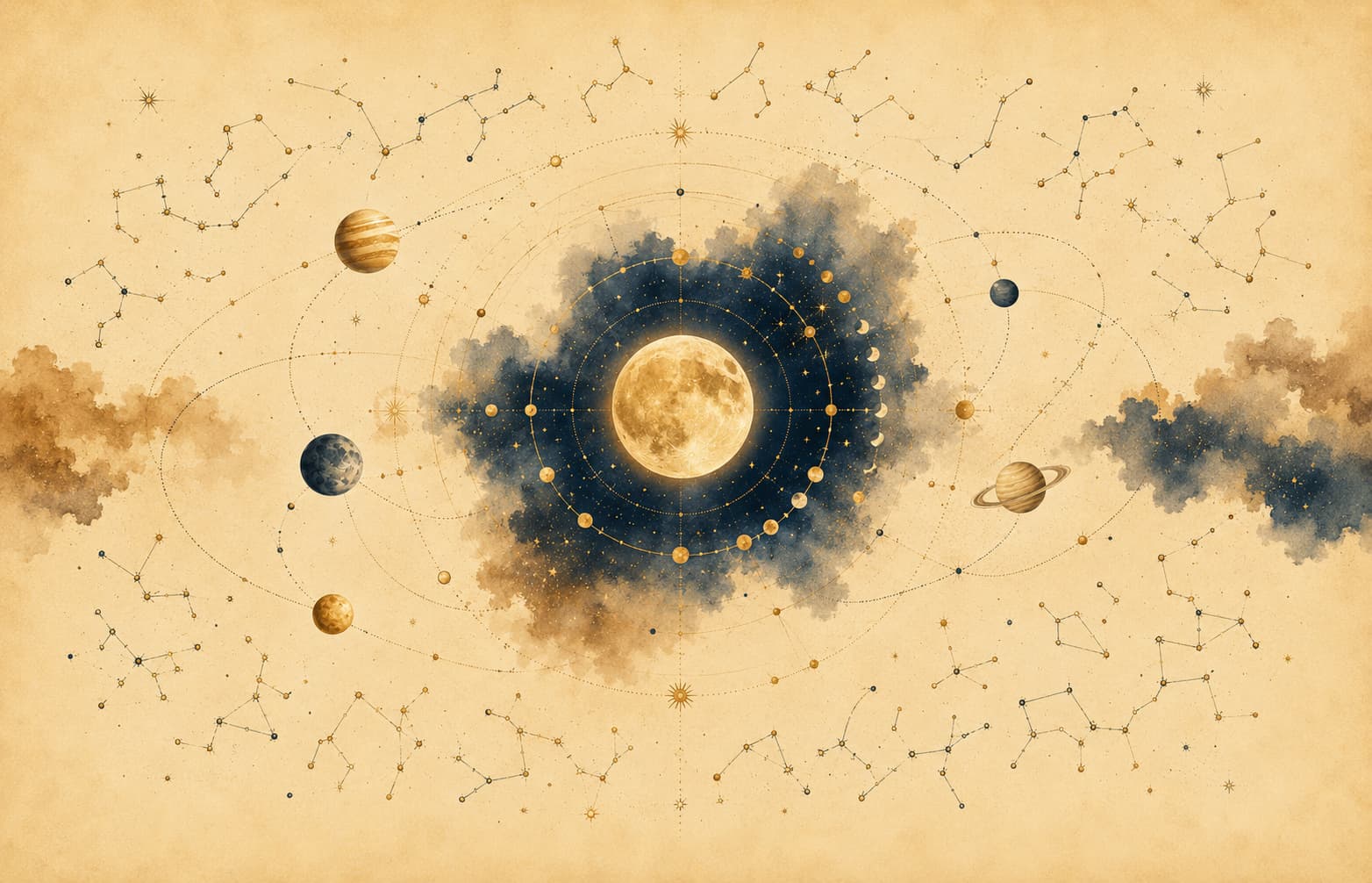
Most people who open a Vedic birth chart for the first time notice two sets of labels around the same circle of sky. One set shows the familiar twelve Rashis or zodiac signs. The other shows twenty-seven Nakshatras or lunar mansions. Both describe the same 360-degree ecliptic, yet they answer different questions. Knowing when to lean on the Rashi and when to lean on the Nakshatra is one of the most practical skills in Jyotisha.
This article explains the distinction in plain language, shows how classical texts and modern practice use each system, and offers a clear decision framework for everyday chart reading, timing, and compatibility work.
Quick Answer and Key Takeaways
- Zodiac signs (Rashis) give the broad stage: planetary dignity, house rulership, aspects, and overall life themes.
- Nakshatras give the finer script: Moon’s emotional colouring, Vimshottari Dasha sequence, marriage compatibility scores, and precise Muhurta selection.
- Use the Rashi first for structural analysis of the Kundli. Switch to the Nakshatra when the question concerns timing, temperament details, or lunar-based systems.
- The Moon’s Nakshatra is almost always more decisive for personality description and Dasha than the Moon’s Rashi alone.
- Both systems must be read together. A planet’s sign placement and its Nakshatra placement modify each other.
What Exactly Are Zodiac Signs in Vedic Astrology?
A Rashi is a thirty-degree segment of the ecliptic. There are twelve of them, each linked to a ruling planet and an elemental quality (fire, earth, air, water). The sequence begins with Mesha (Aries) and ends with Meena (Pisces). In the sidereal zodiac used by most Indian astrologers, these signs are fixed relative to the stars rather than to the tropical equinox.
The Rashi tells us three essential things:
- The natural temperament of a planet when it occupies that sign.
- Which planet owns the house that the sign falls in for a given Ascendant.
- Whether a planet is strong by exaltation, own sign, friendly sign, or weak by debilitation or enemy sign.
For example, if the Ascendant is Karka (Cancer), the sign Vrishabha (Taurus) becomes the eleventh house. Any planet placed in Vrishabha will express its eleventh-house themes through the lens of Taurus qualities: stability, resourcefulness, and a preference for tangible results. The Rashi therefore supplies the structural skeleton of the chart.
What Exactly Are Nakshatras?
A Nakshatra is a smaller arc of thirteen degrees and twenty minutes. There are twenty-seven of them (sometimes a twenty-eighth, Abhijit, is used for special Muhurta purposes). Each Nakshatra is ruled by a planet in the Vimshottari Dasha system and is associated with a presiding deity, a symbol, a Gana (divine, human, or demonic), and a primary motivation (Dharma, Artha, Kama, or Moksha).
The Nakshatra system is lunar in origin. The Moon takes roughly one day to cross one Nakshatra, which is why the Moon’s Nakshatra at birth becomes the starting point for the entire Vimshottari Dasha sequence. Classical texts such as the Brihat Parashara Hora Shastra treat the Nakshatra as a more intimate descriptor of the mind and the subtle qualities of any planet that occupies it.
Because each Rashi contains two and a quarter Nakshatras, a single sign can host planets that feel quite different depending on which lunar mansion they occupy. A planet in the first Pada of a Nakshatra can behave differently from the same planet in the fourth Pada of the same Nakshatra.
Why the Two Systems Exist Side by Side
Vedic astrology never chose one system over the other. The twelve-sign framework entered Indian practice through earlier Mesopotamian and Hellenistic exchanges and was fully absorbed into the classical Jyotisha literature. The Nakshatra framework is older in the Indian context and remains central to the lunar calendar, ritual timing, and the Dasha systems.
Think of the Rashi as the room and the Nakshatra as the furniture arrangement and lighting inside that room. The room tells you the general purpose of the space. The furniture tells you how comfortable, elegant, or restless the experience of being in that room will feel.
When to Prioritise Zodiac Signs
1. Structural Chart Analysis
Begin every reading with the Rashi chart. Determine the Ascendant, note the house cusps, and identify the lords of the twelve Bhavas. Planetary strength by sign (Uchcha, Neecha, Swa, Mitra, Shatru) is assessed first in the Rashi. Aspects (Graha Drishti) are counted by sign distance. Yogas that depend on house lordship or mutual exchange are also Rashi-based.
2. Planetary Dignity and Functional Nature
Whether a planet is a functional benefic or malefic depends on the houses it rules for a given Ascendant. That calculation lives entirely in the Rashi chart. A planet’s capacity to deliver its promise is judged by its sign placement before finer Nakshatra details are added.
3. Transit Analysis at the Sign Level
When Jupiter or Saturn changes signs, the collective and individual effects are first described by the new Rashi. Only later does an astrologer refine the picture by noting the Nakshatra the planet has entered.
4. House-Based Predictions
Questions about career (tenth house), marriage (seventh house), children (fifth house), or property (fourth house) begin with the relevant Rashi and its lord. The Nakshatra of the lord or of planets in that house can refine the answer, but the primary framework remains the sign and house.
When to Prioritise Nakshatras
1. Vimshottari Dasha and All Nakshatra-Based Period Systems
The starting point of the Vimshottari Dasha is the Nakshatra occupied by the Moon at birth. The entire 120-year cycle is sequenced according to the planetary rulers of the twenty-seven Nakshatras. Without the Moon’s Nakshatra, the Dasha cannot be calculated. For any timing question that relies on Mahadasha, Antardasha, or Pratyantardasha, the Nakshatra is indispensable.
2. Psychological and Temperamental Detail
Two people can share the same Moon sign yet feel markedly different because their Moon occupies different Nakshatras. A Moon in Rohini (ruled by the Moon, Taurus sign) tends toward aesthetic sensitivity and emotional steadiness. A Moon in Mrigashira (ruled by Mars, still partly in Taurus) introduces curiosity, restlessness, and a searching quality. The Rashi gives the broad emotional style; the Nakshatra colours the inner dialogue.
3. Marriage Compatibility (Ashtakoota Guna Milan)
The traditional thirty-six-point matching system is built almost entirely on Nakshatra relationships: Varna, Vashya, Tara, Yoni, Graha Maitri, Gana, Bhakoot, and Nadi. While the Rashi of the Moon is used for Bhakoot and a few other factors, the core matching is lunar-mansion based. An astrologer who ignores Nakshatras cannot complete a classical Guna Milan.
4. Muhurta and Electional Astrology
Choosing an auspicious moment for marriage, house entry, travel, or business opening relies heavily on the current Nakshatra, its deity, and its suitability for the activity. Certain Nakshatras are preferred for specific actions; others are avoided. The Rashi of the Moon or Lagna is secondary in most classical Muhurta rules.
The activation window for this theme can be refined through Kaalchakra Dasha.
5. Fine-Tuning Planetary Expression
Once the Rashi placement of a planet is understood, the Nakshatra and its Pada supply the next layer. A Mars in its own sign Mesha will behave differently in Ashwini (swift, pioneering, healing) than in Bharani (intense, transformative, boundary-testing). The Nakshatra ruler also becomes a secondary dispositor that can modify the planet’s results.
6. Remedial and Mantra Work
Many traditional remedies, especially those linked to the Moon or to specific planetary periods, use the Nakshatra deity or the ruling planet of the Nakshatra. The choice of mantra, charity, or ritual day often follows the lunar mansion rather than the sign alone.
A Practical Decision Framework
Ask yourself these questions when you open a chart or face a timing decision:
-
Is the question about overall life structure, house themes, or planetary strength by sign?
Start with the Rashi. -
Is the question about the sequence of life periods, emotional colouring, or compatibility scoring?
Start with the Nakshatra. -
Does the matter involve selecting a favourable day or hour?
Prioritise the current Nakshatra and its qualities. -
Are you describing personality or mental patterns in detail?
Give greater weight to the Moon’s Nakshatra and the Nakshatras of key planets. -
Are you examining a Yoga that depends on house lordship or mutual exchange?
Confirm it first in the Rashi chart, then see whether the Nakshatras support or dilute the Yoga.
In practice, experienced astrologers move fluidly between the two. They never treat them as rivals. The Rashi provides the architecture; the Nakshatra provides the living atmosphere inside that architecture.
How the Two Systems Interact in a Real Chart
Consider a hypothetical example. Suppose the Moon is in the sign of Kanya (Virgo) and the Nakshatra of Hasta. The Rashi of Virgo gives the Moon a discriminating, service-oriented, analytical flavour. Hasta, ruled by the Moon itself and symbolised by the hand, adds skill, craftsmanship, and a desire to shape or heal through precise action. The person may express the Virgo need for order through tangible, hand-related work: design, surgery, artisan crafts, or detailed administrative systems. If the same Moon were in Chitra (still in Virgo or early Libra), the emphasis would shift toward beauty, structure, and a more architectural or aesthetic intelligence.
The Rashi tells us the elemental and planetary environment. The Nakshatra tells us the specific style of intelligence and the deity that colours the experience.
Common Misconceptions
Misconception 1: “Nakshatras are only for the Moon.”
Any planet occupies a Nakshatra. While the Moon’s Nakshatra is the most frequently used, the Nakshatras of the Lagna, of the Atmakaraka, and of the Dasha lord all carry interpretive weight.
Misconception 2: “Zodiac signs are Western and Nakshatras are the true Vedic system.”
Both systems are fully integrated in classical Jyotisha texts. Treating one as authentic and the other as foreign creates unnecessary division.
Misconception 3: “If I know the Nakshatra, I can ignore the Rashi.”
A planet’s sign placement determines its basic dignity and house rulership. Ignoring the Rashi removes the structural foundation of the chart.
Misconception 4: “All twenty-seven Nakshatras are equally important for every question.”
For Dasha and compatibility they are central. For pure house analysis they play a supporting role.
Readers following this theme into intimacy and partnership may also recognize marriage compatibility in Jyotish.
Factors That Modify Both Systems
Neither the Rashi nor the Nakshatra acts in isolation. The final result always depends on:
- The strength of the planet by Shadbala or other measures.
- Aspects and conjunctions from other planets.
- The condition of the dispositor (the sign lord and the Nakshatra lord).
- The current Dasha and the supporting or challenging transits.
- The relevant divisional charts, especially Navamsha for relationships and career.
- The overall promise of the Lagna and its lord.
A strong planet in a difficult Nakshatra can still produce constructive results. A weak planet in a favourable Nakshatra may struggle to deliver its potential. Context remains essential.
Step-by-Step Method for Everyday Practice
- Cast the Rashi chart and note the Ascendant, planetary signs, and house lords.
- Identify the Moon’s Nakshatra and calculate the Vimshottari Dasha balance.
- Note the Nakshatra of the Lagna and of any planet under special scrutiny.
- For personality description, begin with the Moon’s Rashi and then refine with its Nakshatra and Pada.
- For timing questions, move directly to the current or upcoming Dasha and the relevant Nakshatra of the period lord.
- For compatibility, complete the full Ashtakoota using Nakshatras, then cross-check with the seventh house and Venus in both charts.
- For Muhurta, select the day whose Nakshatra suits the activity, then confirm that the Lagna and Moon Rashi of that moment are also acceptable.
This sequence keeps the analysis orderly and prevents the common error of jumping to fine details before the structure is clear.
Positive and Challenging Expressions
When the Rashi and Nakshatra of a key planet are in harmony, the native often experiences smoother expression of that planet’s themes. A Jupiter in its own sign and in a supportive Nakshatra such as Punarvasu can bring both wisdom and the ability to renew hope after difficulty. When the sign and Nakshatra pull in different directions, the person may feel internal tension that requires conscious integration.
The same principle applies to the Moon. A comfortable Moon sign with a challenging Nakshatra can produce emotional intelligence mixed with periodic restlessness. Awareness of both layers helps the individual work with the tension rather than feel controlled by it.
Traditional Guidance Without Determinism
Classical texts never present the Rashi or the Nakshatra as a fixed destiny. They describe tendencies and probabilities. The same placement can rise to constructive use through discipline, ethical choice, and the support of favourable Dashas and transits. Remedial measures in the tradition, whether mantra, charity, or behavioural change, are offered as ways to strengthen the constructive side of a placement, not as magical cancellations of karma.
Conclusion
Zodiac signs and Nakshatras are complementary instruments, not competing systems. The twelve Rashis give the architecture of the chart: houses, dignity, aspects, and the broad life departments. The twenty-seven Nakshatras give the living detail: the emotional texture of the mind, the sequence of life periods, the fine points of compatibility, and the precise selection of time.
A stronger technical foundation for this factor can be found in Vedic and Western astrology.
Use the Rashi when you need structure. Use the Nakshatra when you need nuance, timing, or lunar precision. In skilled hands the two systems speak together, each clarifying what the other leaves unfinished. A complete reading always listens to both.
Frequently Asked Questions
1. Can two people with the same Moon sign have very different personalities?
Yes. The Nakshatra and Pada of the Moon, along with aspects and the overall chart, create significant variation within the same Rashi.
2. Is the Nakshatra more important than the Rashi for career prediction?
The tenth house, its lord, and planets influencing it (all Rashi-based) form the foundation. The Nakshatra of the tenth lord or of planets in the tenth can refine the style of profession and the timing of peaks.
3. Do I need the exact birth time to know the Nakshatra?
For the Moon’s Nakshatra a rough time is often enough because the Moon moves slowly. For the Lagna Nakshatra and for precise Dasha balance, an accurate birth time is necessary.
4. Which system is used in the Panchang?
The daily Panchang lists both the current Rashi of the Moon and the current Nakshatra. Ritual and Muhurta decisions usually give greater weight to the Nakshatra.
5. Can a planet be strong in Rashi but weak in Nakshatra?
Strength is primarily assessed by sign, house, and Shadbala. The Nakshatra adds qualitative colouring rather than a separate strength score, though the Nakshatra lord’s condition can support or hinder the planet.
6. Should beginners learn Rashis first or Nakshatras first?
Most teachers recommend mastering the twelve signs, house meanings, and basic planetary dignity before entering the twenty-seven Nakshatras. The Rashi system provides the necessary foundation.
7. Does the Navamsha chart use Nakshatras?
The Navamsha is a divisional chart based on nine equal parts of each Rashi. While it is not a Nakshatra chart, the Nakshatra of a planet in the Rashi chart influences how that planet expresses in the Navamsha.
8. Are there situations where only one system is used?
Pure sign-based transit reports may omit Nakshatras. Pure Muhurta selection may focus almost exclusively on Nakshatra. Complete personal chart work almost always requires both.
Internal-link anchor suggestions:
- Understanding Vimshottari Dasha calculation
- Complete guide to Ashtakoota Guna Milan
- How to read planetary dignity in the Rashi chart
Related-article suggestions:
- The Role of the Moon’s Nakshatra in Personality and Timing
- A Practical Introduction to the Twelve Rashis in Vedic Astrology
Important factual statements that require editorial verification:
- Exact degree span of each Nakshatra (13°20′)
- Traditional association of each Nakshatra with its planetary ruler in Vimshottari
- Classical preference for certain Nakshatras in specific Muhurta activities
Sources consulted:
Classical principles drawn from standard Jyotisha interpretive tradition (Brihat Parashara Hora Shastra framework, standard Panchang usage, and established teaching on Rashi versus Nakshatra application). No specific verse numbers or modern commercial blogs are cited as primary proof.
About the author
Anika Rao
Editor-in-Chief
Anika Rao is the editor-in-chief of Vedic Astrology Space. Her work brings classical Jyotish into conversation with relationships, identity, emotional life and the questions people carry into a modern chart reading. She is especially interested in nakshatras, the Moon, relational patterns and interpretations that create self-understanding without reducing a person to a placement.
Read the full bioContinue reading
Nakshatra Padas Explained: Why Same Nakshatra Natives Differ in Life
Gandanta Births in Vedic Astrology: Karmic Knots Between Water and Fire Signs