
Jealousy, Possessiveness and Controlling Behavior in Relationships Explained with Vedic Astrology
Explore how Vedic astrology explains jealousy, possessiveness and controlling behaviour in relationships. Learn the difference between normal insecurity and coercive patterns through Mars-Rahu, Moon-Rahu, Venus in Scorpio, 7th and 8th houses, Darapada, Upapada and Navamsha.
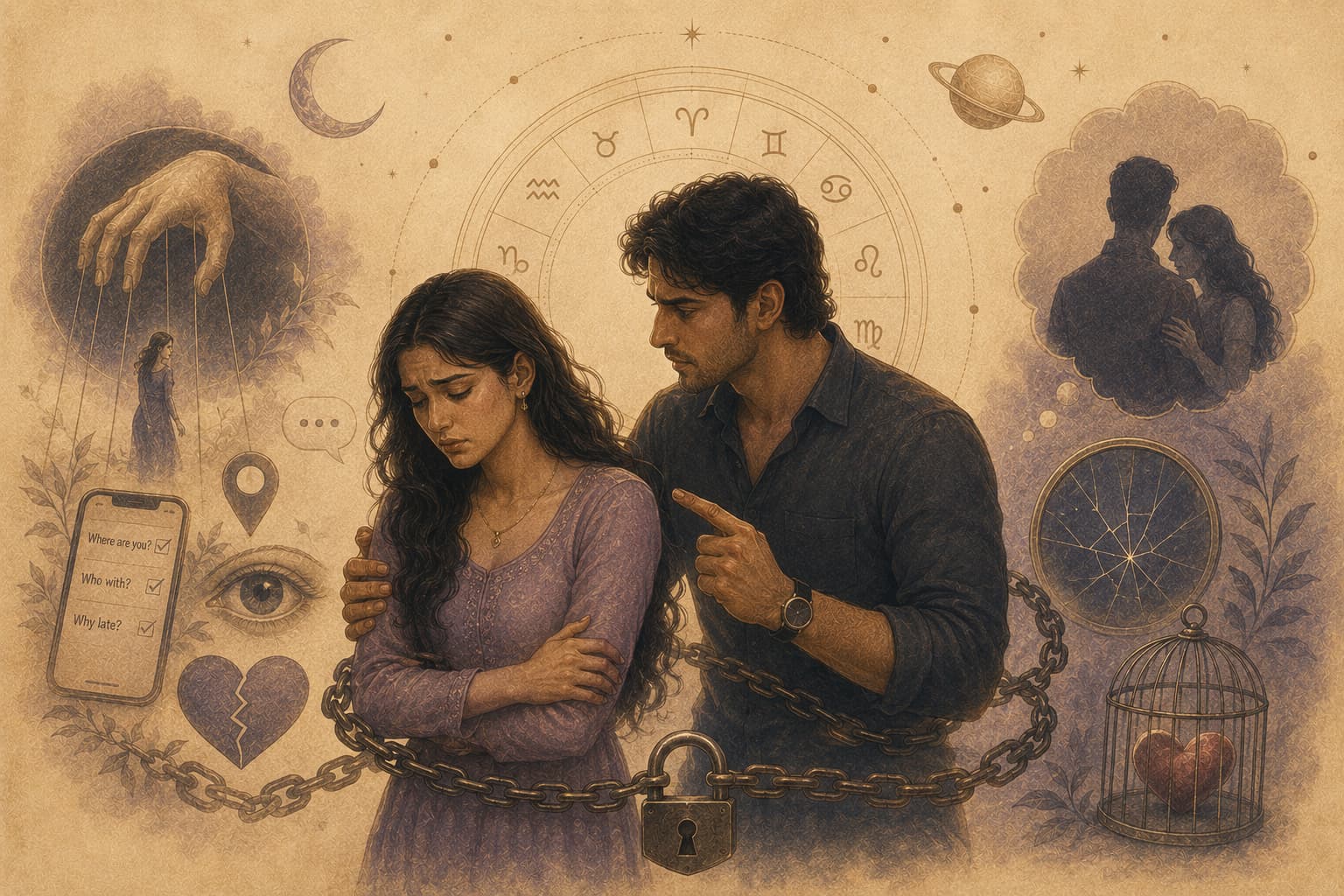
Many people notice a quiet tightening in the chest when a partner takes longer than usual to reply to a message. That brief unease is common. It becomes something else when the same person starts checking phone records, questioning every social interaction, or deciding who the partner may meet. The shift from ordinary insecurity to surveillance, possessiveness and coercive control is not always obvious at first. Vedic astrology, or Jyotisha, does not label anyone as permanently controlling or permanently victimised. It does, however, highlight planetary combinations and house conditions that can incline a chart toward intense emotional ownership or toward difficulty in setting firm boundaries.
This article explains those indications in practical terms. It separates everyday emotional vulnerability from patterns that restrict freedom. It looks at both the person who tends to control and the person who stays in such dynamics. The focus remains on classical factors such as Mars-Rahu, Moon-Rahu, Venus in Scorpio, the condition of the seventh and eighth houses, a weak fourth house, Darapada, Upapada Lagna and the Navamsha chart. Every interpretation requires the complete birth chart. No single placement decides the quality of a relationship.
A closely related partnership pattern is explored in ghosting, catfishing and situationships.
Key Takeaways
- Ordinary insecurity seeks reassurance. Controlling behaviour seeks power over the partner’s choices, contacts and movements.
- Mars with Rahu can intensify the need to dominate or to react with sudden force when security feels threatened.
- Moon with Rahu often heightens emotional restlessness and the fear of abandonment, which may appear as clinging or as constant testing of the partner.
- Venus in Scorpio brings depth and loyalty, yet in certain conditions it can turn attachment into exclusive ownership.
- Afflictions to the seventh and eighth houses, a fragile fourth house, and difficult Darapada or Upapada placements frequently appear when relationship power is uneven.
- The Navamsha reveals whether the pattern is temporary or more deeply woven into the relationship dharma.
- Both the controlling partner and the accommodating partner carry chart signatures. Understanding both sides supports healthier choices rather than blame.
Differentiating Normal Insecurity from Surveillance, Possessiveness and Coercive Control
Normal insecurity arises from the natural human need for connection. A person may feel anxious when plans change or when the partner seems distant. The response is usually conversation, self-reflection or a request for clarity. The other person’s autonomy remains intact.
Surveillance begins when the need for information overrides privacy. Checking messages without permission, installing tracking applications, or demanding continuous location updates are common signs. The underlying motive is no longer reassurance. It becomes verification and restriction.
Possessiveness treats the partner as an extension of the self. Friendships outside the relationship are questioned. Time spent with family or colleagues is monitored. Decisions about clothing, career moves or social media presence are heavily influenced or vetoed. The language often sounds protective, yet the effect is narrowing of the partner’s world.
Coercive control is more systematic. It may include isolation from support networks, financial restriction, repeated criticism that erodes confidence, threats of abandonment or public humiliation, and gradual rewriting of the partner’s sense of reality. These behaviours are not simply “too much love.” They are strategies of dominance.
Jyotisha does not diagnose clinical conditions. It describes tendencies that, under stress or during difficult dashas, may express as the patterns above. A chart showing strong indications still requires conscious effort, counselling and ethical maturity to avoid harm.
Astrological Foundations: Planets, Houses and Relationship Dynamics
In classical Jyotisha the seventh house (Saptama Bhava) governs partnerships, marriage and open enemies. Its lord and any planets placed there colour the style of relating. The eighth house (Ashtama Bhava) rules shared resources, intimacy, secrets, transformation and the hidden side of partnership. When both houses receive malefic influence or when their lords are weak, the relationship field can become charged with suspicion, power struggles or emotional intensity that is hard to regulate.
The fourth house represents emotional foundations, the sense of home and the capacity for inner security. A weak or heavily afflicted fourth house often leaves a person feeling unanchored. That lack of internal safety can spill into the partnership as either controlling behaviour or excessive tolerance of control.
Venus is the natural significator of romantic attachment and harmony. Mars signifies energy, assertion and the capacity to protect. Rahu amplifies whatever it touches, often in unconventional or obsessive directions. The Moon reflects the mind’s need for emotional nourishment. When these planets form challenging combinations, the ordinary desire for closeness can tilt toward ownership or fear-driven compliance.
Two special points used in relationship analysis are Darapada (A7, the Arudha of the seventh house) and Upapada Lagna (UL). Darapada shows the public or projected image of the partner and the partnership itself. Upapada Lagna and its lord describe the nature of the marriage or long-term union, the spouse’s characteristics and the overall tone of commitment. Difficult placements here frequently coincide with uneven power dynamics.
The Navamsha chart (D9) is indispensable. It refines the promise of the Rashi chart regarding dharma in relationship, the deeper quality of the spouse and the long-term sustainability of the bond. Patterns that appear mild in the main chart may become pronounced in the Navamsha, or vice versa.
Mars-Rahu Combinations and the Drive to Control
Mars represents courage, initiative and the instinct to defend what one values. Rahu represents desire that exceeds ordinary limits, illusion and the tendency to pursue extremes. When Mars and Rahu are conjunct, aspect each other, or exchange signs, the native may experience an intensified need to assert dominance in areas of insecurity.
In relationship contexts this combination can manifest as sudden jealousy, verbal or physical forcefulness when the partner asserts independence, or an obsessive need to know the partner’s every movement. The native may believe the intensity is proof of love. In practice it often creates an atmosphere of walking on eggshells.
The house of the combination matters. In the seventh house the partnership itself becomes the arena of conflict. In the eighth house the struggle centres on intimacy and shared control. In the fourth house the home environment may feel tense. The sign involved modifies the expression. Fiery signs can make the reaction more direct. Watery signs may internalise the tension until it erupts.
Not every Mars-Rahu native becomes controlling. Strong Jupiter influence, supportive aspects from benefics, or a well-placed Lagna lord can channel the energy into protective loyalty rather than restriction. Dashas of Mars or Rahu often activate the pattern. Awareness during those periods allows conscious redirection.
Moon-Rahu and Emotional Restlessness
The Moon governs the mind, emotional habits and the need for security. Rahu with the Moon can create a fluctuating emotional landscape. The native may feel that ordinary affection is never enough. Small delays or changes in routine can trigger waves of anxiety that the partner is pulling away.
This combination is frequently linked with clinging behaviour, repeated testing of the partner’s loyalty, or sudden withdrawal followed by intense reconnection. The person may monitor the partner’s moods closely and interpret neutral actions as rejection. On the other side of the relationship, a partner with Moon-Rahu may tolerate controlling behaviour longer than is healthy because the fear of abandonment outweighs the discomfort of restriction.
The house of the Moon-Rahu combination is important. In the fourth house the emotional foundation itself feels unstable. In the seventh or eighth house the partnership becomes the primary source of attempted security, which places excessive pressure on the other person. Nakshatra placement further refines the style. Certain lunar mansions emphasise secrecy or sudden shifts, intensifying the pattern.
Remedial approaches traditionally include practices that stabilise the mind, such as consistent meditation, mantra for the Moon, and charity related to nourishment or care of women and children. Psychological support remains equally valuable.
Venus in Scorpio: Intensity, Loyalty and the Risk of Ownership
Venus in Scorpio is often described as passionate and deeply loyal. Scorpio is a fixed water sign ruled by Mars in the traditional system and associated with transformation, secrecy and strong emotional bonds. When Venus occupies this sign the native tends to love with total commitment. The same intensity can slide into possessiveness if other factors support it.
The native may find it difficult to share the partner’s attention. Past hurts can remain vivid and colour present interactions. Sexual and emotional merging may feel essential, so any perceived distance is experienced as threat. In charts where Venus is further afflicted by Mars, Rahu or Saturn, or where the seventh and eighth houses are troubled, the protective instinct can become restrictive.
Conversely, a well-aspected Venus in Scorpio can produce profound devotion, the capacity to stay through difficult transformations, and an ability to rebuild trust after crisis. The difference lies in the supporting and modifying factors of the full chart, especially the strength of Jupiter and the condition of the Lagna lord.
Afflicted Seventh and Eighth Houses
When malefics occupy or aspect the seventh house without sufficient benefic support, the partnership field becomes prone to conflict, suspicion or power imbalance. The seventh lord if weak, combust, or placed in a difficult house further reduces the capacity for equal relating.
The eighth house rules the hidden contracts of a relationship, including emotional and financial interdependence. Afflictions here can indicate secrecy, control over shared resources, or transformative crises that test the bond. When both the seventh and eighth houses are under pressure, the relationship may alternate between intense closeness and struggles over autonomy.
Classical texts emphasise that the lords of these houses and their mutual relationship are as important as the planets placed in them. A strong seventh lord in the eighth house, for example, can indicate deep commitment that still requires careful handling of trust issues.
Weak Fourth House and the Search for Security
A fourth house that is occupied by malefics, whose lord is weak or afflicted, or that receives difficult aspects often leaves the native with an unstable sense of emotional home. The person may look to the partner to supply the safety that was missing earlier in life. This can appear as either controlling behaviour (attempting to create safety by managing the partner) or as excessive accommodation (accepting control in exchange for a sense of belonging).
The fourth house also relates to the mother and early nurturing. Patterns of insecurity established in childhood frequently surface in adult partnerships. Jyotisha does not excuse harmful behaviour on this basis. It simply notes the vulnerability so that conscious work can begin.
Darapada and the Projected Image of Partnership
Darapada, or A7, is the Arudha Pada of the seventh house. It shows how the partnership appears to the world and how the native experiences the partner’s public image. When Darapada is occupied or aspected by malefics, or when its lord is weak, the relationship may be marked by public tension, jealousy triggered by social situations, or a sense that the partner’s external life is a source of threat.
A difficult Darapada can also indicate that the native projects controlling or possessive qualities onto the partner, whether or not those qualities are actually present. Careful examination of both the Rashi and Navamsha charts helps distinguish projection from reality.
Upapada Lagna and the Nature of the Union
Upapada Lagna is calculated from the twelfth house and is used to assess the quality of marriage or long-term partnership. The sign of the Upapada, its lord, and planets associated with it describe the spouse’s nature and the overall tone of the commitment.
When the Upapada Lagna or its lord is afflicted by Mars, Rahu, Saturn or a weak Moon, the union may involve power struggles, emotional intensity that becomes restrictive, or difficulty in maintaining balanced autonomy. Benefic influence on the Upapada supports mutual respect and healthier boundaries.
Neurodivergence should not be confused with controlling behaviour; ADHD, executive dysfunction and neurodivergence examines its distinct chart signatures.
Traditional practice examines the second house from the Upapada for longevity of the marriage and the seventh from the Upapada for the spouse’s character in more detail. These layers add nuance that a single house in the main chart cannot provide.
The Role of the Navamsha Chart
The Navamsha is the primary divisional chart for marriage and dharma in relationship. Planets that appear mild in the Rashi chart may show stronger controlling or accommodating tendencies in the Navamsha. Conversely, difficult Rashi placements may be softened if the Navamsha is supportive.
Particular attention is given to the seventh house of the Navamsha, its lord, Venus, and the Navamsha Lagna. Mars or Rahu strongly placed in the Navamsha seventh or eighth house often intensifies the themes already discussed. A weak Moon in the Navamsha can indicate emotional vulnerability that either seeks control or accepts it.
Dasha periods of planets that are prominent in both the Rashi and Navamsha charts frequently bring relationship patterns into clearer view. Awareness during those times allows the native to choose responses rather than simply react.
The Controlling Partner: Chart Indicators
Charts of individuals who lean toward controlling behaviour often show one or more of the following:
- Mars-Rahu influence on the seventh, eighth or fourth houses
- Venus in Scorpio with additional malefic aspects
- Afflicted seventh and eighth houses without strong benefic relief
- Strong but poorly directed Mars, especially if it is the Lagna lord or seventh lord
- Rahu influencing the Moon or Venus
- Difficult Darapada or Upapada placements
These combinations do not create a fixed character. They describe an energetic tendency that becomes problematic when the native lacks self-awareness or when stressful dashas and transits activate the combination. Many people with similar charts channel the same intensity into protective loyalty, passionate commitment or creative drive.
The Person Who Tolerates the Pattern: Chart Indicators
The partner who remains in a controlling dynamic often shows:
- A weak or afflicted Moon, especially with Rahu
- A fragile fourth house indicating low emotional security
- Venus under pressure from Saturn, Rahu or Mars
- Seventh house or seventh lord under malefic influence that reduces the capacity to assert needs
- Upapada or Darapada conditions that accept difficulty in partnership
- Strong influence of the twelfth house, which can indicate self-sacrifice or difficulty in recognising personal boundaries
Again, these are tendencies, not destinies. A person with such placements may still develop strong boundaries through conscious effort, supportive relationships and, when needed, professional guidance. The chart simply highlights the area that requires extra attention.
Hypothetical Example for Clarity
Consider a hypothetical chart with Ascendant in Cancer. The Moon is in the seventh house with Rahu. Mars is in the eighth house. Venus is in Scorpio in the fifth house, aspected by Saturn. The seventh lord Saturn is in the sixth house. Darapada falls in a sign occupied by Ketu. Upapada Lagna is in a sign whose lord is weak and aspected by Mars.
The spiritual and ethical dimension of this question is developed further in fake gurus and spiritual manipulation.
In such a chart the native may experience intense emotional need for the partner (Moon-Rahu in seventh), sudden reactions when intimacy feels threatened (Mars in eighth), deep but potentially possessive attachment (Venus in Scorpio), and difficulty maintaining equal partnership (afflicted seventh lord and Darapada). The Navamsha would need examination to confirm whether these themes are reinforced or mitigated.
This example is illustrative only. Real charts contain many more factors, including aspects, yogas, dashas and the overall strength of the Lagna.
Factors That Modify the Results
Several conditions can reduce or redirect the intensity:
- Strong Jupiter aspecting the relevant planets or houses
- Benefic influence on the Lagna and Lagna lord
- Well-placed Venus without severe affliction
- Supportive Navamsha placements
- Favourable dashas of benefics during critical relationship periods
- Conscious self-work, counselling and ethical maturity
Transits of Saturn, Rahu or Mars over sensitive points can temporarily heighten the pattern. Awareness of the timing helps the native prepare constructive responses.
Common Misconceptions
One frequent misunderstanding is that any Mars or Rahu influence automatically produces a controlling personality. Many charts with these combinations produce energetic, protective and loyal partners.
Another misconception is that the “victim” chart is purely passive. Both partners contribute to the dynamic, and both carry responsibility for change.
A third error is treating the Navamsha as secondary. In relationship matters it often reveals the deeper pattern more clearly than the Rashi chart alone.
Finally, some believe that remedies alone will dissolve long-standing behavioural patterns. Traditional practices support the process. They do not replace personal effort or, when required, professional psychological help.
Traditional Remedies and Practical Guidance
Classical suggestions focus on balancing the relevant planets and strengthening emotional foundations.
For Mars-related intensity: disciplined physical activity, service that channels assertive energy constructively, and mantra such as the Mangal Beej or Hanuman-related practices according to the native’s tradition.
For Moon-Rahu emotional restlessness: regular sleep hygiene, nourishing routines, Chandra mantra, and charity connected with milk, white items or care of the vulnerable.
For Venus in difficult condition: practices that cultivate genuine appreciation rather than ownership, artistic expression, and mantra for Venus offered with sincerity rather than mechanical repetition.
General supportive measures include:
- Strengthening the fourth house through care of the home environment and respectful relationship with the mother or maternal figures where appropriate
- Honest communication about needs and boundaries
- Cultivating interests and friendships outside the primary relationship so that emotional security does not rest on one person alone
- Seeking guidance from a qualified counsellor when patterns of control or excessive tolerance become harmful
Gemstones, elaborate rituals or severe austerities should never be adopted without full chart analysis and consideration of health and circumstances. The most reliable remedies remain consistent ethical conduct, self-awareness and willingness to change.
How to Examine These Factors in a Birth Chart
A practical sequence for an astrologer or serious student:
- Assess the Lagna and Lagna lord for overall capacity to handle relationship stress.
- Examine the seventh house, its lord, and planets placed there.
- Study the eighth house and its lord for intimacy and shared power themes.
- Evaluate the fourth house and its lord for emotional security.
- Note the positions and aspects of Mars, Rahu, Moon and Venus.
- Calculate and interpret Darapada and Upapada Lagna.
- Compare the same factors in the Navamsha.
- Check current and upcoming dashas for activation periods.
- Consider transits only after the natal picture is clear.
- Weigh benefic influences that may soften difficult combinations.
No single step is sufficient. The synthesis of all factors produces a balanced understanding.
Conclusion
Jealousy, possessiveness and controlling behaviour in relationships arise from a complex interplay of emotional needs, planetary influences and lived experience. Vedic astrology provides a precise language for recognising the tendencies that support these patterns. Mars-Rahu, Moon-Rahu, Venus in Scorpio, afflicted seventh and eighth houses, a weak fourth house, difficult Darapada or Upapada placements, and confirming indications in the Navamsha all deserve careful attention.
Readers following this theme into intimacy and partnership may also recognize polyamory and open relationships.
The same chart factors that can incline toward control can also support profound loyalty and protective care when guided by awareness and maturity. The chart of the person who tolerates such patterns often reveals vulnerabilities that can be strengthened rather than judged. In every case the complete birth chart, current dashas and the individual’s free will determine the outcome.
Understanding these indications is not an invitation to label or to fear. It is an opportunity to recognise where extra care is needed so that relationships can move toward mutual respect, emotional safety and genuine partnership.
Frequently Asked Questions
1. Does Mars-Rahu always create a controlling partner? No. The combination intensifies assertion and desire. Whether it becomes controlling depends on house placement, aspects, the overall chart strength and the native’s conscious choices.
2. Can a weak fourth house be improved? Traditional practices, consistent emotional self-care and, when needed, therapeutic support can strengthen the sense of inner security that a fragile fourth house may lack.
3. Is Venus in Scorpio always possessive? Venus in Scorpio is intense and loyal. Possessiveness arises mainly when additional afflictions or difficult house conditions support that expression.
4. How important is the Navamsha for these issues? Very important. Relationship patterns that appear moderate in the Rashi chart often show their true strength or mitigation in the Navamsha.
5. Should someone leave a relationship solely because of chart indications? Astrological indications describe tendencies. Decisions about remaining in or leaving a relationship should rest on lived experience, safety, mutual respect and, where appropriate, professional advice.
6. Do remedies guarantee change? Remedies support balance and awareness. Lasting change requires personal effort, honest communication and sometimes external guidance.
7. Can both partners in a controlling dynamic show difficult placements? Yes. It is common for complementary vulnerabilities to appear in both charts. Understanding both sides helps move beyond blame toward constructive adjustment.
8. Is coercive control only an astrological matter? No. Coercive control has psychological, social and sometimes legal dimensions. Astrology can highlight predispositions. It does not replace practical steps needed for safety and wellbeing.
About the author
Anika Rao
Editor-in-Chief
Anika Rao is the editor-in-chief of Vedic Astrology Space. Her work brings classical Jyotish into conversation with relationships, identity, emotional life and the questions people carry into a modern chart reading. She is especially interested in nakshatras, the Moon, relational patterns and interpretations that create self-understanding without reducing a person to a placement.
Read the full bioContinue reading

Friendship Breakups and Betrayal in Vedic Astrology: 3rd & 11th House Insights

Childfree by Choice or Delayed Parenthood in Vedic Astrology