
How Astrology Shapes Authoritarian or Libertarian Political Leanings
Explore how Vedic astrology, through planets, houses, Lagna and Moon sign, may indicate tendencies toward authoritarian, libertarian or balanced political views. Full chart analysis explained.
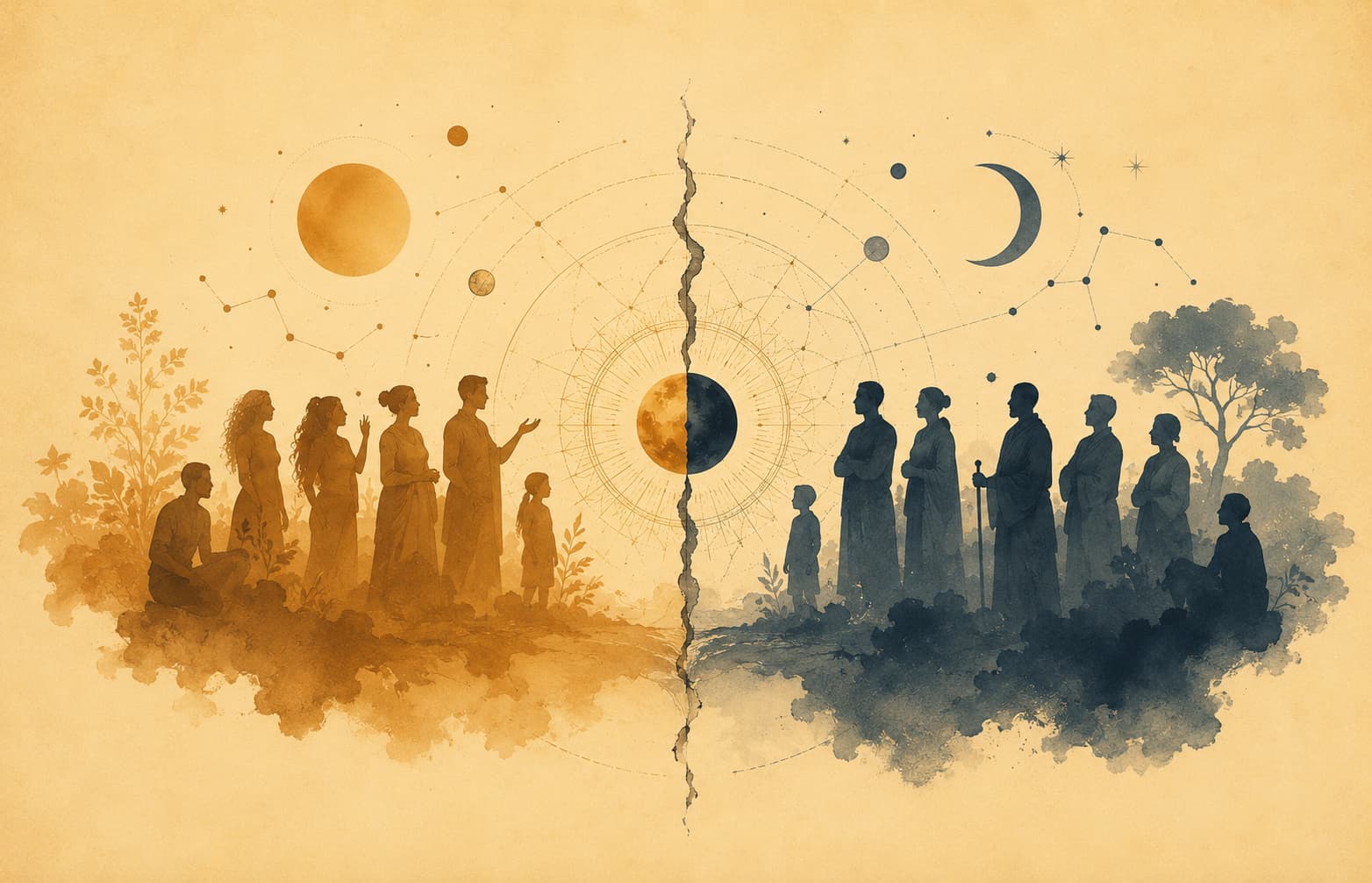
Many people notice that their political preferences feel almost instinctive. One person feels safer under clear rules and strong leadership. Another feels restricted by the same structures and seeks maximum personal space. A third person moves comfortably between both poles depending on the issue. These differences often appear early and remain consistent across years. Vedic astrology, or Jyotisha, offers one traditional framework for understanding such temperament through the birth chart, known as the Janma Kundli.
The subject is not about predicting which party a person will support or how they will vote in a particular election. Political ideology here refers to a deeper orientation: the degree of comfort with hierarchical control, the value placed on individual autonomy, and the preferred balance between collective order and personal liberty. Classical Jyotisha texts do not speak of modern labels such as authoritarianism or libertarianism. They do, however, describe planetary qualities, house themes and sign characteristics that shape how a person relates to authority, freedom, responsibility and social structure. When these factors are read together, they can illuminate why one chart leans toward structured systems while another resists them.
The public expression of this pattern is examined from another angle in left-wing and right-wing political inclinations.
This article explains the relevant concepts in plain language, shows how astrologers examine them, and stresses that no single placement decides political outlook. The complete chart, including Lagna, Moon sign, planetary strength, house lordships and current periods, must always be considered. Interpretation remains probabilistic and open to modification by environment, education and personal choice.
Key Takeaways
- Vedic astrology links political temperament mainly to the Lagna, Lagna lord, Moon, Saturn, Jupiter, Mars, Rahu and the 9th, 10th and 11th houses.
- Strong Saturn and well-placed Mars often correlate with preference for order, hierarchy and clear rules.
- Strong Jupiter, Venus or certain Moon placements may support ethical expansion, individual dignity and balanced freedom.
- Rahu and certain air-sign influences can incline toward unconventional or anti-authoritarian views.
- No chart produces a fixed ideology. Dasha periods, transits, education and life experience modify expression.
- The goal is self-understanding, not political labelling or prediction of voting behaviour.
Understanding Authoritarianism and Libertarianism through a Vedic Lens
Authoritarianism, in the limited sense used here, describes a preference for clear hierarchy, firm leadership, defined social roles and collective discipline. Libertarianism, again in a temperament sense, describes a preference for individual autonomy, minimal external control, personal responsibility and resistance to imposed structure. Most people fall somewhere between these poles. Vedic astrology does not judge either tendency as superior. It simply notes that different planetary combinations support different comfort zones.
In classical terms, these leanings arise from the native’s relationship with power (Shakti), dharma (ethical order), and the balance between individual will and social duty. The 10th house and its lord speak of authority and public role. The 9th house and its lord speak of philosophy, belief and higher principles. The 11th house speaks of collective desires and social networks. The 1st house and Lagna lord reveal how the self asserts itself in the world. When these factors are examined together with planetary nature, a pattern of orientation often becomes visible.
This becomes clearer when placed beside the planetary analysis in Guru Chandal Yoga.
It is important to separate temperament from ideology. A person with strong Saturn may value order yet still support democratic institutions. A person with strong Rahu may question authority yet accept necessary regulation. Astrology describes tendencies, not finished political programmes.
Core Astrological Indicators of Political Temperament
The Role of the Lagna and Lagna Lord
The Lagna, or Ascendant, is the rising sign at birth and the foundation of the chart. It shows how the native approaches life and projects the self. The Lagna lord carries this energy into specific houses and signs.
A Lagna in fixed signs (Vrishabha, Simha, Vrischika, Kumbha) often supports steady, determined outlooks that can translate into preference for stable systems. Cardinal signs (Mesha, Karka, Tula, Makara) favour initiative and may produce either assertive leadership or active reform. Mutable signs (Mithuna, Kanya, Dhanu, Meena) tend toward adaptability and can support more fluid or negotiated positions.
When the Lagna lord occupies or aspects the 10th house, the native often feels a natural connection with structures of authority or public responsibility. When the Lagna lord connects with the 9th house, philosophical or ethical considerations become central to how authority is judged. A Lagna lord placed in the 11th house may prioritise group ideals or social networks over rigid hierarchy.
Dignity of the Lagna lord matters. An exalted or own-sign Lagna lord gives confidence in one’s orientation. A debilitated or afflicted Lagna lord can produce internal conflict about where one stands on questions of control versus freedom.
The Moon and Emotional Disposition
The Moon represents the mind, emotional security and habitual responses. Chandra Rashi, the Moon sign, colours how political ideas are felt rather than merely thought.
Moon in earth signs often seeks concrete security and may favour systems that promise stability. Moon in water signs responds strongly to collective emotion and protection of the vulnerable, which can support either nurturing authority or compassionate individualism depending on other factors. Moon in fire signs tends toward decisive, sometimes idealistic positions. Moon in air signs values discussion, ideas and personal space.
Aspects to the Moon are telling. Saturn aspecting the Moon can create emotional seriousness and respect for duty and structure. Jupiter aspecting the Moon supports faith in ethical order and broader principles. Mars aspecting the Moon can produce quick, assertive reactions to perceived threats to freedom or order. Rahu or Ketu with the Moon often generates unconventional or questioning mental patterns.
Key Planets and Their Political Significations
Planets carry natural significations that colour political temperament when strong, well-placed or activated by Dasha.
Saturn (Shani)
Saturn signifies discipline, hierarchy, time, duty, restriction and long-term structure. A strong, well-placed Saturn frequently correlates with respect for rules, institutions and gradual, ordered change. The native may feel more comfortable when authority is clear and responsibilities are defined. Afflicted Saturn can produce either rigid control tendencies or deep resentment of authority, depending on the rest of the chart.
Jupiter (Guru)
Jupiter signifies dharma, expansion, ethics, teaching and higher wisdom. Strong Jupiter often supports belief in principled order that still allows growth and individual dignity. The native may prefer systems guided by ethics rather than pure power. Weak or afflicted Jupiter can lead to ideological rigidity or, conversely, lack of guiding principles.
Mars (Mangal)
Mars signifies energy, courage, conflict and assertive action. Strong Mars can support decisive leadership and willingness to enforce or defend a system. In certain combinations it fuels reformist zeal. Afflicted Mars may produce impatience with both authority and the slow pace of consensus.
Rahu
Rahu signifies desire for the unconventional, foreign ideas, disruption of existing norms and intense ambition. Prominent Rahu often correlates with questioning traditional authority and attraction to new or radical frameworks of freedom. The expression depends heavily on sign, house and aspects.
Venus (Shukra)
Venus signifies harmony, relationships, comfort and refined values. Strong Venus can support preference for systems that protect personal dignity, artistic freedom and negotiated balance. It rarely favours harsh control.
Sun (Surya)
The Sun signifies soul, authority, leadership and the centre of power. Strong Sun often produces comfort with hierarchical structures when the native occupies a leadership role, or respect for legitimate authority when not. Combust or weak Sun can create either over-assertion or difficulty relating to power.
Mercury (Budha)
Mercury signifies intellect, communication and analysis. Strong Mercury supports reasoned debate and flexible positions based on information. It tends to moderate extreme poles when well placed.
A simple comparative table helps organise these natural leanings:
| Planet | Constructive Structural Tendency | Constructive Freedom Tendency | Common Challenge Expression |
|---|---|---|---|
| Saturn | Respect for rules, duty, long-term order | Acceptance of necessary limits for stability | Rigidity or oppressive control |
| Jupiter | Ethical hierarchy, principled guidance | Expansion of dignity and opportunity | Dogmatic moralism |
| Mars | Decisive defence of order or reform | Courage to claim or protect autonomy | Aggression or conflict orientation |
| Rahu | Innovation within systems | Questioning of inherited authority | Extreme disruption or confusion |
| Venus | Harmonious social structure | Protection of personal and relational freedom | Avoidance of necessary firmness |
| Sun | Clear leadership and accountability | Self-respect and independent dignity | Ego-driven domination or insecurity |
These are natural significations only. Functional status in the individual chart (whether the planet is a Yogakaraka, functional malefic, or lord of certain houses) always modifies the result.
Relevant Houses and Their Contribution
The 1st house shows self-assertion and personal style of relating to the world.
The 9th house shows philosophy, belief systems, teachers and higher principles that shape how authority is judged.
The 10th house shows career, public role, government and structures of power.
The 11th house shows gains, social networks, collective desires and larger group identity.
The 7th house can indicate how partnerships and contracts are approached, including social contracts.
The 4th house speaks of emotional roots, homeland and the need for security that may favour protective systems.
When the 10th lord is strong and connected to Saturn or the Sun, structural authority often feels natural. When the 9th and 11th lords are strong and linked to Jupiter or Rahu, questions of principle and collective freedom receive greater weight. Mutual aspects or exchange between the 9th and 10th lords can produce a thoughtful balance between ethics and practical power.
Sign-wise Tendencies and Political Temperament
Sign placements of the Lagna, Moon and key planets add further colour. These are general patterns only.
Mesha (Aries) energy favours initiative and can support either pioneering leadership or strong defence of personal space.
Vrishabha (Taurus) seeks stability and tangible security, often leaning toward systems that protect resources and continuity.
Mithuna (Gemini) values information exchange and may prefer flexible, debated arrangements.
Karka (Cancer) prioritises protection of the group and emotional security, which can support nurturing authority or community-based freedom.
Simha (Leo) is comfortable with visible hierarchy and leadership roles.
Kanya (Virgo) focuses on practical order, efficiency and service within systems.
Tula (Libra) seeks balance, fairness and negotiated solutions.
Vrischika (Scorpio) deals intensely with power, transformation and hidden structures.
Dhanu (Sagittarius) is oriented toward principles, expansion and belief systems.
Makara (Capricorn) respects hierarchy, duty and long-term institutional strength.
Kumbha (Aquarius) often questions conventional authority and values group ideals or reform.
Meena (Pisces) responds to compassion, dissolution of rigid boundaries and spiritual or imaginative freedom.
Again, the full chart decides expression. A Makara Lagna with strong Rahu and weak Saturn can produce very different results from a Makara Lagna with exalted Saturn and strong 10th house.
How Dashas and Transits May Activate These Tendencies
Even a clear natal pattern remains latent until activated. The Vimshottari Dasha system is the most widely used timing method. When the Mahadasha or Antardasha of a planet connected with the 9th, 10th or 11th houses runs, questions of authority, principle and social role often become more prominent in the native’s life.
Saturn Dasha frequently brings confrontation with structures, responsibilities and limitations. The native may either deepen commitment to ordered systems or feel the weight of restriction more acutely. Jupiter Dasha tends to expand philosophical and ethical concerns. Mars periods can heighten assertiveness around power or autonomy. Rahu periods often introduce unconventional influences, foreign ideas or sudden shifts in perspective on freedom and control.
Transits (Gochar) add temporary colour. Saturn transiting the 10th or 4th house can increase focus on duty and institutional pressure. Jupiter transiting the 9th or 11th can enlarge interest in principles and collective ideals. Rahu or Ketu transits over the Lagna or Moon frequently coincide with re-evaluation of long-held views.
These activations do not create ideology from nothing. They amplify existing natal predispositions and bring external circumstances that test or refine them.
Positive or Constructive Possibilities
When the relevant factors are strong and well-integrated, the native can develop a mature orientation. Strong Saturn with benefic aspects may produce a reliable, duty-oriented citizen who values institutions that protect the vulnerable over time. Strong Jupiter can support principled leadership or thoughtful advocacy for expanded opportunity within ethical bounds. Balanced Mars and Sun combinations may produce effective organisers who exercise authority with accountability. Rahu in supportive dignity can bring innovative thinking that improves systems without pure destruction.
Charts that show connections between the 9th and 10th houses often produce individuals who can hold both principle and practical power in constructive tension. Such natives may serve as bridges rather than pure partisans.
Challenges or Imbalanced Expressions
Afflictions create difficulty. Saturn heavily afflicted by Mars or Rahu can produce either harsh controlling tendencies or deep alienation from all structure. Weak Jupiter may leave the native without a coherent ethical compass, making them vulnerable to whichever strong voice dominates the environment. Combust Sun or heavily afflicted Lagna lord can create insecurity around power that swings between excessive assertion and withdrawal. Rahu without proper dignity may generate restless opposition for its own sake rather than constructive reform.
In all cases the full chart and real-life maturity matter more than any single affliction. Difficult placements can also produce hard-won wisdom when the native works consciously with them.
Factors That Change the Results
Several classical and practical factors modify the basic indications:
- Functional benefic or malefic status of the planets involved.
- Planetary dignity: exaltation, own sign, friendly sign, debilitation or enemy sign.
- Combustion, retrogression or planetary war.
- Aspects (Graha Drishti) and conjunctions.
- Strength in divisional charts, especially Navamsha (D9) for deeper orientation and Dasamsha (D10) for public role.
- Overall Shadbala or other strength measures.
- Condition of the dispositor (the planet ruling the sign occupied).
- Current Dasha and major transits.
- Education, family environment, geographic location and personal effort.
A chart that looks strongly structural on the surface can express in highly individualistic ways if the 11th house, Rahu and air signs dominate the Navamsha. The reverse is equally possible. This is why isolated placement reading is unreliable.
How to Examine Political Temperament in a Birth Chart: A Practical Sequence
- Note the Lagna and its lord. Observe sign, house placement, dignity and aspects.
- Examine the Moon sign, its lord, and aspects to the Moon.
- Assess the strength and house connections of Saturn, Jupiter, Mars, Sun and Rahu.
- Study the 9th, 10th and 11th houses, their lords, and planets occupying or aspecting them.
- Check for any Yoga linking these houses or planets (for example, Dharma-Karmadhipati Yoga between 9th and 10th lords).
- Review the Navamsha positions of the same planets for deeper consistency or contradiction.
- Consider the current or recent Mahadasha and Antardasha for activation.
- Weigh the overall chart balance rather than forcing a single label.
Hypothetical illustration only: Suppose a native has Makara Lagna, Lagna lord Saturn in the 10th house in Tula, Moon in Kanya, Jupiter in the 9th house, and Rahu in the 11th. The structural emphasis is clear through Lagna, Saturn and 10th house. Jupiter in the 9th adds ethical dimension. Rahu in the 11th introduces an unconventional or reformist social orientation. The result is unlikely to be pure authoritarianism or pure libertarianism. More probably the native values ordered systems that still allow measured innovation and principled expansion. Real interpretation would require the full chart degrees, aspects and divisional strength.
The wellbeing dimension of this combination is considered more carefully in sociopathy, psychopathy and empathy.
Common Misconceptions
One frequent error is to equate a strong Saturn with authoritarian politics and a strong Rahu with libertarian politics in every case. Context changes everything. Another error is to treat Sun-sign or Moon-sign descriptions as sufficient. Political temperament is a multi-factor synthesis. A third misconception is that astrology can predict voting behaviour or party loyalty. It cannot. It can only describe underlying temperament that interacts with education, media, economics and personal history. Finally, some assume that difficult placements produce “bad” ideology. Jyotisha does not moralise in this way. It describes patterns of energy and the work required to express them constructively.
Practical Reflections Rather Than Predictions
The useful application of this analysis is self-awareness. A person who recognises a strong structural bias in the chart can consciously examine whether that bias serves fairness or has hardened into rigidity. A person who sees strong freedom-oriented factors can ask whether that orientation still allows necessary collective responsibility. The chart does not dictate political conclusions. It offers a mirror for the temperament that approaches political questions.
Traditional practices that support clarity include honest self-reflection, study of ethical texts connected with one’s tradition, service that tests both discipline and compassion, and conversation across differing viewpoints. These are ordinary human disciplines, not special remedies for ideology.
Conclusion
Vedic astrology does not assign political labels. It describes how a person relates to authority, freedom, duty and collective life through the Lagna, Moon, key planets and the 9th, 10th and 11th houses. Strong Saturn and structured 10th-house combinations often correlate with comfort in hierarchical order. Strong Jupiter, certain Moon placements and 9th-house emphasis support principled expansion and dignity. Rahu and air-sign influences frequently encourage questioning of inherited systems. Most charts contain a mixture and produce orientations somewhere between the poles.
At a collective level, similar symbolism appears in planetary combinations for political careers.
The complete birth chart, planetary strength, divisional charts, Dashas and real-life development always modify the picture. Astrology in this domain is best used for understanding temperament, not for predicting or prescribing political affiliation. When read with humility and attention to the full chart, it can help a person recognise the roots of their own leanings and engage more consciously with the complex questions of order and liberty that every society faces.
Frequently Asked Questions
Does a strong Saturn always mean authoritarian leanings?
No. Strong Saturn supports respect for structure and duty. Whether that becomes authoritarian, responsible conservatism, or simply personal discipline depends on the rest of the chart, aspects, dignity and the native’s maturity.
Can Vedic astrology predict which political party a person will support?
No. It can indicate temperament around authority and freedom. Party choice involves economics, culture, media, family and many non-astrological factors.
Is the Moon sign more important than the Lagna for political views?
Both matter. The Lagna shows outer approach and self-assertion. The Moon shows emotional security needs and habitual mental patterns. They must be read together.
Do Rahu placements always produce anti-authority views?
Prominent Rahu often questions conventional norms, but the house, sign and aspects decide whether the result is constructive reform, restless opposition, or something else entirely.
Should political temperament be checked in the Navamsha?
Yes. The Navamsha frequently reveals deeper consistency or contradiction with the Rashi chart indications and is especially useful for questions of principle and orientation.
Can Dashas change a person’s political views?
Dashas can activate latent tendencies and bring external events that prompt re-evaluation. Sudden or complete ideological reversal is uncommon unless the natal chart already contains conflicting factors.
Is there a classical text that directly discusses political ideology?
Classical Jyotisha texts discuss kings, governance, authority, dharma and social roles, but not modern categories such as authoritarianism or libertarianism. Contemporary application uses traditional planetary and house significations in a new context.
What is the most important single factor?
There is no single factor. The relationship between the Lagna, the 9th and 10th houses, and the condition of Saturn and Jupiter forms a useful starting synthesis, but the whole chart remains necessary.
Disclaimer: This article presents traditional Jyotisha interpretive frameworks applied to questions of political temperament. It does not constitute political advice, prediction of electoral behaviour, or a substitute for personal ethical reflection and civic engagement. Chart analysis should be performed by a qualified practitioner using the complete birth data.
About the author
Vikram Iyer
Contributing Editor, Spirituality and Society
Vikram Iyer writes about spirituality, belief, remedies and the social expression of planetary symbolism. His interests include Jupiter and Rahu, the ninth house, political life, public authority and the ethics of spiritual practice. He approaches Jyotish as a tradition that can illuminate faith and collective behavior without demanding conformity or surrendering critical thought.
Read the full bioContinue reading

Vedic Astrology of Internet Fame: Virality, Influencers and Micro-Celebrity
Planetary Combinations for Political Career in Vedic Astrology