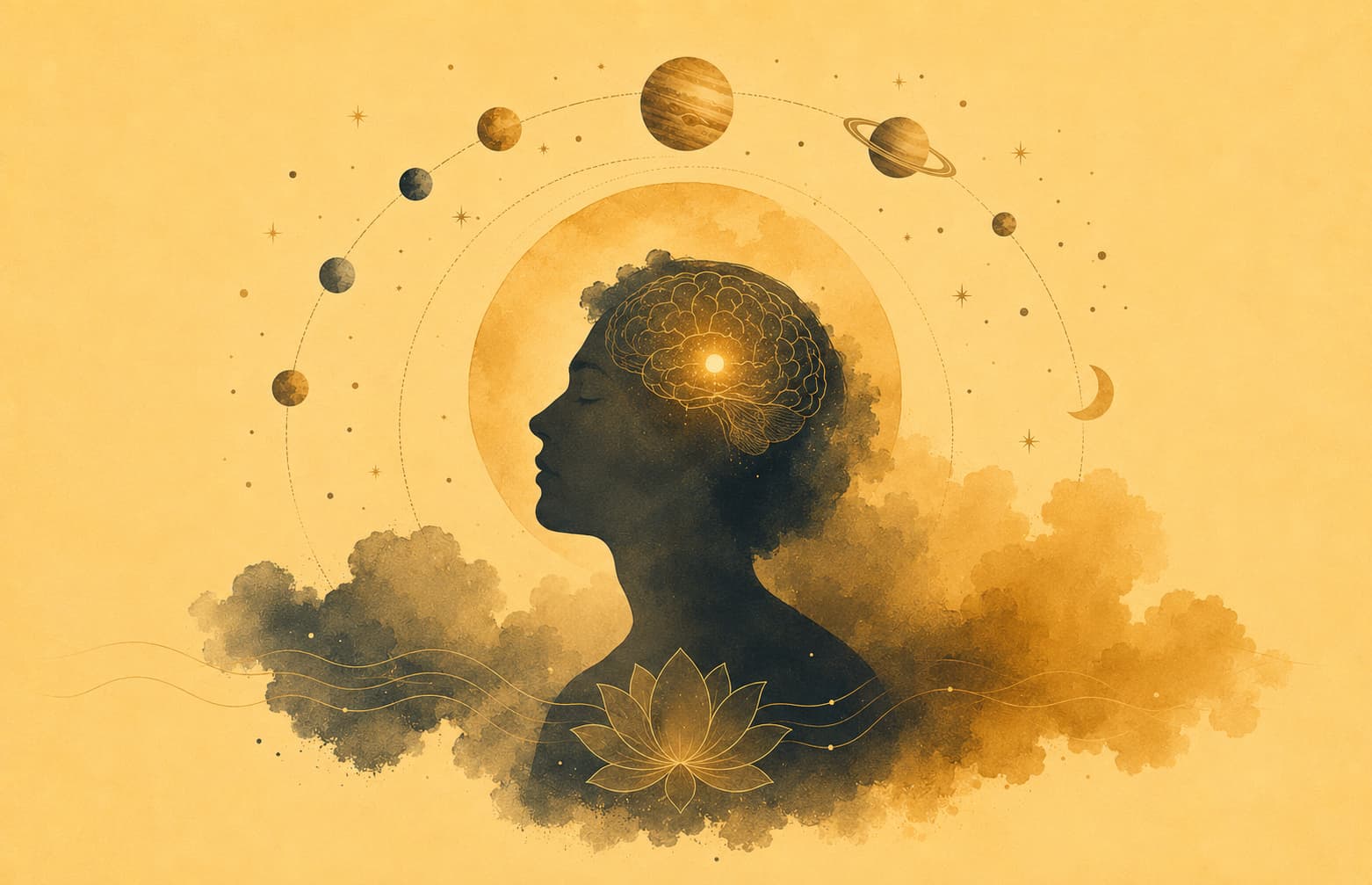
Sociopathy and Psychopathy in Vedic Astrology: Chart Signs of Zero Empathy
Discover how Vedic astrology interprets sociopathy and psychopathy via afflicted 4th house, combust Moon-Mercury, Saturn-Mars conjunctions and damaged emotional axis in the birth chart. Clear, traditional analysis for serious students of Jyotisha.
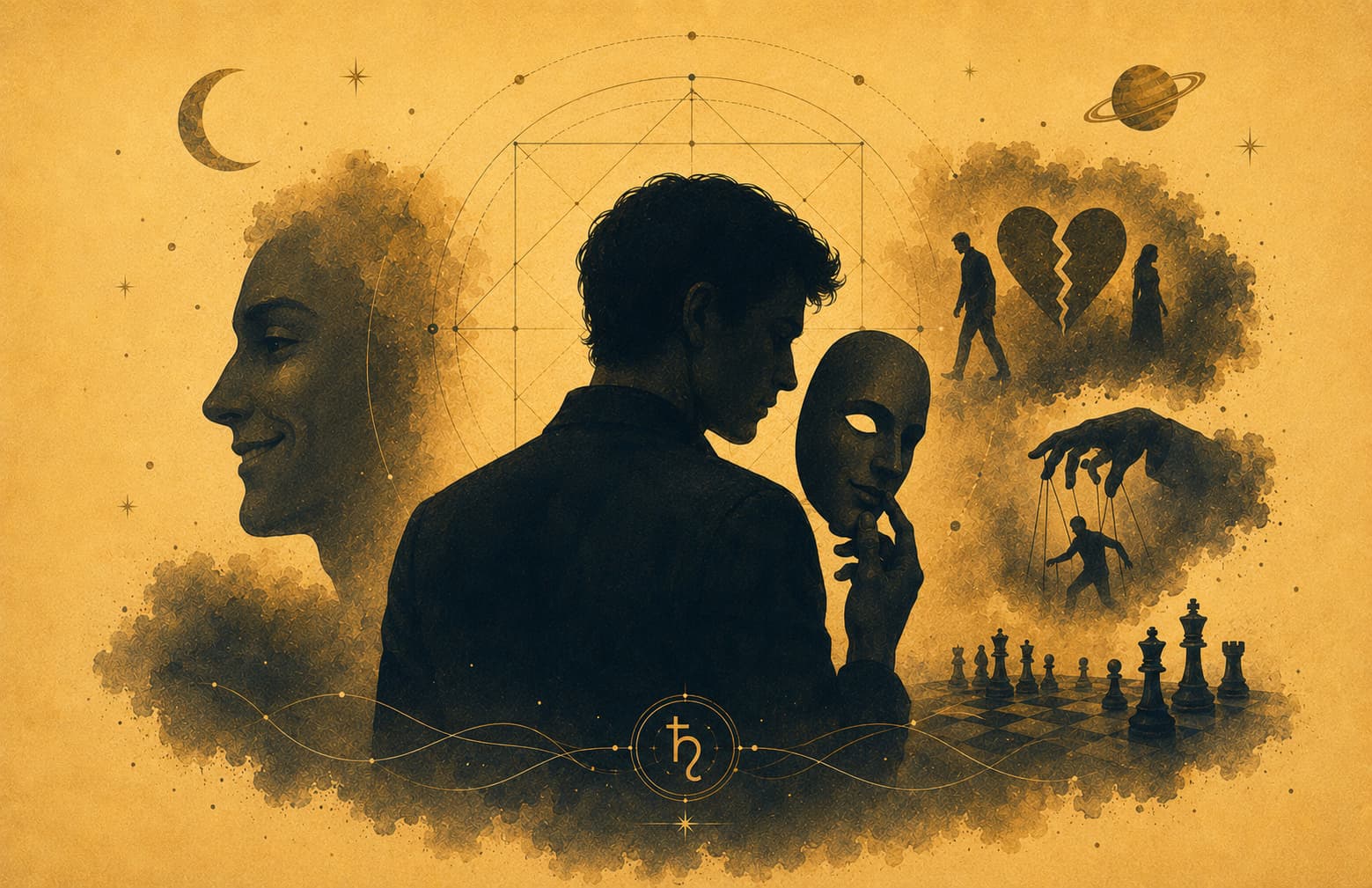
Some people move through life without the ordinary brakes of guilt, warmth or second thought. They can hurt others, manipulate situations or remain indifferent to suffering while appearing calm, logical or even charming. Modern psychology labels extreme forms of this pattern as psychopathy or sociopathy. In everyday language people simply say the person has no heart, no conscience or is cold-blooded.
Vedic astrology, or Jyotisha, does not use these modern clinical terms. Yet classical texts and the living interpretive tradition have long described chart combinations that coincide with emotional numbness, absence of remorse, ruthless calculation and a striking lack of genuine empathy. The most consistent indicators centre on a heavily afflicted 4th house that receives no benefic aspect, combustion of the Moon or Mercury, tight Saturn-Mars conjunctions placed in cardinal houses, and a damaged Moon-Mercury axis.
The planetary mechanics behind this theme are developed further in Gulika and Mandi.
This article examines these indicators in depth. It explains what each factor signifies, how they interact, which modifying conditions can soften or intensify the pattern, and why a single placement never tells the whole story. The discussion remains educational and traditional. It does not diagnose any living person, nor does it claim that astrology replaces psychological or medical evaluation.
Quick Key Takeaways
- The 4th house represents the heart, emotional foundation, inner peace and capacity for genuine feeling. When it is severely afflicted and receives zero benefic aspect, emotional warmth can remain undeveloped.
- Combustion of the Moon or Mercury weakens the capacity to process feelings and to communicate them with sensitivity.
- A tight Saturn-Mars conjunction in a cardinal house (1, 4, 7 or 10) often produces cold determination, suppressed anger and a readiness to act without soft emotional restraint.
- The Moon-Mercury axis governs emotional intelligence. When both are damaged by malefics, combustion or severe affliction, the natural bridge between feeling and thought can break.
- These factors gain force only when they operate together and when the rest of the chart offers little counterbalancing support from Jupiter, Venus or a strong Lagna lord.
- Complete-chart analysis, including Navamsha, dashas and current transits, remains essential. Isolated combinations never determine character with certainty.
Meaning of Sociopathy and Psychopathy in Everyday and Clinical Language
Before turning to the birth chart, a short clarification of terms helps. Psychopathy is generally understood as a personality pattern marked by shallow affect, lack of remorse, grandiosity, superficial charm and a readiness to exploit others without guilt. Sociopathy is often described as a similar pattern that arises more from environmental factors and may still show some capacity for attachment to a narrow group. Both involve profound deficits in empathy and conscience.
In ordinary speech people use the words more loosely for anyone who appears emotionally cold, calculating or unmoved by the pain of others. Jyotisha does not diagnose these conditions. It observes planetary patterns that traditionally correspond to emotional detachment, hardness of heart, suppressed conscience and a preference for strategy over feeling. The language of the classical texts speaks of cruelty (krura), hardness (kathina), absence of compassion (nirdaya) and a mind that does not soften.
The astrologer’s task is therefore not to label a person but to understand the planetary logic that may support such an expression and to note the conditions that can redirect it toward constructive discipline, strategic skill or even spiritual detachment.
The 4th House: Seat of Emotion, Heart and Inner Foundation
In Vedic astrology the 4th house is called Sukha Bhava or Matru Bhava. It rules the mother, early emotional environment, home, inner peace, vehicles, property and, most relevant here, the heart and the capacity for genuine feeling. Classical writers associate a strong and well-aspected 4th house with contentment, emotional stability and the ability to feel connected to others.
When the 4th house is heavily afflicted and receives no benefic aspect, the emotional foundation itself can remain underdeveloped. Affliction means occupation or strong aspect by natural malefics such as Saturn, Mars, Rahu, Ketu or a functionally malefic planet for the Lagna. Zero benefic aspect means that Jupiter, Venus or a well-placed Mercury do not cast their glance on the 4th house or its lord. In such cases the chart may show a person who finds emotional warmth difficult to access or express.
The 4th lord’s condition is equally important. If the 4th lord is combust, debilitated, hemmed by malefics or placed in a dusthana (6th, 8th or 12th house) without cancellation, the capacity for soft feeling is further reduced. In practical observation, individuals with such configurations often describe an early environment that felt emotionally barren or overly controlled. The chart does not create the environment, yet it describes the native’s internal response to it.
A hypothetical illustration helps. Suppose Cancer Lagna with Moon (Lagna lord and 4th lord) placed in the 8th house in Aquarius, aspected only by Saturn and receiving no benefic glance. The 4th house itself is occupied by Mars and receives the aspect of Rahu. Emotional security and open-hearted warmth are unlikely to be the native’s natural mode. The person may still function efficiently in the outer world, yet the inner emotional thermostat remains set very low.
Combustion of Moon and Mercury: Weakened Mind and Feeling
Combustion, or Asta, occurs when a planet comes too close to the Sun and loses independent strength. The classical threshold for the Moon is generally within 12 degrees of the Sun; for Mercury it is within 14 degrees, though some traditions use slightly different orbs. A combust Moon struggles to reflect emotional light. A combust Mercury struggles to process and express thought with nuance and empathy.
When both luminaries are combust or when one is combust and the other is heavily afflicted, the natural dialogue between feeling (Moon) and discrimination (Mercury) becomes strained. The person may intellectualise emotion, dismiss it as weakness, or simply fail to register it in real time. In extreme cases the chart supports a pattern in which the native can plan and execute actions while remaining largely untouched by the emotional consequences for others.
Combustion does not automatically produce cruelty. A combust Moon can also indicate a person who seeks emotional clarity through detachment or spiritual practice. The difference lies in the supporting factors. When combustion combines with an afflicted 4th house, malefic aspects to the Moon-Mercury axis and a hard Saturn-Mars combination, the likelihood of emotional coldness rises.
Saturn-Mars Conjunction in Cardinal Houses: Cold Determination and Suppressed Heat
Saturn represents coldness, delay, discipline, restriction and the capacity to endure hardship without complaint. Mars represents heat, aggression, initiative, courage and the capacity to act decisively. When these two planets form a tight conjunction (generally within 8–10 degrees, tighter when under 5 degrees), their natures modify each other. The heat of Mars is cooled and channelled by Saturn; the cold of Saturn is given force and direction by Mars.
In cardinal houses the combination becomes particularly potent. Cardinal houses (1st, 4th, 7th and 10th) are angular and therefore strong by house strength. A Saturn-Mars conjunction in the 1st house can produce a personality that appears hard, controlled and capable of decisive action without emotional hesitation. In the 4th house the same combination can freeze the emotional centre while giving the native the endurance to pursue long-range goals. In the 7th house it may show cold calculation in partnerships. In the 10th house it often supports ruthless professional drive.
Classical texts note that Saturn-Mars combinations can produce both great endurance and potential for cruelty, depending on the rest of the chart. When the conjunction is free of benefic influence and the 4th house is already weak, the pattern frequently coincides with an absence of soft emotional restraint. The native may experience anger as a cold, controlled force rather than an explosive heat, which can make the behaviour appear more calculated.
It is important to distinguish this from ordinary ambition or toughness. Many successful military leaders, surgeons, judges and crisis managers carry strong Saturn-Mars combinations and use them constructively. The difference appears when empathy circuits are simultaneously compromised by the other factors discussed in this article.
The Damaged Moon-Mercury Axis: Broken Bridge Between Feeling and Thought
The Moon and Mercury together form the core of emotional intelligence in the chart. The Moon receives impressions and generates feeling. Mercury analyses, names and communicates those impressions. When the axis between them is damaged, the translation process fails.
Damage can occur in several ways:
- Both planets combust or under severe solar affliction.
- Mutual aspect or conjunction of strong malefics (especially Saturn, Mars, Rahu).
- Placement of one or both in dusthanas without cancellation.
- Severe affliction to their dispositors.
- Occupation of inimical signs with no relief.
In such charts the native may report that they understand emotion intellectually yet do not feel it in the body, or that they feel something vague yet cannot name or express it accurately. Over time this gap can widen into a consistent pattern of emotional non-recognition. Other people experience the native as cold, mechanical or lacking in genuine response.
A damaged Moon-Mercury axis does not equal clinical psychopathy. It can also appear in highly analytical personalities, certain forms of neurodivergence, or individuals who have trained themselves into extreme emotional control for professional reasons. Context and the remainder of the chart decide the expression.
This same symbolism can affect inner life in ways examined in mental health and Vedic astrology.
How These Factors Interact in the Complete Chart
Isolated afflictions rarely produce extreme patterns. The combinations become significant when several of the following conditions occur together:
- The 4th house is occupied or strongly aspected by malefics and receives no aspect from Jupiter, Venus or a strong Mercury.
- The 4th lord is weak, combust, debilitated or placed in a difficult house.
- Moon or Mercury (or both) is combust or heavily afflicted.
- A tight Saturn-Mars conjunction occupies a cardinal house and is free of benefic influence.
- The Moon-Mercury axis is further damaged by Rahu, Ketu or additional malefic pressure.
- The Lagna and Lagna lord offer little counterbalancing warmth or ethical restraint (for example, a weak Jupiter or Venus that cannot function as a natural benefic).
- Supporting factors such as a strong 6th or 8th house emphasis, or dashas of the afflicted planets, activate the pattern during key life periods.
When most of these conditions are present, the chart may describe a person whose emotional thermostat is set very low and whose conscience does not generate the ordinary internal signals of remorse. The native can still be highly intelligent, organised and successful in worldly terms. The difficulty lies in the missing emotional feedback loop.
Positive or Constructive Possibilities
Even severe combinations are not solely negative. Traditional Jyotisha always looks for the higher expression of the same planetary energy.
A person with a cold 4th house and strong Saturn-Mars may develop extraordinary endurance, the ability to remain calm in crisis, and a talent for strategic thinking that is not clouded by sentiment. In professions that require emotional detachment (surgery, certain forms of law, military command, high-stakes negotiation, forensic analysis) these qualities can be assets.
A combust Moon, when supported by spiritual practice or a strong 12th house, can indicate genuine vairagya (dispassion) rather than pathological coldness. The same planetary pattern that produces indifference to ordinary human drama can, under different life conditions, support deep meditation or philosophical detachment.
The key is whether the native has any pathway, through education, mentors, spiritual practice or conscious effort, to develop a functional ethical framework even if spontaneous empathy remains limited. Charts that contain at least one strong benefic influence or a well-placed Jupiter often show this possibility.
Challenges and Imbalanced Expressions
When the pattern is strongly activated and receives little relief, the difficulties can include:
- Persistent emotional numbness or inability to form deep attachments.
- Readiness to use people as instruments without internal conflict.
- Absence of remorse after causing harm.
- Superficial charm that serves strategic rather than relational purposes.
- Difficulty recognising the emotional reality of others.
- Preference for control, calculation and long-range planning over spontaneous warmth.
These expressions are more likely during the dashas and antardashas of the afflicted planets, especially when transits of Saturn, Rahu or Mars reinforce the natal pattern. The complete chart must still be examined. A strong Lagna lord, a well-placed Jupiter or significant benefic influence in the Navamsha can moderate the outer expression even when the Rashi chart looks severe.
Factors That Modify the Result
Several classical and practical factors can strengthen, weaken or redirect the pattern:
- Benefic aspects or conjunctions: Even a single aspect from Jupiter or Venus to the 4th house, Moon or Mercury can introduce a measure of softening.
- Cancellation of combustion: If the combust planet is also in its own or exaltation sign, or receives strong benefic aspect, the damage is reduced.
- Dignity of the planets: Saturn or Mars in own sign, exaltation or friendly sign may express the conjunction as disciplined force rather than pure coldness.
- Navamsha and other divisional charts: A more balanced emotional picture in the Navamsha can indicate that the coldness is not the deepest layer of the personality.
- Dasha sequence: Early life dashas of soft planets may allow some emotional development before harder periods activate.
- Current Gochar: Transits that temporarily relieve the 4th house or Moon can create windows of greater feeling.
- Functional nature: For certain Lagnas, Saturn or Mars may function as yogakaraka and therefore carry more constructive potential.
No single factor cancels the entire pattern, yet each can shift the probability and the outer expression.
How to Examine These Indicators in a Birth Chart
A practical sequence for the student or consulting astrologer:
- Note the sign and any planets in the 4th house. Record all aspects to the 4th house and its lord.
- Assess the strength and dignity of the 4th lord. Check combustion, debilitation, planetary war and house placement.
- Examine the Moon’s degree relative to the Sun. Note any combustion and all aspects or conjunctions to the Moon.
- Do the same for Mercury.
- Locate any Saturn-Mars conjunction. Measure the orb. Note the house and sign. Record aspects received by the conjunction.
- Evaluate the Moon-Mercury relationship: mutual aspect, conjunction, common dispositor, or mutual affliction.
- Check the overall strength of Jupiter and Venus as natural indicators of compassion and harmony.
- Review the Navamsha for the same planets and houses.
- Note the current or upcoming dashas that activate the relevant planets or houses.
- Form a tentative synthesis only after all the above steps, keeping probability language and acknowledging that environment and free will still operate.
This sequence prevents over-interpretation of any single factor.
Common Misconceptions
Several popular ideas need correction:
- “Any Saturn-Mars conjunction means a psychopath.” This is false. The conjunction appears in many ordinary and highly constructive charts. Context decides.
- “A weak Moon always produces emotional coldness.” A weak Moon can also produce sensitivity, anxiety or emotional volatility. Coldness requires additional hard factors.
- “Combust planets are always destructive.” Combustion reduces independent strength; it does not automatically create cruelty.
- “The 4th house alone determines empathy.” Empathy involves the Moon, Mercury, Jupiter, the 4th and 5th houses, and the overall chart tone.
- “Astrology can diagnose clinical psychopathy.” It cannot. Clinical diagnosis belongs to trained mental-health professionals. Astrology describes planetary patterns that may coincide with certain behavioural tendencies.
Traditional Remedies and Practical Guidance
Remedies in Jyotisha are offered as traditional spiritual and behavioural practices, not guaranteed cures. For patterns involving emotional coldness the classical approach emphasises cultivation of the opposite qualities rather than fear-based rituals.
Useful traditional suggestions include:
- Regular recitation of mantras associated with the Moon (for example, the Chandra Beej mantra) and Mercury, performed with attention and correct pronunciation, preferably under guidance.
- Acts of service directed toward mothers, children, the elderly or animals, which traditionally strengthen the 4th house significations.
- Cultivation of simple daily emotional awareness practices: noting physical sensations that accompany decisions, journaling without self-judgement, or spending quiet time in natural settings.
- Charity on Mondays or Wednesdays, or offering white or green items according to the native’s tradition.
- Respectful study of texts or teachings that emphasise compassion, even if the native approaches them intellectually at first.
- Strengthening the Lagna and Lagna lord through appropriate lifestyle discipline, because a stronger sense of self often supports clearer ethical boundaries.
Gemstones, elaborate yajnas or severe fasting should never be recommended casually. Suitability depends on the complete chart, the native’s health and circumstances, and ideally the guidance of an experienced astrologer who has examined the full Kundli.
Most important is the recognition that conscious effort, education and supportive relationships can modify the expression of even difficult planetary patterns. Astrology describes tendencies; it does not lock a person into a fixed character.
Conclusion
Extreme emotional coldness, absence of remorse and the clinical patterns labelled sociopathy or psychopathy find clear correspondences in Vedic astrology through a severely afflicted 4th house without benefic relief, combustion of the Moon or Mercury, tight Saturn-Mars conjunctions in angular houses, and a damaged Moon-Mercury axis. These factors gain significance when they operate together and when the remainder of the chart offers little counterbalancing warmth or ethical restraint.
Readers following this theme into intimacy and partnership may also recognize codependency and narcissist-empath dynamics.
Yet no combination is absolute. Dignity, aspects, divisional charts, dashas, transits and the native’s own efforts all participate in the final expression. The responsible use of Jyotisha in this area is therefore descriptive rather than deterministic, educational rather than diagnostic, and always subordinate to the complete picture of the birth chart.
Students and practitioners who approach these patterns with care, technical accuracy and respect for the complexity of human character will find that the classical indicators remain useful tools for understanding, without sliding into fear or over-simplification.
Frequently Asked Questions
Can a single placement show psychopathy in the chart? No. Extreme patterns require multiple reinforcing factors, especially involving the 4th house, Moon, Mercury and hard Saturn-Mars combinations. One placement alone is never sufficient.
Does a strong Saturn-Mars conjunction always make a person cruel? No. The same combination can produce discipline, endurance, strategic skill and the ability to remain calm under pressure. Cruelty appears only when empathy-related factors are simultaneously compromised.
Is a combust Moon a sign of emotional emptiness? Combustion weakens the Moon’s independent expression. It can indicate difficulty accessing or expressing feeling, yet many other factors decide whether the result is emptiness, controlled detachment or spiritual dispassion.
How important is the Navamsha in assessing emotional coldness? Very important. A more balanced picture in the Navamsha often shows that the coldness visible in the Rashi chart is not the deepest layer of the personality and may be modifiable.
Can remedies completely remove these tendencies? Traditional remedies are offered as supportive practices that strengthen constructive planetary expressions. They do not guarantee transformation of character. Consistent ethical effort, self-reflection and, when needed, professional psychological support remain essential.
This becomes clearer when placed beside the planetary analysis in the Sun and Moon in Jyotish.
Should these combinations be discussed with clients who show them? Only with great care, using probability language, emphasising free will and the complete chart, and never in a way that labels the person as fixed or hopeless. The focus should remain on understanding tendencies and possible constructive channels.
Do modern psychological diagnoses map exactly onto classical planetary combinations? No. Classical Jyotisha developed its own language for hardness of heart, absence of compassion and emotional numbness. Modern clinical categories are useful for medical and therapeutic purposes but should not be forced onto the older system.
Is it possible for someone with these chart factors to develop genuine empathy later in life? Yes. Charts that contain at least some benefic influence, supportive dashas later in life, or strong spiritual indicators often show the capacity for growth. Conscious effort and favourable environmental conditions play a significant role.
About the author
Anika Rao
Editor-in-Chief
Anika Rao is the editor-in-chief of Vedic Astrology Space. Her work brings classical Jyotish into conversation with relationships, identity, emotional life and the questions people carry into a modern chart reading. She is especially interested in nakshatras, the Moon, relational patterns and interpretations that create self-understanding without reducing a person to a placement.
Read the full bioContinue reading
Celebrity Obsession in Vedic Astrology Explained
Combinations for Addiction in Vedic Astrology: Alcohol, Smoking, Drugs and More