Vedic Astrology Causes of Impotence, Erectile Dysfunction and Unexplained Infertility
Explore traditional Vedic astrology views on impotence, erectile dysfunction and unexplained infertility. Understand Mars, Venus, 5th and 8th house influences plus practical chart factors and remedies.
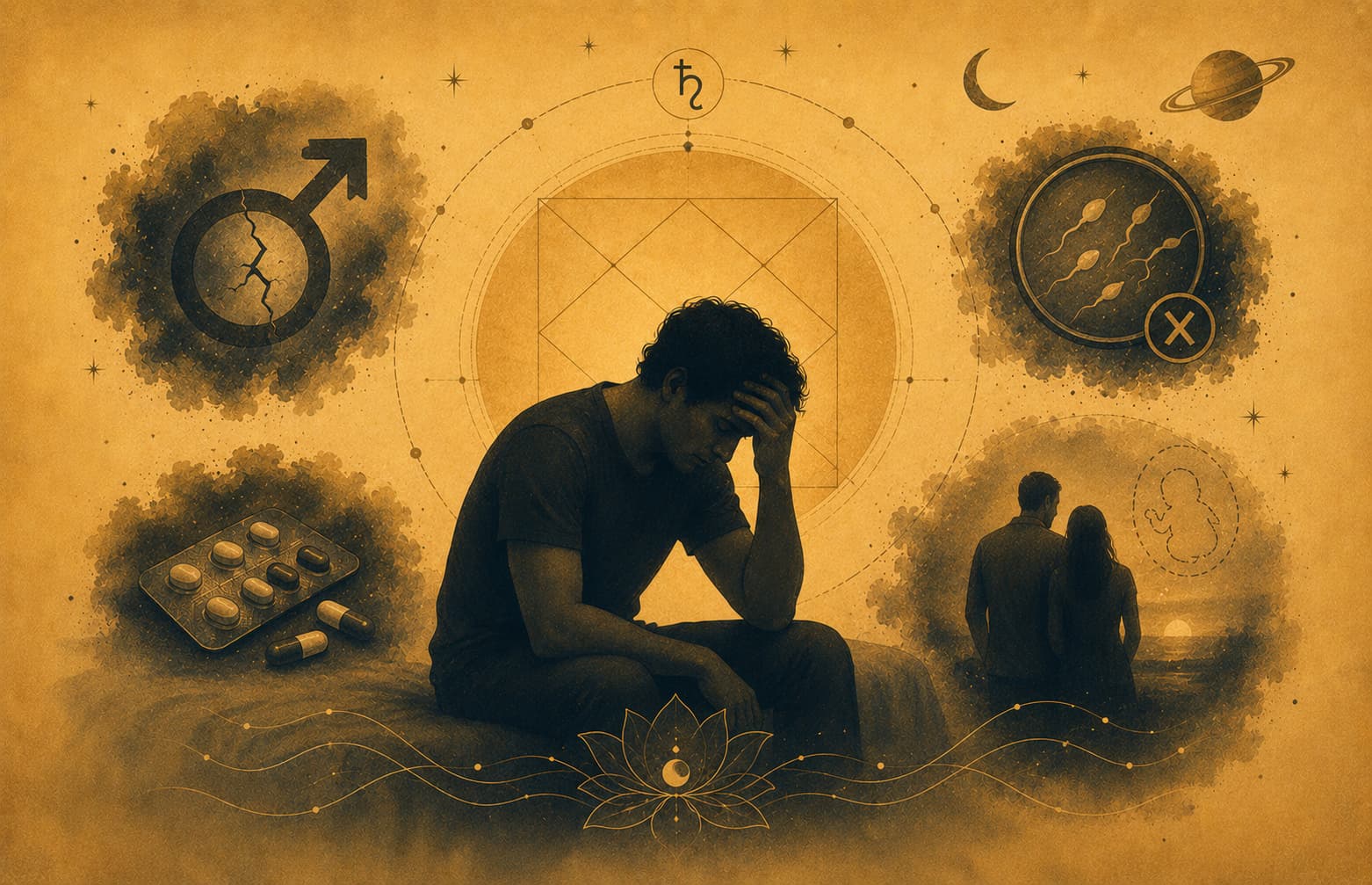
Many men quietly carry a heavy sense of inadequacy when their body does not respond the way they expect during intimate moments. Performance anxiety, erectile difficulties, premature ejaculation or the inability to conceive despite normal medical reports can create deep private distress. In Indian cultural settings this distress often mixes with unspoken expectations around masculinity, family continuity and personal dignity. Vedic astrology, known as Jyotisha, offers one traditional lens for understanding such experiences. It does not replace medical diagnosis or treatment. Instead it looks at planetary patterns that classical texts associate with vitality, reproductive tissue and the capacity for progeny.
This article explains the main astrological factors that traditional Jyotisha links to these concerns. The focus stays on Mars as significator of potency and semen strength, Venus as significator of reproductive fluids known as Shukra Dhatu, and the condition of the 5th and 8th houses in a male chart. You will see how afflictions, combustion, aspects and dasha periods may shape the expression of these themes. Every interpretation remains probability based. A complete birth chart, current dashas and medical advice together form a more balanced approach than any single placement.
Quick Takeaways
- Mars governs physical strength, sexual energy and the quality of semen. When heavily afflicted by Saturn or Ketu it may correspond to reduced vitality or delayed response.
- Venus rules reproductive tissue and the fluid essence called Shukra Dhatu. Combustion or severe affliction can weaken its constructive expression.
- The 5th house speaks of progeny and creative potency. The 8th house relates to chronic or hidden reproductive concerns and the longevity of sexual capacity.
- Afflictions alone never determine an outcome. Strength of the lagna, dignity of the house lords, supporting aspects, navamsha placements and the running dasha all modify results.
- Traditional remedies focus on lifestyle discipline, mantra, charity and ethical conduct. They are supportive practices, not guaranteed solutions.
- Always consult a qualified medical professional for symptoms. Astrology remains an interpretive tradition, not a diagnostic system.
Meaning and Basic Concept of Reproductive Indicators in Jyotisha
In classical Jyotisha the body is understood through a network of planetary significations and house rulerships. Sexual vitality and the capacity to father children belong to a cluster of factors rather than one isolated planet. Mars, known as Mangala or Kuja, carries the fire of initiative, muscular strength and the assertive force needed for physical union. Classical writers connect Mars with the production and quality of semen. Venus, known as Shukra, governs the refined essence of bodily fluids, attractiveness and the pleasure principle. Shukra Dhatu refers to the reproductive tissue that supports fertility and sexual response.
The 5th house, putra bhava, covers children, creative output and the mental desire for progeny. The 8th house, ayur bhava or randhra bhava, deals with longevity, chronic conditions, hidden processes and the deeper reserves of vitality. When these houses or their lords face repeated pressure from malefic planets, traditional interpretation notes possible difficulties in the areas they rule.
These associations appear across several classical and later commentarial traditions. They are not presented as medical diagnoses. They form part of a symbolic language that links planetary condition with lived experience. A chart showing pressure on these factors does not mean the person is destined to suffer. It indicates areas that may require greater care, medical attention and conscious effort during certain periods.
Astrological Significance of Mars in Relation to Potency
Mars rules the signs of Aries and Scorpio. It is exalted in Capricorn and debilitated in Cancer. Its natural temperament is fiery, sharp and assertive. In the body it corresponds to blood, muscles, bone marrow and the active force behind sexual function. When Mars is strong by sign, house and aspect it supports confidence, stamina and the ability to initiate and sustain physical intimacy.
Affliction of Mars commonly arises through conjunction or aspect from Saturn or Ketu. Saturn brings restriction, coldness, delay and a sense of heaviness. Ketu introduces detachment, sudden fluctuations and a scattered quality. When either planet closely influences Mars, traditional texts note possible reduction in the free flow of vital energy. The person may experience hesitation, performance anxiety or a gap between desire and physical response.
Other factors matter. Mars in its own sign or exaltation recovers more easily from mild affliction. Mars in a friendly sign with benefic aspects retains constructive capacity. Mars in the 6th, 8th or 12th house faces additional environmental pressure. The dispositor of Mars, that is the lord of the sign it occupies, also influences the final expression. A strong dispositor can cushion difficult aspects.
In male charts Mars additionally links to the left side of the body and to the quality of reproductive fluid. Classical writers sometimes describe an afflicted Mars as producing thin or insufficient semen. Modern readers should treat such statements as traditional symbolic language rather than laboratory findings. Medical testing remains essential for any actual concern about semen parameters.
Venus, Shukra Dhatu and Reproductive Tissue
Venus rules Taurus and Libra. It is exalted in Pisces and debilitated in Virgo. Its nature is refined, moisture giving and connective. In the bodily system Venus corresponds to the reproductive fluids, the capacity for pleasure and the harmonious flow of intimacy. Shukra Dhatu is the term used in Ayurvedic and astrological literature for the essence that supports fertility and sexual vitality.
When Venus suffers combustion, meaning it comes within a close degree range of the Sun, its independent expression weakens. The planet is said to be “ashta” or burned. In practice this can correspond to reduced moisture, diminished pleasure response or difficulty in sustaining intimate connection. Combustion is temporary in transit but permanent if present in the natal chart. The exact degree of separation and the sign involved modify the intensity.
Other afflictions include conjunction with Saturn, Rahu or Ketu, or placement in enemy signs without benefic support. Venus in the 6th, 8th or 12th house may face environmental strain. The 7th house, which Venus naturally influences through relationships, also matters. A heavily afflicted 7th lord or Venus can colour the entire experience of partnership and physical closeness.
The same combination can take another relational form in transactional relationships and sugar dynamics.
Venus also governs the right side of the reproductive system in some traditional descriptions. When both Mars and Venus face simultaneous pressure, classical interpretation notes greater likelihood of combined vitality and fluid related concerns. Again, the full chart decides the actual expression.
The 5th House and Progeny Themes
The 5th house stands for children, intelligence, creative projects and the mental readiness for parenthood. Its karaka or natural significator is Jupiter. In matters of fertility the 5th house shows the promise of progeny. The condition of the 5th lord, planets placed in the 5th, and aspects to the 5th house all contribute to the reading.
When the 5th house receives repeated malefic influence without benefic cancellation, traditional texts speak of obstacles to the birth of children. These obstacles may appear as delayed conception, medical complications or, in some cases, unexplained infertility after thorough medical investigation. The 5th house also reflects the psychological desire for children. Affliction here can coincide with performance anxiety rooted in fear of failing to fulfil family expectations.
Important modifying factors include the strength of Jupiter, the condition of the 5th lord in the navamsha, and the running dasha of the 5th lord or Jupiter. A strong Jupiter can protect the 5th house even when other planets create pressure. The presence of benefic aspects from Jupiter or Venus often softens difficult placements.
The 8th House and Chronic or Hidden Reproductive Concerns
The 8th house rules longevity, inheritance, chronic conditions, surgery and processes that remain partially hidden from ordinary view. In reproductive matters it relates to the deeper reserves of sexual vitality and to conditions that develop slowly or resist easy diagnosis. Classical writers associate the 8th house with the reproductive organs in a structural sense and with the endurance of sexual capacity over time.
Malefic planets in the 8th, or the 8th lord under heavy affliction, may correspond to lingering difficulties rather than sudden events. Saturn in the 8th can bring dryness or delayed response. Rahu or Ketu in the 8th may introduce sudden fluctuations or a sense of disconnection from bodily signals. Mars in the 8th can create intense but unstable energy that sometimes turns against itself.
The 8th house also links to the partner’s reproductive capacity in some interpretive traditions, because it is the 2nd house from the 7th. When both partners show 8th house pressure, traditional analysis notes possible combined challenges that require careful medical and supportive attention.
How Afflictions Are Identified in Practice
Astrologers examine several layers. First comes the natal placement of Mars and Venus by sign, house and nakshatra. Next comes the presence of combustion, retrogression or close conjunctions. Planetary aspects, especially the special aspects of Mars, Saturn and Jupiter, receive close attention. The dignity of the house lords of the 5th and 8th is checked in both the rashi chart and the navamsha.
Shadbala or other strength measurements help quantify whether a planet can express its nature effectively. The current mahadasha and antardasha reveal when latent patterns may become more noticeable. Transits of Saturn, Rahu or Ketu over natal Mars, Venus or the 5th and 8th houses can temporarily intensify existing themes.
A practical sequence many practitioners follow is:
- Assess the lagna and lagna lord for overall vitality.
- Examine Mars for potency indicators.
- Examine Venus for fluid and pleasure indicators.
- Study the 5th house and its lord for progeny promise.
- Study the 8th house and its lord for chronic or structural themes.
- Check navamsha placements of the same factors.
- Note the running dasha and major transits.
- Look for cancellation or protective yogas that reduce difficulty.
No single step is sufficient. The interaction of all these layers produces the final interpretive picture.
Positive or Constructive Possibilities
Even charts with visible pressure can show constructive outcomes. A strong lagna lord often protects general health. Benefic aspects from Jupiter can restore confidence and support medical recovery. Venus in a friendly sign with good dignity may preserve emotional connection even when physical response fluctuates. Mars in its own sign or exaltation recovers more readily from temporary afflictions.
Some individuals channel the intensity of an afflicted Mars into disciplined physical training, martial arts or focused professional effort. Others develop deeper emotional maturity through the challenges indicated by an 8th house emphasis. The same planetary pressure that creates difficulty in one area of life can produce resilience and insight in another.
When the 5th house receives later benefic support through dasha or transit, conception becomes more likely for many couples who have faced earlier delays. Traditional interpretation therefore always leaves room for improvement through time, medical care and conscious effort.
Challenges and Imbalanced Expressions
When protective factors are weak, the traditional literature notes several possible expressions. Mars under Saturn’s influence may correspond to delayed arousal or reduced stamina. Mars under Ketu’s influence may correspond to sudden loss of interest or a sense of detachment during intimacy. Venus in combustion may coincide with diminished pleasure response or dryness. Heavy 5th house affliction may appear as prolonged difficulty in conceiving despite medical normalcy. 8th house pressure may show as chronic low grade concerns that require ongoing attention.
Performance anxiety itself often has a mixed origin. Planetary patterns may create a predisposition, while cultural expectations, past experiences and current stress amplify the psychological component. Jyotisha does not separate the physical and mental layers completely. Both remain part of the same interpretive field.
It is essential to remember that these are traditional associations, not medical certainties. Many men with challenging placements function well. Many men with strong placements still face temporary difficulties. The chart shows tendencies, not fixed destiny.
Factors That Change the Results
Several elements can strengthen or weaken the expression of difficult combinations.
- Dignity of the planet: own sign, exaltation or friendly sign improves resilience.
- Benefic aspects: Jupiter or strong Venus aspects often protect.
- Cancellation of debilitation or neecha bhanga raja yoga can reverse weakness.
- Strong lagna and lagna lord support overall vitality.
- Navamsha strength of Mars, Venus and the relevant house lords.
- Running dasha of a well placed planet can bring improvement.
- Supportive transits of Jupiter over the 5th or 8th can ease pressure.
- Lifestyle factors, medical treatment and emotional support remain outside the chart yet strongly influence outcomes.
A planet that looks weak in the rashi chart may recover in the navamsha. Conversely a planet that looks strong in the rashi chart may lose power in the divisional charts. Experienced practitioners therefore examine multiple layers before forming an opinion.
How to Examine These Themes in a Birth Chart
Begin with the lagna. A strong lagna and lagna lord provide the foundation for physical confidence. Next locate Mars. Note its sign, house, aspects and any conjunction with Saturn or Ketu. Measure its distance from the Sun to check combustion. Then locate Venus and repeat the same checks. Study the 5th house: planets placed there, the 5th lord’s condition, and aspects. Study the 8th house in the same way.
Readers following this theme into intimacy and partnership may also recognize secret paternity and hidden family lineages.
Move to the navamsha. Check where Mars and Venus fall and whether the 5th and 8th lords gain or lose dignity. Note the current mahadasha. If the dasha lord is Mars, Venus, the 5th lord or the 8th lord, the themes become more active. Observe major transits of Saturn and the nodes over these points.
A hypothetical example may illustrate the method. Suppose a male chart has lagna in Virgo, Mars in Capricorn in the 5th house conjunct Saturn, and Venus in Leo within five degrees of the Sun. Traditional reading would note strong Mars by exaltation yet simultaneous Saturn pressure and 5th house involvement. Venus suffers mild combustion. The combination suggests possible performance related tension and delayed progeny themes. Yet if Jupiter aspects the 5th house and the navamsha shows Mars in its own sign, the difficulties remain manageable with medical support and conscious effort. The example is purely illustrative. Real charts require individual analysis.
A closely related partnership pattern is explored in childfree living and delayed parenthood.
Common Misconceptions
One frequent misconception is that a single planet determines sexual function. In reality multiple factors interact. Another misconception is that affliction equals permanent damage. Many charts show temporary activation during certain dashas followed by recovery. A third misconception treats astrology as a substitute for medical investigation. Jyotisha can highlight areas of sensitivity. It cannot measure hormone levels or detect structural issues.
Some readers fear that any mention of Saturn or Ketu means irreversible loss. Classical texts themselves describe periods of difficulty followed by improvement when protective factors operate. Others believe that gemstones or expensive rituals alone can resolve the matter. Traditional practice emphasises ethical conduct, disciplined living and medical care alongside any spiritual practice.
Finally, the presence of difficult combinations does not reflect moral failure or past life punishment in a simplistic sense. Karmic language in Jyotisha points to patterns that can be understood and worked with, not to permanent condemnation.
Traditional Remedies and Practical Guidance
Remedies in Jyotisha are supportive practices, never guaranteed cures. They aim to strengthen the constructive qualities of the relevant planets and to cultivate mental steadiness.
For Mars related concerns traditional suggestions include regular physical discipline, service to those who work with tools or land, and the recitation of the Mangala mantra with proper guidance. Charity of red items or support to causes that protect the vulnerable can also form part of the practice. For Venus, practices that cultivate harmony, artistic expression and care for relationships are emphasised. Simple acts of cleanliness, moderation in sensory enjoyment and respect for the principle of balance support Venusian themes.
General practices that help many people include consistent sleep, balanced diet, reduction of excessive stimulants, and open communication with a trusted partner. Medical consultation remains the first practical step for any persistent symptom. Spiritual practices such as meditation or quiet reflection can reduce the anxiety that often amplifies physical difficulty.
Gemstone recommendations, if considered at all, require full chart analysis and should never replace medical treatment. Severe fasting or extreme austerities are not advised for anyone dealing with health concerns. The most reliable traditional remedies remain those that improve daily discipline, ethical behaviour and mental clarity.
Conclusion
Vedic astrology offers a detailed symbolic language for understanding patterns connected with potency, reproductive tissue and the capacity for progeny. Mars, Venus, the 5th house and the 8th house form the core of this language in male charts. Afflictions by Saturn or Ketu, combustion of Venus, and pressure on the relevant houses may correspond to the experiences many men describe as performance anxiety, erectile difficulty or unexplained infertility. Yet these associations remain interpretive. They gain meaning only within the complete chart, the running dashas and the living context of medical care and personal effort.
A closely related partnership pattern is explored in sexuality, hypersexuality and asexuality.
No placement condemns a person to permanent difficulty. Protective factors, time, treatment and conscious living frequently improve the situation. Readers who recognise these themes in their charts are encouraged to seek qualified medical advice first and to approach astrological insight as one additional layer of understanding. The goal is greater self knowledge and practical support, not fear or self blame.
Frequently Asked Questions
Does an afflicted Mars always cause erectile dysfunction? No. An afflicted Mars indicates a possible area of sensitivity. Many other chart factors, current dashas, lifestyle and medical conditions determine the actual experience. Strong protective influences often prevent or reduce difficulty.
Can Venus combustion alone explain infertility? Venus combustion weakens the expression of reproductive fluid significations in traditional terms. It is rarely the sole cause. The 5th house, Jupiter, the 8th house and overall chart strength must also be examined.
Is unexplained infertility always shown in the 5th house? The 5th house is central to progeny themes, yet the 9th house, Jupiter, the 2nd house from the 7th and the condition of both partners’ charts also contribute. Unexplained cases still require thorough medical investigation.
Do Saturn periods always worsen these issues? Saturn periods can intensify existing patterns of restriction or delay. If Saturn is well placed or receives benefic support, the same period may bring discipline and gradual improvement rather than deterioration.
Are there specific nakshatras linked to these concerns? Certain nakshatras ruled by Mars, Saturn or Ketu may colour the expression when they contain the relevant planets. The full planetary condition remains more important than nakshatra alone.
Should I stop medical treatment if my chart looks difficult? Never. Astrology does not replace medical care. Any persistent symptom requires professional medical evaluation and appropriate treatment.
Can remedies completely remove the problem? Traditional remedies support constructive planetary expression and mental steadiness. They are not medical cures. Results vary and depend on many factors including consistent practice and overall chart strength.
Is performance anxiety purely psychological according to Jyotisha? Jyotisha views body and mind as interconnected. Planetary patterns may create predisposition while stress, expectation and past experience shape the psychological layer. Both aspects deserve attention.
Sources Consulted: Traditional interpretive frameworks drawn from standard Jyotisha teaching on planetary karakatwas, house meanings and affliction principles. No single commercial website was treated as final authority.
Disclaimer: This article presents traditional Vedic astrology perspectives for educational purposes only and does not constitute medical advice; readers experiencing symptoms should consult qualified healthcare professionals.
About the author
Anika Rao
Editor-in-Chief
Anika Rao is the editor-in-chief of Vedic Astrology Space. Her work brings classical Jyotish into conversation with relationships, identity, emotional life and the questions people carry into a modern chart reading. She is especially interested in nakshatras, the Moon, relational patterns and interpretations that create self-understanding without reducing a person to a placement.
Read the full bioContinue reading

Celebrity Obsession in Vedic Astrology Explained
Combinations for Addiction in Vedic Astrology: Alcohol, Smoking, Drugs and More