
Polyamory and Open Relationships in Vedic Astrology: Chart Signatures Explained
Explore how Vedic astrology views non-monogamous wiring, open marriages and multi-partner patterns through 7th 8th 12th houses, Venus in dual signs, Rahu Mercury influence and Navamsha signatures.
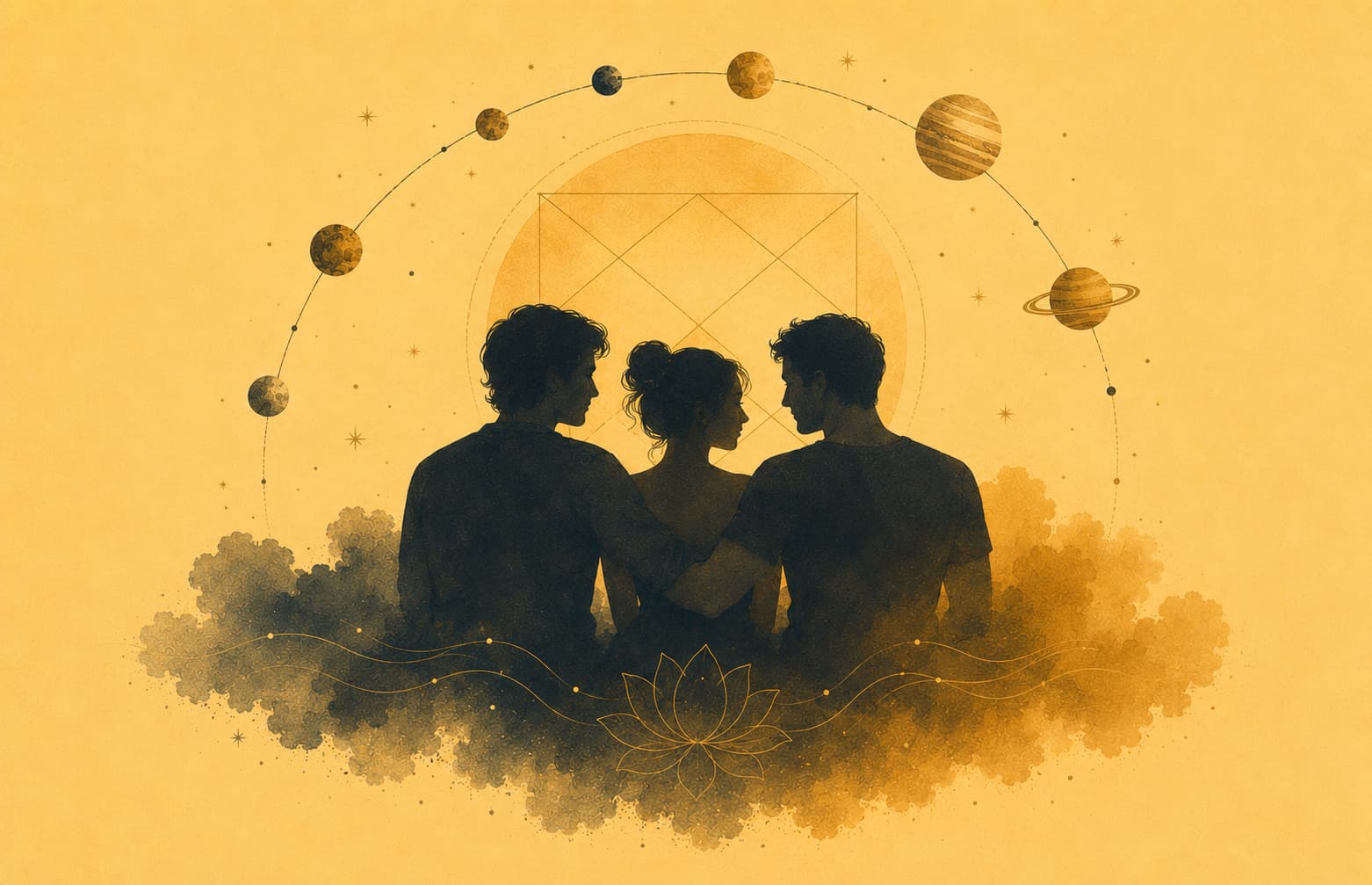
Many people who practise or explore non-monogamy eventually wonder whether their charts reflect a natural inclination toward multiple intimate bonds. Others notice repeated patterns of secrecy, parallel relationships or a strong need for emotional freedom and ask the same question from the opposite direction. Vedic astrology, or Jyotisha, does not prescribe one correct form of partnership. It describes tendencies in the way a person experiences desire, commitment, privacy and shared life. When certain combinations appear, the chart may support greater ease with open structures, multi-partner arrangements or, at times, hidden dynamics that remain outside conventional monogamy.
This article examines those combinations in a practical and traditional framework. We focus on multiple planets in the seventh, eighth and twelfth houses, Venus placed in dual signs especially when influenced by Rahu or Mercury, and the relationship signatures visible in the Navamsha or D9 chart. The goal is not to declare anyone “polyamorous by birth” or to encourage any particular lifestyle. The goal is to show how classical factors of partnership, secrecy and multiplicity can combine, how their results are modified by the rest of the chart, and how an astrologer examines them with care.
A complete birth chart, accurate birth time and careful study of both Rashi and Navamsha remain essential. No single placement decides the entire story of a person’s intimate life.
Key Takeaways
- The seventh house and its lord describe the style of formal partnership. Multiple planets here can multiply the themes of relationship rather than limit them to one person.
- The eighth house brings intensity, shared resources, transformation and sometimes hidden or taboo elements into intimate life.
- The twelfth house relates to privacy, bed pleasures, foreign or unconventional connections and the dissolution of ordinary boundaries.
- Venus in Gemini, Sagittarius or Pisces often carries dual or expansive qualities. When linked with Rahu or Mercury these qualities can become more pronounced.
- The Navamsha shows the deeper pattern of marriage and committed bonds. Non-monogamous signatures frequently appear there even when the main chart looks conventional.
- Results depend on planetary dignity, aspects, functional nature for the Lagna, Dasha periods and the overall strength of the chart.
- Open or multi-partner arrangements can express constructively through honesty and mutual respect, or create difficulty when secrecy and unresolved desire dominate.
- Astrological observation never replaces personal ethics, communication or professional counselling when relationships involve real people.
Understanding Non-Monogamy through the Lens of Jyotisha
In classical Jyotisha the seventh house is the primary house of partnership, marriage and contractual bonds. The eighth house rules shared resources, longevity of the relationship, sudden changes and matters that remain private or transformative. The twelfth house governs losses of a conventional kind, expenditure, foreign lands, moksha-oriented detachment and also the private sphere of sleep and intimacy. When these three houses receive multiple planetary influences, the native’s experience of partnership often expands beyond a single exclusive model.
Venus is the natural karaka for marriage, romance, beauty and sensual pleasure. Its placement in dual signs (Dwiswabhava Rashis) Gemini, Sagittarius and Pisces already suggests a mind that can hold more than one perspective or affection at the same time. Rahu amplifies desire and draws the native toward the unconventional or foreign. Mercury multiplies interests through intellect and communication. Together they can produce a restless or exploratory approach to intimacy.
The Navamsha, or D9 chart, is the primary divisional chart for marriage and the quality of the spouse or spouses. Classical texts emphasise that the promise of the Rashi chart must be confirmed or refined in the Navamsha. When the D9 shows multiple strong influences on the seventh house, Venus or the relevant lagna of the Navamsha, the deeper pattern may support non-exclusive structures even if the main chart appears more conventional.
It is important to remember that Jyotisha describes tendencies, not fixed destinies. A chart that contains these signatures may still produce a lifelong monogamous marriage if other factors, maturity, culture and personal choice intervene. Conversely, a chart without these combinations can still experience open or secret relationships under the influence of Dashas, transits or free will. The astrology of relationship is therefore always probabilistic and contextual.
The Seventh House: Multiplicity in Formal Partnership
The seventh house, known as Kalatra Bhava or the house of the spouse, is the natural opposite of the first house of self. Planets placed here colour the native’s experience of “the other.” When only one planet occupies the seventh, the focus often remains on a primary partner. When two, three or more planets gather in the seventh, the themes of partnership become layered.
A stellium in the seventh does not automatically mean many marriages. It can indicate:
- A partnership that involves several important people over a lifetime.
- A single marriage that itself contains multiple emotional or practical dimensions.
- A strong need for variety and stimulation within the committed bond.
- Professional or social relationships that feel as significant as marriage.
Benefic planets such as Jupiter or a well-placed Venus in the seventh can support open communication and ethical non-monogamy. Malefic planets or afflicted lords may produce secrecy, power struggles or repeated dissolution of bonds. The condition of the seventh lord is equally important. If the seventh lord is itself placed in a dual sign or conjunct Rahu or Mercury, the multiplicity theme strengthens.
Consider a hypothetical chart with Sun, Mercury and Venus in the seventh house in Gemini. The native may experience relationships as a continuous conversation involving more than one person. The presence of the Sun can bring ego investment, Mercury adds intellectual curiosity, and Venus supplies affection. Whether this expresses as sequential partners, concurrent ethical relationships or hidden affairs depends on the eighth and twelfth houses, the Navamsha and the running Dasha.
The Eighth House: Intensity, Secrecy and Shared Transformation
The eighth house is traditionally associated with longevity, inheritance, occult knowledge, sudden events and the private dimensions of sexuality. In relationship astrology it often shows how partners share resources, face crisis together and navigate the taboo or unspoken. Multiple planets in the eighth can create a life in which intimate bonds are never ordinary.
Planets here may indicate:
- Relationships that involve deep psychological transformation.
- Financial or emotional entanglement that goes beyond surface partnership.
- Attraction to partners who carry secrets or unconventional histories.
- Periods of crisis that force renegotiation of relationship agreements.
When the eighth house contains Venus or the seventh lord, the private sexual and emotional life becomes central. Rahu in the eighth frequently draws the native toward experiences that society labels extreme or hidden. Ketu in the eighth can produce detachment from conventional marital expectations. Mars or Saturn in the eighth may introduce intensity that feels controlling or restrictive unless consciously channelled.
The eighth house also rules research, therapy and shared investigation. Some natives with strong eighth-house influence find that open relationship structures become a form of mutual study of desire and attachment rather than simple multiplication of partners. Others experience the same placements as repeated cycles of secret involvement followed by exposure and crisis. The difference often lies in the dignity of the planets and the presence of supporting Jupiter or a strong Lagna lord.
The Twelfth House: Privacy, Foreign Connections and Dissolution of Boundaries
The twelfth house is the house of loss, expenditure, foreign residence, hospitals, ashrams and the bed. In classical texts it is also linked with the private pleasures of sleep and intimacy. Multiple planets in the twelfth frequently produce a life in which important relationships occur outside the public eye or across cultural boundaries.
Key themes include:
- Attraction to partners from different countries, cultures or social backgrounds.
- Relationships conducted in private or through long-distance communication.
- A need for solitude even within partnership.
- Expenditure of emotional or financial energy on more than one bond.
- Spiritual or escapist approaches to intimacy.
Venus in the twelfth can indicate secret love or love that remains unfulfilled in conventional terms. The seventh lord in the twelfth may show a spouse who is foreign, frequently travelling or somehow “lost” to ordinary social visibility. Rahu in the twelfth amplifies the desire for experiences that transcend ordinary limits. When several planets gather here, the native may feel that ordinary monogamy cannot contain the full range of their emotional or sensual life.
The twelfth house also dissolves. A strong twelfth can therefore support the conscious release of possessive attachment, which is one psychological foundation of ethical non-monogamy. The same placement, when afflicted, can produce self-sabotage, addiction or relationships that drain rather than nourish.
Venus in Dual Signs: Gemini, Sagittarius and Pisces
Venus is the primary significator of romantic and marital happiness. Its placement in a dual sign already suggests a capacity to hold more than one affection or perspective. The three dual signs each add a distinct flavour.
Venus in Gemini Gemini is ruled by Mercury and is an airy, intellectual, communicative sign. Venus here seeks variety in conversation, mental stimulation and light-hearted exchange. The native may form attachments based on shared ideas and may find exclusive emotional intensity restrictive. When Mercury is strong or conjunct, the desire for multiple conversational and romantic connections increases. Rahu with Venus in Gemini can produce restless searching for new mental and sensual experiences, sometimes across social boundaries.
Venus in Sagittarius Sagittarius is ruled by Jupiter and is fiery, expansive and freedom-loving. Venus here seeks growth, adventure and philosophical alignment in love. The native may feel confined by a partnership that does not allow personal expansion or travel. Multiple planets influencing this Venus can support open structures in which each partner retains autonomy and continues individual exploration. Affliction can produce impulsiveness or a tendency to idealise freedom at the expense of commitment.
Venus in Pisces Pisces is ruled by Jupiter in classical assignment and is watery, compassionate and boundless. Venus here experiences love as a dissolving of separate identities. The native may feel natural empathy for more than one person and may struggle with the concept of exclusive ownership of affection. When supported by benefic aspects this can become genuine inclusive love. When afflicted by Rahu or Saturn it may produce confusion, idealisation or sacrificial patterns that leave the native depleted.
In all three cases the presence of Rahu intensifies the unconventional quality. Rahu with Venus is classically associated with strong desire, attraction to the foreign or forbidden, and a tendency to seek experiences outside the ordinary. Mercury with Venus multiplies the number of interests and the need for intellectual exchange within intimacy. The combination of dual-sign Venus plus Rahu or Mercury is therefore one of the clearer signatures for non-monogamous wiring, provided the rest of the chart supports it.
Rahu and Mercury as Amplifiers of Multiplicity
Rahu is the north node of the Moon and represents amplification, obsession, foreign influence and the breaking of conventional limits. In relationship matters Rahu can produce:
- Attraction to partners who are culturally, socially or geographically distant.
- Desire that feels larger than ordinary social permission.
- A tendency to live outside the expected timeline or structure of marriage.
- Periods of sudden involvement that disrupt existing arrangements.
When Rahu aspects or conjoins the seventh house, seventh lord or Venus, the native’s experience of partnership often includes elements that society labels unconventional. This does not automatically produce polyamory. It can equally produce secret affairs, delayed marriage, foreign marriage or a marriage that itself feels foreign to the native’s family background. The ethical or secret expression depends on other factors, especially the twelfth house and the Navamsha.
Mercury, as the planet of intellect, communication and multiplicity, supports the mental capacity to manage more than one relationship. Mercury with Venus or the seventh lord can indicate a person who processes intimacy through conversation and who can maintain several emotional threads simultaneously. When Mercury is strong and well-aspected this can support transparent open relationships. When Mercury is afflicted it can produce rationalisation, scattered attention or superficial connections.
The combination of Rahu and Mercury with Venus or the relationship houses is particularly potent for multi-partner patterns because it joins amplification of desire with the intellectual tools to navigate complexity.
The same combination can take another relational form in jealousy, possessiveness and controlling behavior.
Non-Monogamous Signatures in the Navamsha (D9)
The Navamsha is the most important divisional chart for marriage and the quality of committed relationship. Classical authorities state that the Rashi chart shows the promise and the Navamsha shows the actualisation. A chart that looks monogamous in the main Rashi may reveal multiplicity once the D9 is examined, and the reverse is also true.
Key Navamsha indicators include:
- Multiple planets in the seventh house of the Navamsha.
- Venus in a dual sign in the Navamsha, especially if influenced by Rahu or Mercury.
- The Navamsha lagna or its lord placed in a dual sign or aspected by several planets.
- The seventh lord of the Rashi chart placed in a dual Navamsha or conjunct multiple planets in D9.
- Strong influence of the eighth or twelfth house lords on the Navamsha seventh or Venus.
When the Navamsha seventh house contains three or more planets, the deeper pattern of partnership is rarely simple. The native may experience successive marriages, concurrent bonds that feel equally significant, or a single marriage that itself contains multiple layers of intimacy and responsibility. The dignity of those planets and the condition of the Navamsha lagna determine whether the experience is enriching or chaotic.
A practical method for examination is to note the Rashi seventh lord and then observe its Navamsha placement, aspects and conjunctions. If that planet sits in Gemini, Sagittarius or Pisces in D9 and receives the aspect of Rahu or Mercury, the non-monogamous theme is strengthened even if the main chart appears conventional.
Constructive Expressions of Non-Monogamous Patterns
When the relevant planets are strong by dignity, receive benefic aspects and operate under supportive Dashas, the same combinations can support ethical, communicative and mutually respectful open structures. Possible constructive outcomes include:
- Clear agreements that protect the emotional security of all involved.
- Capacity for honest conversation about desire and boundaries.
- Ability to sustain deep affection for more than one person without deception.
- Relationships that expand rather than diminish the native’s sense of self.
- Integration of freedom and commitment without chronic conflict.
Jupiter’s aspect on the seventh house, Venus or the relevant dual-sign placements is often a stabilising factor. A strong Lagna lord that can manage complexity also helps. When the eighth house is involved constructively, the partners may use the intensity for mutual growth rather than crisis. When the twelfth house is involved constructively, the native may cultivate genuine non-attachment and compassion.
These constructive expressions still require personal maturity, communication skill and ethical clarity. Astrology shows the tendency. Character and choice determine the outcome.
Challenging or Imbalanced Expressions
The same planetary combinations can produce difficulty when planets are weak, afflicted or operating under challenging Dashas. Common challenging patterns include:
- Secret relationships that create ongoing anxiety and eventual exposure.
- Repeated cycles of intense involvement followed by sudden endings.
- Difficulty sustaining any long-term bond because novelty is constantly sought.
- Power imbalances, jealousy or control issues that remain unspoken.
- Emotional or financial drain from multiple unresolved connections.
- Conflict between personal desire and family or social expectations.
Rahu’s influence can amplify obsession or the feeling that ordinary rules do not apply. An afflicted Venus can produce idealisation followed by disappointment. Multiple planets in the eighth without supporting strength can turn intimacy into a site of crisis rather than nourishment. The twelfth house, when heavily occupied by malefics, can produce escapism or relationships that remain permanently unintegrated into ordinary life.
None of these outcomes is inevitable. They represent possibilities that become more likely when the chart factors align in a particular way and when the native has not yet developed conscious relationship skills.
Factors That Modify the Results
Several classical factors can strengthen, weaken or redirect the non-monogamous signatures:
- Dignity of the planets. Exalted, own-sign or friendly-sign placements support constructive expression. Debilitated or enemy-sign placements increase friction.
- Functional nature for the Lagna. A planet that is a yoga-karaka or natural benefic for the Ascendant will express more helpfully than a functional malefic.
- Aspects and conjunctions. Benefic aspects from Jupiter or a strong Moon stabilise. Malefic aspects from Saturn, Mars or an afflicted Rahu increase challenge.
- Condition of the Moon. The Moon shows the emotional capacity to handle complexity. A strong Moon supports emotional honesty. A weak or afflicted Moon can produce anxiety or mood-driven decisions.
- Dasha and Antardasha. Even a clear signature remains latent until activated by the relevant planetary periods.
- Transit support or pressure. Saturn or Rahu transiting the seventh, eighth or twelfth can bring the themes into active experience.
- Overall chart strength. A strong Lagna and Lagna lord give the native greater capacity to manage complexity consciously.
- Cultural and personal context. Family background, education and personal values shape how the native interprets and expresses the same planetary pattern.
No single factor decides the outcome. The art of interpretation lies in weighing these elements together.
How to Examine These Patterns in a Birth Chart
A practical sequence for analysis is as follows:
- Note the planets occupying the seventh, eighth and twelfth houses in the Rashi chart. Count how many and assess their dignity and aspects.
- Examine the seventh lord: its sign, house, aspects and conjunctions.
- Locate Venus: its sign, house, aspects and any connection with Rahu or Mercury.
- Check whether Venus or the seventh lord occupies a dual sign.
- Cast the Navamsha and repeat the examination of the seventh house, Venus and relevant lords in D9.
- Assess the strength of the Lagna and Moon for emotional and practical capacity.
- Note current and upcoming Dashas that involve the relevant planets or houses.
- Consider the overall cultural and personal context of the native.
Only after this complete review is it reasonable to speak about non-monogamous tendencies. Isolated observation of one placement is never sufficient.
Common Misconceptions
Several misconceptions frequently appear in discussions of this topic.
Misconception 1: Multiple planets in the seventh house always mean many marriages. Reality: They multiply the themes of partnership. The actual number of formal marriages depends on many other factors including the eighth house, Dashas and personal choice.
Misconception 2: Venus in a dual sign guarantees polyamory. Reality: It indicates a capacity for dual or expansive affection. Expression depends on the rest of the chart and on maturity.
Misconception 3: Rahu with Venus always produces secret affairs. Reality: Rahu amplifies desire and the unconventional. The result can be open ethical non-monogamy, foreign marriage, delayed commitment or secret involvement depending on supporting factors.
Misconception 4: A “polyamorous chart” cannot sustain a monogamous marriage. Reality: Many people with these signatures choose and sustain monogamy successfully, especially when Jupiter or a strong Lagna lord supports commitment.
Misconception 5: Astrology can decide whether open relationships are right or wrong for a person. Reality: Astrology describes tendencies. Ethical decisions belong to the people involved.
Misconception 6: The Navamsha is optional for relationship analysis. Reality: Classical tradition treats the Navamsha as essential for marriage and committed partnership.
Practical Guidance and Traditional Perspectives
Jyotisha does not offer a standard set of remedies for non-monogamous patterns because the patterns themselves are not considered doshas in the classical sense. What the tradition does emphasise is the cultivation of the constructive qualities of the relevant planets.
For Venus-related themes: practices that increase clarity, honesty and aesthetic refinement rather than excess. Simple acts of charity, care for relationships already present, and honest self-reflection are traditionally valued.
For Rahu-related restlessness: grounding practices, service, and clear communication that reduces the need for secrecy.
For Mercury-related multiplicity: disciplined study and clear speech that prevent scattered attention.
For eighth and twelfth house intensity: practices that transform private energy into constructive channels, whether through study, service or spiritual discipline according to the native’s tradition.
None of these practices is a guarantee. They are traditional ways of working with the planetary energies already present. Professional counselling, clear agreements and mutual respect remain essential whenever real relationships are involved.
The wellbeing dimension of this combination is considered more carefully in mental health and Vedic astrology.
Conclusion
Vedic astrology offers a nuanced language for understanding why some people experience partnership as a single exclusive bond while others experience it as a field of multiple, concurrent or sequential connections. Multiple planets in the seventh, eighth and twelfth houses, Venus in dual signs especially when linked with Rahu or Mercury, and corresponding signatures in the Navamsha form a coherent set of indicators for non-monogamous wiring. These indicators describe tendencies, not destinies. Their constructive or challenging expression depends on planetary dignity, aspects, Dashas, the strength of the Lagna and Moon, and the ethical choices of the native.
A closely related partnership pattern is explored in ghosting, catfishing and situationships.
The chart does not judge. It simply shows the architecture of desire, privacy and commitment. When that architecture includes multiplicity, the task of the individual is to bring awareness, honesty and care to whatever form of relationship they choose. A complete birth chart examined with traditional methods remains the only reliable foundation for such understanding.
Frequently Asked Questions
1. Does a stellium in the seventh house mean I will have multiple marriages? Not necessarily. Multiple planets in the seventh multiply the themes of partnership. The actual number of formal marriages depends on the condition of the seventh lord, the eighth house, Dashas and personal decisions. Many people with such placements experience one complex marriage that itself contains several dimensions.
2. Can Venus in Gemini or Pisces alone indicate polyamory? Venus in a dual sign shows a capacity for dual or expansive affection. Alone it is not sufficient. Confirmation from the seventh house, Rahu or Mercury influence, and the Navamsha is needed before speaking of a clear non-monogamous pattern.
3. What is the role of the Navamsha in identifying open relationship patterns? The Navamsha reveals the deeper pattern of committed relationship. Even if the main Rashi chart looks conventional, multiple planets in the D9 seventh house or Venus in a dual Navamsha with Rahu or Mercury influence can indicate non-exclusive tendencies at a foundational level.
Readers following this theme into intimacy and partnership may also recognize transactional relationships and sugar dynamics.
4. Is Rahu with Venus always a sign of secret affairs? Rahu amplifies desire and draws toward the unconventional. The result can be secret involvement, open ethical non-monogamy, foreign marriage or delayed commitment. The twelfth house, eighth house and overall chart strength determine the expression.
5. Can someone with these chart signatures still have a successful monogamous marriage? Yes. Many people with non-monogamous signatures choose and sustain monogamy, especially when Jupiter aspects the relevant houses or planets and when the Lagna lord is strong enough to manage complexity through conscious commitment.
6. Do current transits matter more than the natal chart for relationship style? Transits and Dashas activate natal potential. A natal chart without the relevant signatures is unlikely to produce sustained multi-partner patterns merely from transits. The natal foundation remains primary.
7. Should I change my relationship style because of my chart? Astrology describes tendencies. Decisions about relationship structure belong to the people involved and should be based on mutual consent, communication and ethical clarity rather than chart readings alone.
8. Is there a classical text that directly discusses polyamory? Classical Jyotisha texts discuss multiple marriages, secret relationships, foreign partners and the quality of the seventh house and Venus. Modern language such as “polyamory” or “open relationship” is recent. The traditional factors remain the same and can be applied carefully to contemporary relationship forms.
This same symbolism can affect inner life in ways examined in fertility and sexual health indicators.
Relationship structure and sexual orientation are distinct themes; LGBTQ+ orientation and relationship signatures examines the latter on its own terms.
About the author
Anika Rao
Editor-in-Chief
Anika Rao is the editor-in-chief of Vedic Astrology Space. Her work brings classical Jyotish into conversation with relationships, identity, emotional life and the questions people carry into a modern chart reading. She is especially interested in nakshatras, the Moon, relational patterns and interpretations that create self-understanding without reducing a person to a placement.
Read the full bioContinue reading
Friendship Breakups and Betrayal in Vedic Astrology: 3rd & 11th House Insights

Childfree by Choice or Delayed Parenthood in Vedic Astrology