
Trauma Bonding and Stockholm Syndrome in Vedic Astrology
Explore trauma bonding and Stockholm syndrome through Vedic astrology. Learn how intense Rahu-Ketu synastry, 8th house fear-intimacy patterns and afflicted 5th house placements may relate to irrational attachments to destructive partners.
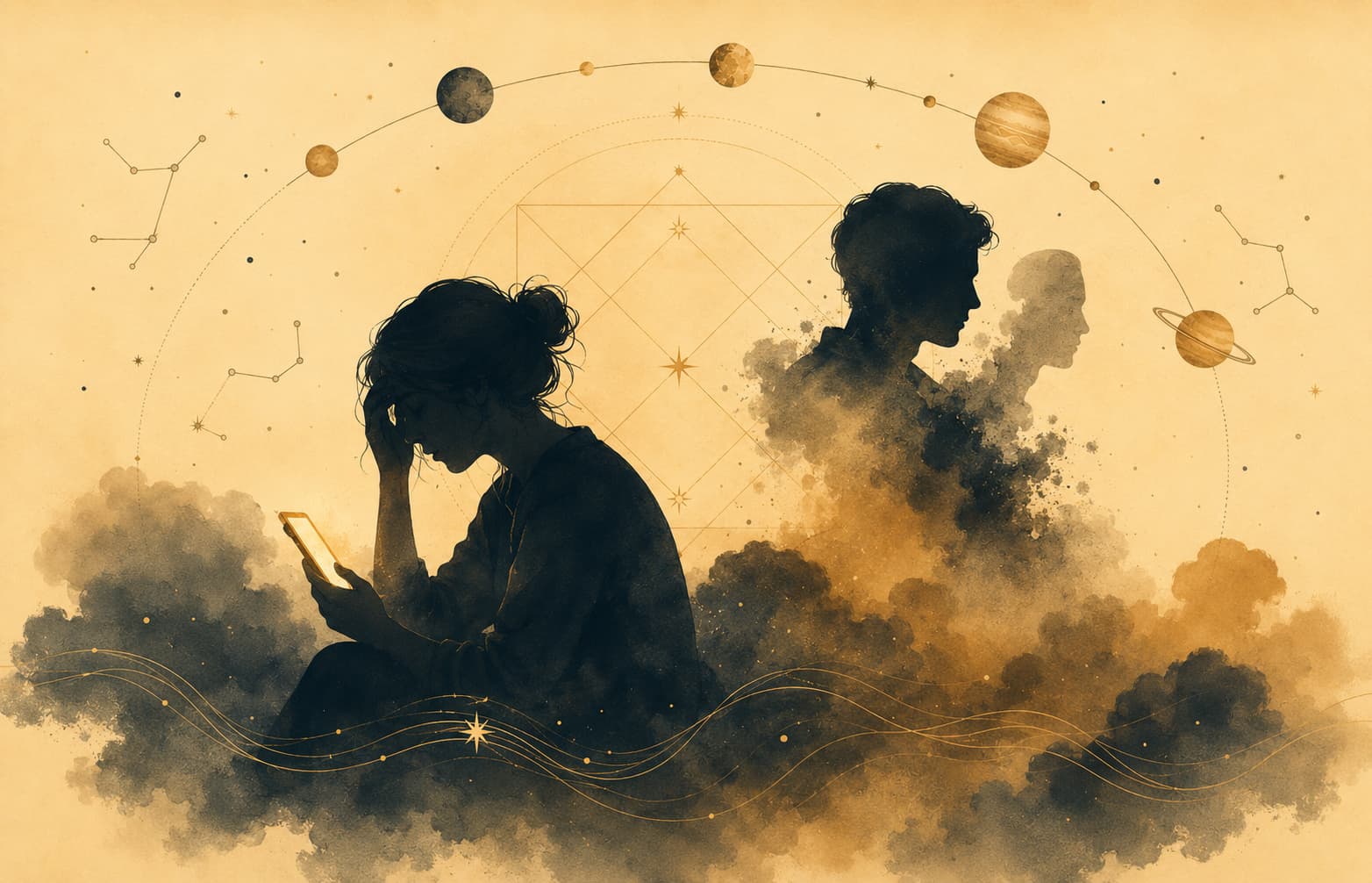
Many people notice a puzzling pattern in their relationships. They feel deeply attached to someone who causes repeated emotional pain, yet the idea of leaving feels almost impossible. The attachment continues even when logic, friends and past experience all point toward separation. Modern psychology describes this as trauma bonding or, in more extreme cases of captivity, Stockholm syndrome. In Vedic astrology these experiences are not treated as random. They are examined through specific planetary combinations, house activations and nodal dynamics that can intensify the fusion of fear and intimacy.
This article explores how classical Jyotisha principles, particularly the Rahu-Ketu axis in synastry, the 8th house of shared vulnerability and an afflicted 5th house of judgment, may relate to such patterns. The discussion remains within the interpretive framework of Vedic astrology. It does not claim that any placement forces a person into harmful relationships, nor does it replace professional psychological support. A complete birth chart, current dashas and the lived maturity of the individuals always shape the final picture.
The emotional and behavioral expression of this pattern is explored further in burnout and emotional collapse.
Key Takeaways
- Trauma bonding refers to strong emotional attachment that develops under conditions of intermittent reward mixed with fear or control. Stockholm syndrome is a more extreme form observed in some captivity situations.
- In Vedic astrology the Rahu-Ketu axis often features in intense synastry overlays that can create magnetic yet destabilising connections.
- The 8th house rules shared resources, secrets, transformation and the place where intimacy and vulnerability meet. When heavily activated or afflicted it may coincide with bonds that feel both necessary and frightening.
- The 5th house governs romance, creative intelligence and the capacity for clear judgment in matters of the heart. Malefic influence here can weaken discernment and increase susceptibility to idealisation or confusion.
- No single placement creates a trauma bond. The full chart, dashas, aspects, dignity and the condition of relevant house lords must be examined together.
- Awareness of these patterns can support greater self-understanding. Traditional remedies and practical steps are offered as supportive practices, not guaranteed solutions.
- Professional counselling or support services remain essential whenever a relationship involves ongoing harm.
Understanding Trauma Bonding, Stockholm Syndrome and Psychological Captivity
Trauma bonding develops when a relationship alternates between periods of warmth or relief and periods of criticism, withdrawal or control. The brain begins to associate the source of pain with the source of comfort. Over time the attachment deepens even as the cost rises. Stockholm syndrome describes a related but more extreme dynamic in which a captive develops positive feelings toward a captor. Psychological captivity is a broader term for situations in which a person feels emotionally or mentally unable to leave a destructive dynamic, even when external freedom exists.
These concepts belong to modern psychology. Vedic astrology does not use the same vocabulary. Yet Jyotisha has long recognised that certain planetary configurations can intensify emotional entanglement, obscure clear perception and fuse fear with desire. The task of the astrologer is to observe the classical factors and then translate their traditional meanings into language that helps the present-day reader recognise patterns.
The three areas that most frequently appear in such discussions are the Rahu-Ketu axis, the 8th house and the 5th house. Each carries its own classical significations. When they interact strongly, especially across two charts in synastry, the emotional field can become unusually charged.
The Rahu-Ketu Axis and Intense Emotional Entanglement
Rahu and Ketu are the lunar nodes. They are not physical planets but mathematical points where the Moon’s path intersects the ecliptic. In classical Jyotisha they represent the axis of desire and detachment, obsession and release, material hunger and spiritual insight. Rahu amplifies, magnifies and creates craving. Ketu severs, internalises and produces sudden insights or sudden losses.
In synastry, the comparison of two birth charts, an intense Rahu-Ketu overlay occurs when one person’s Rahu or Ketu falls on a sensitive point of the other person’s chart, particularly the Moon, Ascendant, Venus, 7th house or 8th house. The contact can feel fated, magnetic and difficult to ignore. The relationship may begin with a sense of recognition or destiny. Over time the same contact can produce cycles of idealisation followed by disillusionment, or attachment followed by a strong urge to escape.
Classical texts describe Rahu as capable of creating illusion and Ketu as capable of creating sudden separation or deep internalisation. When these points link two people strongly, the emotional experience can swing between extremes. One person may feel compelled to stay even while recognising the cost. The other may oscillate between caretaking and withdrawal. The nodal axis does not “cause” trauma bonding. It can, however, intensify the emotional voltage in a way that makes ordinary boundaries harder to maintain.
Astrologers also examine the signs and nakshatras occupied by the nodes, the condition of the node lords, and whether the nodes receive aspects from benefics or malefics. A Rahu-Ketu contact that is supported by Jupiter or Venus may still feel intense yet remain within the realm of growth. The same contact under heavy malefic pressure or during a difficult dasha may coincide with more destabilising experiences.
The 8th House: Where Fear and Intimacy Intertwine
The 8th house is traditionally called Randhra Bhava or the house of longevity, secrets, shared resources, inheritance, transformation and the deeper layers of partnership. It is the house of vulnerability. What is given or taken in the 8th house is rarely light or temporary. Sexual intimacy, financial merging, shared crises and psychological exposure all belong here.
When the 8th house or its lord is heavily activated in a natal chart or in synastry, the relationship can carry a quality of intensity that feels both necessary and dangerous. Partners may share private fears, financial dependence or experiences of crisis that bind them more tightly than ordinary affection would. The classical literature associates the 8th house with both regenerative power and potential for crisis. Modern interpreters sometimes describe 8th-house bonds as places where intimacy and fear become intertwined.
In synastry an 8th-house overlay occurs when one person’s planets fall into the other person’s 8th house, or when the 8th lords aspect each other strongly. The connection may feel transformative. It can also feel consuming. The person whose 8th house is occupied may experience the partner as someone who sees too deeply or who holds too much power over shared resources or emotional safety. The person whose planets occupy the 8th may feel drawn into the other’s hidden world.
An afflicted 8th house, meaning one occupied or aspected by malefics without sufficient benefic support, or whose lord is weak or under pressure, can coincide with patterns in which vulnerability is repeatedly tested. The chart does not dictate that harm will occur. It indicates an area of life that requires greater awareness and careful boundaries.
The Afflicted 5th House and Weakened Discernment
The 5th house governs creative intelligence, romance, children, speculative judgment and the capacity for clear, heartfelt discrimination. It is the house of buddhi in the sense of discerning wisdom applied to matters of the heart and mind. When the 5th house or its lord is under strong malefic influence, the natural ability to weigh emotional choices can become clouded.
Malefic influence may take the form of Saturn, Mars, Rahu or Ketu occupying or aspecting the 5th, or the 5th lord placed in a difficult house, combust, or in enemy sign without cancellation. The result is not automatic poor judgment. Rather, the chart may show a tendency toward idealisation, sudden attraction that bypasses ordinary caution, or difficulty separating genuine connection from intensity for its own sake.
In the context of trauma bonding the afflicted 5th house is relevant because clear discernment is precisely what becomes difficult under conditions of intermittent reward and fear. A person may recognise the pattern intellectually yet struggle to act on that recognition. The 5th house also rules romance and the early stages of attraction. When it is under pressure, the initial magnetic pull can override quieter signals of caution.
Astrologers examine the strength of the 5th lord, its dispositor, aspects from Jupiter or Mercury that can restore clarity, and the condition of the Moon and Venus, the natural significators of emotional and relational life. A strong Jupiter aspect to the 5th or its lord can mitigate some of the confusion. A heavily pressured Mercury may add mental circularity that keeps the person analysing without deciding.
How These Factors Interact in Practice
The most charged patterns often appear when two or more of these factors combine. Consider a hypothetical synastry in which Person A’s Rahu falls on Person B’s Moon in the 8th house, while Person B’s Mars aspects Person A’s 5th house and Venus. The nodal contact creates a sense of fated intensity. The 8th-house Moon brings emotional vulnerability into the shared space. The Mars influence on the 5th and Venus can add both passion and potential for conflict or control. The overall picture may describe a relationship that feels deeply necessary yet repeatedly tests emotional safety.
Readers following this theme into intimacy and partnership may also recognize codependency and narcissist-empath dynamics.
In another hypothetical natal chart the native has Rahu in the 8th house aspecting the 5th lord, while Ketu occupies the 2nd house of values and speech. During a Rahu dasha or a dasha of the 8th lord the person may experience a series of relationships that begin with magnetic attraction and later reveal patterns of control or intermittent closeness. The chart does not guarantee such experiences. It indicates an area of life where the themes of desire, vulnerability and judgment are closely linked and therefore require conscious attention.
These examples are illustrative only. Real charts contain many more factors. The condition of the 7th house and its lord, the strength of Venus, the role of Jupiter as the natural significator of wisdom and the current transits all modify the picture. Dashas activate specific areas at specific times. A difficult combination that remains dormant under a supportive dasha may become more noticeable when the relevant planetary period begins.
Positive and Constructive Possibilities
Even intense nodal or 8th-house configurations can support growth. The same energy that creates entanglement can, when recognised, become a catalyst for deeper self-knowledge. Some individuals with strong 8th-house or nodal patterns develop exceptional capacity for psychological insight, crisis counselling or transformative healing work. The experience of intense attachment, once understood, can lead to clearer boundaries and more conscious relationship choices.
A well-supported 5th house, even if previously afflicted, can regain clarity through education, creative practice or the influence of benefic transits and dashas. Jupiter periods often bring opportunities for wiser counsel, whether through a teacher, a therapist or simply greater internal perspective. The classical view is that awareness itself is a form of remedy. When a person begins to see the pattern, the automatic quality of the attachment can loosen.
In some charts the very intensity of the Rahu-Ketu or 8th-house contact pushes the individual toward spiritual inquiry. Ketu’s influence, after the initial detachment pain, can open a path of genuine renunciation of harmful patterns. The same axis that once magnified craving can later support detachment from what no longer serves.
Challenges and Imbalanced Expressions
When the same factors operate without sufficient awareness or support, the challenges become more visible. The person may remain in a relationship long after it has become harmful because the emotional charge feels like love or destiny. Decision-making around the relationship can feel foggy. Friends and family may express concern that the individual dismisses or rationalises. Periods of crisis may be followed by intense reconciliation that resets the cycle rather than ending it.
The activation window for this theme can be refined through Rahu Mahadasha and dominant Rahu behavior.
In synastry the partner whose planets occupy the other’s 8th house or conjunct the nodes may themselves feel pulled into a role of rescuer, controller or the one who holds emotional power. Neither person is simply the “cause.” Both charts participate in the dynamic. The classical approach is to examine both charts and the synastry without assigning moral blame.
An afflicted 5th house can also express as repeated attraction to the same type of intensity, or as difficulty trusting one’s own judgment after previous experiences. The person may swing between over-idealising and sudden rejection, never quite finding stable middle ground.
These possibilities are described in probability language because many other chart factors influence outcomes. A strong Ascendant, supportive Jupiter, or mature handling of previous dashas can reduce the intensity of the pattern. Conversely, concurrent difficult transits or a challenging Antardasha can amplify it.
Factors That Modify the Results
Several classical considerations change how these themes express:
- Dignity and strength of the planets involved. A well-placed Rahu or 8th lord behaves differently from a debilitated or combust one.
- Aspects from benefics, especially Jupiter and Venus, can soften the sharper edges.
- The condition of the Moon, the natural significator of the mind and emotional security.
- Current Mahadasha and Antardasha. The same natal combination may remain relatively quiet under one period and become prominent under another.
- Transit activation. Saturn, Rahu or Ketu transiting the 5th, 7th or 8th houses or their lords can bring the themes into focus.
- Navamsha and other divisional charts. The D-9 chart often shows the deeper quality of relationship experiences.
- Overall chart balance. A chart with strong protective yogas or a resilient Ascendant may handle intensity with greater resilience.
- Individual maturity and external support systems. Astrology describes tendencies. Conscious effort and practical help shape how those tendencies unfold.
No interpretation is complete without examining these modifiers. Isolating one contact or one house and declaring a fixed outcome is not consistent with classical method.
How to Examine These Themes in a Birth Chart
A practical sequence for study might include the following steps. This is not a diagnostic checklist but a way of organising observation.
- Note the positions of Rahu and Ketu by sign, house and nakshatra. Observe any conjunctions or strong aspects to the Moon, Venus, Ascendant or 7th and 8th houses.
- Examine the 8th house: planets occupying it, the condition of the 8th lord, and aspects to the house or its lord.
- Examine the 5th house in the same way. Pay special attention to the 5th lord’s placement, dignity and aspects.
- In synastry, map the nodal axis of each person onto the other’s chart, especially onto the Moon, Ascendant, Venus and the 7th and 8th houses.
- Check the current dasha sequence. Note whether the dasha or Antardasha lord is connected to the nodes, the 5th or the 8th.
- Review recent and upcoming transits of Saturn, Rahu, Ketu and Mars relative to these points.
- Look at the Navamsha for further detail on relationship patterns.
- Weigh the whole picture against the strength of Jupiter, the condition of the Moon and any protective combinations present in the chart.
The goal is pattern recognition rather than prediction of inevitable harm. When several indicators converge, the chart suggests an area of life that benefits from conscious attention and, when needed, external support.
Common Misconceptions
Several misunderstandings frequently appear in discussions of these topics.
One is the idea that a single Rahu-Ketu contact or an 8th-house planet guarantees trauma bonding. Classical astrology works with combinations and conditions, not isolated factors.
Another is the belief that people with certain placements are destined to attract only destructive partners. Charts show tendencies and areas of focus. They do not remove free will or the influence of personal growth.
A third misconception is that astrology can diagnose psychological conditions. Jyotisha describes planetary patterns that may coincide with certain experiences. It is not a substitute for clinical assessment.
Finally, some readers assume that difficult placements require expensive or elaborate remedies. Traditional practice emphasises ethical conduct, mantra, charity and self-awareness as primary supports. External rituals are secondary and should be chosen with care.
Traditional Remedies and Practical Guidance
Remedies in Vedic astrology are understood as supportive practices that strengthen beneficial influences and reduce the sharpness of difficult ones. They are not guaranteed cures for relationship patterns.
For nodal themes, traditional practices include recitation of the Rahu or Ketu beej mantras with proper pronunciation guidance from a knowledgeable teacher, charity related to the nodes (such as supporting causes connected with the marginalised or with research and innovation for Rahu, or with animals, elders or spiritual institutions for Ketu), and cultivation of the constructive qualities of the nodes: focused ambition balanced by detachment.
For 8th-house themes, practices that encourage healthy vulnerability and transformation can be helpful. This may include honest self-reflection, appropriate sharing with trusted people, and charitable acts related to longevity, research or crisis support. Strengthening the 8th lord through its natural remedies, when the lord is identifiable and the chart supports it, is sometimes recommended.
For the 5th house, practices that restore clarity of judgment are relevant. Jupiter-related remedies such as study of wisdom literature, association with ethical teachers, and acts of generosity can support the discernment function. Creative expression that channels the 5th-house energy constructively is also traditionally valued.
In all cases the most practical guidance is awareness itself. Recognising the pattern is the first step toward changing it. Seeking support from qualified counsellors or therapists is fully compatible with Jyotisha and often necessary when a relationship involves ongoing harm. Astrology can illuminate the internal landscape. External help addresses the lived situation.
Gemstones, complex rituals or severe fasting should not be adopted casually. Suitability depends on the complete chart, the person’s health and circumstances. No remedy should be pursued out of fear or the belief that greater expenditure produces greater spiritual result.
Conclusion
Trauma bonding, Stockholm syndrome and psychological captivity describe powerful emotional patterns that can leave a person feeling trapped by attachment itself. Vedic astrology approaches these experiences through the classical language of the Rahu-Ketu axis, the 8th house of shared vulnerability and the 5th house of discernment. Intense nodal overlays in synastry, heavy activation of the 8th house and malefic pressure on the 5th can coincide with relationships in which fear and intimacy become tightly woven.
The wellbeing dimension of this combination is considered more carefully in sociopathy, psychopathy and empathy.
The chart does not dictate destiny. It describes tendencies and areas that repay careful attention. Modifying factors such as planetary dignity, benefic aspects, dashas, transits and the overall strength of the chart shape how any combination expresses. Awareness, ethical self-reflection and, when needed, professional support remain the most reliable paths toward healthier patterns.
A complete birth-chart analysis, ideally with both natal and synastry considerations, offers the most nuanced picture. The principles outlined here provide a framework for understanding, not a set of fixed predictions. Used with care and humility, they can support greater clarity in one of life’s most complex emotional territories.
Frequently Asked Questions
Can Rahu-Ketu synastry alone create a trauma bond? No. A strong nodal contact can intensify emotional magnetism and the sense of fate, but trauma bonding involves many psychological and relational factors. The nodes are one possible indicator among several. The full charts of both people, current periods and the actual behaviour in the relationship must all be considered.
Does an afflicted 8th house mean I will always attract harmful partners? An afflicted 8th house highlights themes of vulnerability, shared resources and transformation. It does not guarantee harmful relationships. Many people with such placements form deep, constructive bonds. The condition of the 8th lord, aspects and the rest of the chart determine the range of possible expressions.
How does the 5th house relate to emotional judgment in relationships? The 5th house rules romance and the capacity for clear, creative discrimination. When under strong malefic pressure the natural ability to weigh emotional choices can feel less steady. Supportive influences from Jupiter or a strengthened 5th lord can restore greater clarity over time.
Should I leave a relationship if my chart shows these indicators? Astrology describes patterns. It does not issue relationship instructions. Decisions about remaining or leaving belong to the individual, ideally with the support of trusted counsel and, when safety is involved, professional guidance. Chart indicators can help explain why a bond feels difficult to release. They do not replace practical judgment.
Are there specific dashas when these patterns become more noticeable? Periods ruled by the nodes, the 8th lord, the 5th lord or planets occupying those houses often bring the relevant themes into sharper focus. Transit activations of the same points can produce similar timing. Not every such period produces crisis. Some produce insight and constructive change.
Can remedies completely remove the tendency toward intense attachments? Traditional remedies are supportive practices. They can strengthen beneficial influences and encourage healthier expression of planetary energy. They do not erase natal patterns or guarantee specific outcomes. Awareness and consistent effort remain central.
Is Stockholm syndrome a recognised concept in classical Jyotisha texts? No. Stockholm syndrome is a modern psychological term. Classical Jyotisha discusses intense attachment, illusion, shared vulnerability and the results of nodal and 8th-house combinations using its own language. Contemporary astrologers sometimes draw parallels between the two frameworks for interpretive purposes.
What is the most important factor to check first? Begin with the overall condition of the Moon and the Ascendant, because they show the baseline emotional and physical resilience. Then examine the nodes, the 8th house and the 5th house in context. No single factor stands alone.
About the author
Anika Rao
Editor-in-Chief
Anika Rao is the editor-in-chief of Vedic Astrology Space. Her work brings classical Jyotish into conversation with relationships, identity, emotional life and the questions people carry into a modern chart reading. She is especially interested in nakshatras, the Moon, relational patterns and interpretations that create self-understanding without reducing a person to a placement.
Read the full bioContinue reading
Friendship Breakups and Betrayal in Vedic Astrology: 3rd & 11th House Insights

Childfree by Choice or Delayed Parenthood in Vedic Astrology