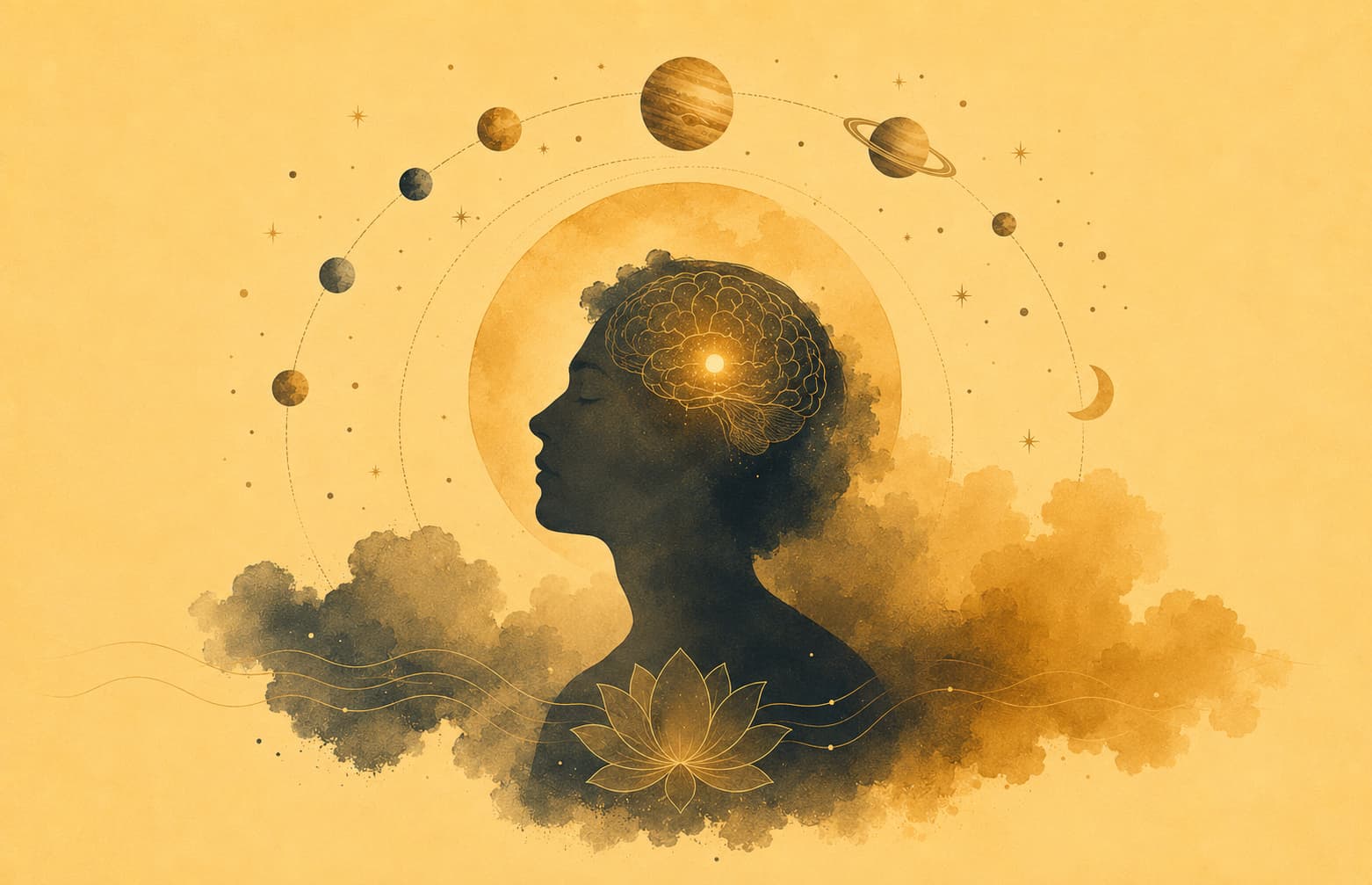
Suicidal Urges, Rock-Bottom Burnout and Emotional Collapse in Vedic Astrology
Understand how heavily afflicted Moon, Kemadruma Yoga, Saturn-Rahu transits, 8th house and Maraka dashas relate to emotional collapse in Jyotisha. Practical traditional remedies and clear guidance for psychological grounding.
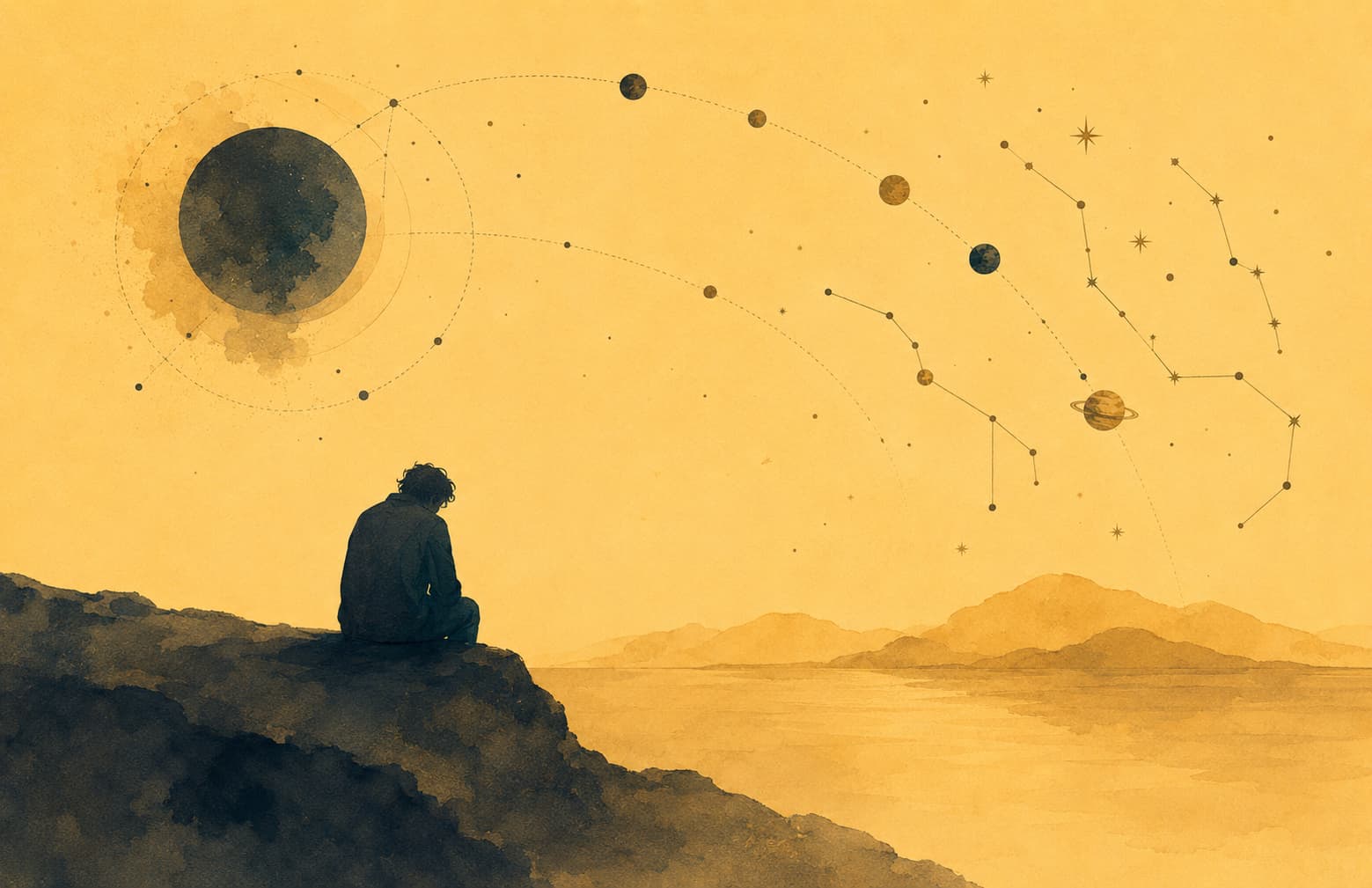
If you are currently experiencing intense emotional pain, persistent hopelessness or thoughts of ending your life, please pause and reach out for immediate professional support. In India you can contact Tele-MANAS at 14416, AASRA at 022-27546669 (24 hours), or the Vandrevala Foundation at 1860-266-2345. These services offer confidential listening. Astrology can offer perspective and traditional practices for grounding, yet it is never a substitute for medical or psychological care.
Many people who open their birth chart during periods of deep exhaustion describe a similar experience. Sleep becomes fragmented. Motivation disappears. Ordinary tasks feel heavy. A quiet inner voice begins to question whether life still holds meaning. In classical Jyotisha language this state often coincides with a heavily afflicted Moon, the activation of Maraka or Badhaka periods, intense Saturn or Rahu transits over the natal Moon, or the running of an 8th-house related dasha. The experience is sometimes called the dark night of the soul. The purpose of this article is to explain the relevant astrological factors clearly, to show how they are identified, and to outline traditional practices that many practitioners recommend for psychological stabilisation. The complete birth chart must always be examined. No single yoga or transit produces identical results for every person.
The wellbeing dimension of this combination is considered more carefully in body dysmorphia and eating disorders.
Quick Key Takeaways
- The Moon represents the mind, emotional memory and capacity for inner nourishment. When it is isolated, eclipsed or heavily pressured, emotional resilience can weaken.
- Kemadruma Yoga forms when the Moon has no planets in the 2nd or 12th houses from itself (with certain classical exceptions and cancellations).
- Conjunction or close aspect of Rahu or Ketu with the Moon is traditionally linked with sudden fluctuations in mood and a sense of disconnection.
- Saturn or Rahu transiting over the natal Moon can intensify feelings of isolation, duty and emotional heaviness for an extended period.
- The 8th house and its lord relate to deep transformation, hidden fears and psychological crisis. Their dashas often coincide with rock-bottom experiences that later produce insight.
- Maraka (2nd and 7th) and Badhaka houses indicate periods of strain that can feel life-threatening at the emotional level even when physical longevity is not at risk.
- Traditional remedies focus on stabilising the Moon through routine, mantra, charity, relationship repair and disciplined daily habits rather than dramatic rituals.
- Professional counselling, medical evaluation and supportive human contact remain essential alongside any astrological approach.
Understanding Emotional Collapse Through the Lens of the Moon
In Vedic astrology the Moon is the primary significator of the mind (manas). It governs emotional response, memory of comfort or deprivation, the capacity to feel nurtured, and the daily rhythm of rest and activity. A well-supported Moon allows a person to recover from setbacks, to feel connection with others, and to maintain a basic sense of inner safety. When the Moon is weakened or heavily afflicted, that recovery mechanism can become impaired.
Classical texts describe several ways the Moon can lose strength. It may be placed in an enemy sign, combust by the Sun, aspected by malefics, or isolated from supporting planets. The most relevant combinations for the experience of emotional collapse are isolation (Kemadruma), eclipse by the nodes (Rahu or Ketu), and pressure from Saturn. These factors do not operate in isolation. Their results are shaped by the lagna, the Moon’s nakshatra, the current dasha, and the overall promise of the chart.
The phrase “rock-bottom burnout” often appears when multiple indicators converge: a weak natal Moon, a difficult dasha of the 8th lord or a Maraka planet, and a slow-moving transit of Saturn or Rahu across the natal Moon. The person may feel that every external support has been withdrawn and that the inner reservoir of emotional energy is empty. Classical Jyotisha does not treat this state as a permanent sentence. It treats it as a period that requires careful management of the mind and body until the supporting planetary factors improve.
Kemadruma Yoga: The Isolated Moon
Kemadruma Yoga is one of the classical lunar combinations described in texts such as Brihat Parashara Hora Shastra. In its primary definition the Moon has no planet occupying the 2nd house or the 12th house from itself. The Sun is usually excluded from the count. Some later authorities also require that no planets occupy the kendras from the Moon or from the lagna for the yoga to remain fully active.
The traditional result is a sense of emotional loneliness, reduced capacity to enjoy ordinary comforts, and difficulty receiving consistent support from family or society. The person may work hard yet feel that the effort does not translate into lasting security or emotional warmth. In modern language this can manifest as chronic low-grade depression, difficulty forming or sustaining close bonds, or a persistent feeling that one is moving through life without a reliable inner anchor.
Important modifying factors must be noted. If a planet occupies a kendra from the Moon, the isolation is reduced. If the Moon is in its own sign, exalted, or receiving the aspect of Jupiter, the harshness softens. A strong lagna lord or beneficial influence in the 4th house can also provide alternative sources of emotional stability. Therefore the mere presence of an empty 2nd and 12th from the Moon does not automatically produce lifelong suffering. The yoga becomes more noticeable during the Moon’s own dasha or during transits that further isolate the natal Moon.
Moon with Rahu or Ketu: Eclipse Combinations
When the Moon is conjunct or closely aspected by Rahu or Ketu, classical literature speaks of a form of lunar eclipse in the birth chart. Rahu tends to amplify and distort the mind’s perceptions. Ketu tends to detach and dissolve emotional attachments. Either combination can produce sudden waves of anxiety, confusion about one’s own feelings, or a sense that ordinary emotional anchors have become unreliable.
People with these placements often report vivid dreams, heightened sensitivity to atmospheres, and periods when the mind races or goes completely blank. During the dasha of the Moon, Rahu or Ketu, or when the nodes transit over the natal Moon, these tendencies can intensify. The experience is sometimes described as a dark night of the soul because the usual sources of comfort feel distant and the future appears unclear.
Again, the complete chart matters. A strong Jupiter aspect, placement in a friendly sign, or support from the lagna lord can convert the same combination into heightened intuition, spiritual insight or creative depth. The difficulty arises mainly when the Moon is already weak by sign, dignity or house placement and the nodes add further instability.
Saturn and Rahu Transits over the Natal Moon
Slow-moving planets create longer periods of pressure. Saturn transiting the natal Moon is traditionally associated with emotional heaviness, increased sense of duty, and a reduction in spontaneous joy. The transit lasts roughly two and a half years in each sign and can feel especially intense when Saturn is also aspecting the Moon by its special 3rd, 7th or 10th aspect.
Rahu transiting the natal Moon produces a different flavour. The mind may become restless, filled with unusual fears or sudden desires that are difficult to satisfy. Sleep patterns can change. Ordinary routines feel insufficient. Because Rahu moves more quickly than Saturn, the peak intensity is usually shorter, yet the psychological impact can be sharp.
When both planets influence the Moon at the same time, either by transit or by natal placement, the combination is often experienced as rock-bottom burnout. The person may feel simultaneously burdened by responsibilities and unable to find emotional relief. Classical advice in such periods emphasises simplification of life, consistent daily rhythm, and reduction of unnecessary stimulation.
The 8th House and Its Dasha Periods
The 8th house is the house of longevity, hidden matters, sudden transformation, and the deeper layers of the psyche. Its karaka is Saturn in some traditions and the natural significators of crisis in others. When the mahadasha or antardasha of the 8th lord runs, or when planets placed in the 8th become activated, many people report experiences that feel like emotional death and rebirth.
The external circumstances may include financial pressure, health scares, relationship endings, or simply an internal sense that the old identity is no longer sustainable. The mind may confront fears that were previously suppressed. In the language of the dark night of the soul, this is the stage where the familiar structures of meaning collapse so that a more authentic foundation can eventually form.
The results depend heavily on the condition of the 8th lord, the planets occupying the 8th, and the overall strength of the chart. A well-placed 8th lord can produce profound research ability, psychological insight or spiritual depth. A weak or heavily afflicted 8th lord can coincide with prolonged periods of anxiety, insomnia or feelings of being overwhelmed by unseen forces. In either case the period is rarely comfortable while it is active.
Maraka and Badhaka Periods
Maraka houses are the 2nd and the 7th. Their lords are called maraka planets because classical texts associate them with the potential to end life when the longevity factors are weak. In practice, during the dasha of a maraka planet most people experience strain in the areas of family, speech, resources (2nd) or relationships and partnerships (7th). The emotional tone can become one of exhaustion, conflict or a sense that something essential is being taken away.
Badhaka houses vary according to the lagna. For movable lagnas the 11th is badhaka, for fixed lagnas the 9th, and for dual lagnas the 7th. The badhaka lord is said to create obstacles, delays and a feeling of being blocked. When its period runs, progress in the relevant area of life may feel unusually difficult, contributing to frustration and emotional depletion.
It is important to stress that maraka and badhaka periods do not automatically produce physical death. In the great majority of charts they produce psychological or circumstantial pressure that can feel overwhelming if the Moon is already weak. The classical approach is to treat these periods with care: conserve energy, avoid unnecessary risks, and focus on stabilising routines rather than launching major new initiatives.
How to Examine These Factors in a Birth Chart
A practical sequence for assessment is useful:
- Locate the Moon by sign, house, nakshatra and dignity.
- Check whether any planet occupies the 2nd or 12th from the Moon. Note cancellations if planets occupy kendras from the Moon or lagna.
- Examine conjunctions or close aspects of Rahu, Ketu or Saturn to the Moon.
- Assess the strength of the Moon by shadbala or simple dignity (own sign, exaltation, friendly sign, enemy sign, debilitation).
- Identify the current mahadasha and antardasha. Note whether the period lord rules the 8th, a maraka house or a badhaka house, or is itself a malefic influencing the Moon.
- Look at current gochar. Note whether Saturn or Rahu is transiting the natal Moon or closely aspecting it.
- Check the 4th house and its lord for alternative sources of emotional support.
- Review the overall chart for benefic influences that can mitigate the difficult combinations.
Only after this complete review can an astrologer speak with reasonable confidence about the intensity and duration of an emotional crisis. Isolated identification of one yoga or one transit is insufficient.
Constructive Possibilities Within the Same Combinations
Difficult lunar combinations and crisis periods are not solely destructive. Many people who have passed through them later describe increased self-knowledge, greater compassion for others in pain, and a more realistic understanding of what truly sustains them. The 8th-house period can strip away superficial goals and leave a clearer sense of purpose. Saturn’s transit over the Moon can teach emotional endurance and the value of simple, consistent effort. Even Kemadruma, when mitigated, can produce a person who learns to generate inner resources rather than relying solely on external validation.
The classical tradition therefore does not treat these placements as curses. It treats them as conditions that require conscious management. The same planetary forces that produce collapse can, under supportive circumstances, produce depth.
Factors That Soften or Intensify the Experience
Several classical and practical factors modify the outcome:
- Strength of the lagna and lagna lord.
- Presence of Jupiter’s aspect on the Moon or on the 4th house.
- Moon placed in its own or exaltation sign, or in a friendly nakshatra.
- Supportive planets in the kendras from the Moon.
- Concurrent dasha of a functional benefic.
- Favourable transit of Jupiter over the natal Moon or lagna.
- The person’s age, physical health, social support network and access to professional help.
- Willingness to maintain basic daily routines of sleep, food and gentle movement.
When several mitigating factors are present, the same combination that produces collapse in one chart may produce only temporary melancholy in another.
Traditional Remedies for Psychological Grounding
Classical Jyotisha offers behavioural and spiritual practices aimed at stabilising the Moon and reducing the intensity of malefic pressure. These are presented as supportive traditions, not as guaranteed cures. They work best when combined with professional psychological care, adequate sleep, balanced nutrition and, where needed, medical treatment.
Practices connected with the Moon
- Maintain a regular sleep schedule and avoid late-night stimulation.
- Offer water or milk to a sacred plant or at a place of worship according to one’s tradition, preferably on Mondays.
- Recite the Chandra Beej mantra “Om Som Somaya Namah” 108 times with attention to calm breathing.
- Wear clean white or light-coloured clothing when possible.
- Spend quiet time near water or under moonlight when the mind feels agitated.
- Cultivate respectful and nurturing relationships with maternal figures or with anyone who provides consistent emotional safety.
Practices for Rahu or Ketu influence
- Reduce exposure to chaotic or overly stimulating environments and digital overload, especially late at night.
- Practise simple grounding techniques such as walking barefoot on clean earth or focusing attention on the physical sensations of breathing for a few minutes several times a day.
- Offer food or practical help to people living on the margins of society, as traditional texts associate such acts with reducing the restless quality of Rahu.
- Maintain clear boundaries around speculative thinking or sudden impulsive decisions during peak Rahu periods.
Practices connected with Saturn
- Accept a measured daily routine of work, rest and simple physical activity rather than forcing high intensity when energy is low.
- Serve or show respect to elders, teachers and those who perform steady, often unnoticed labour.
- Recite the Shani mantra “Om Sham Shanaischaraya Namah” with a calm and steady voice, preferably on Saturdays if it feels supportive.
- Reduce unnecessary commitments and practise saying no without excessive guilt.
- Keep the living and working space orderly, as external order often supports internal steadiness during Saturn pressure.
General stabilising habits
- Prioritise consistent meal times and adequate hydration.
- Limit alcohol, excessive caffeine and other substances that further agitate the nervous system.
- Seek the company of steady, non-dramatic people rather than those who intensify emotional turbulence.
- Keep a simple written record of daily mood, sleep and small acts of self-care so that progress, even if slow, becomes visible.
- When the mind feels overwhelmed, return attention to one concrete, manageable task rather than attempting to solve the entire life situation at once.
These practices are traditional behavioural and spiritual supports. They do not replace professional counselling, medical evaluation or crisis intervention. If the emotional weight feels unmanageable, contact a qualified mental-health professional or one of the helplines listed at the beginning of this article without delay.
Common Misconceptions About These Combinations
Several misunderstandings circulate widely and can increase unnecessary fear.
One frequent claim is that Kemadruma Yoga guarantees lifelong poverty and emotional isolation. Classical texts do describe difficulty, yet they also list clear cancellation conditions. Many charts with an isolated Moon still show professional success and eventual emotional maturity when other factors are supportive.
Another misconception is that any conjunction of the Moon with Rahu or Ketu produces permanent mental instability. The actual result depends on the dignity of the Moon, the house involved, the strength of the nodes, and the supporting influences. Some individuals with these placements develop exceptional psychological insight or creative originality.
A third error is to treat every Maraka or Badhaka dasha as a literal threat to life. In the large majority of cases these periods produce strain in the areas ruled by the relevant houses, not physical death. Longevity is assessed through multiple factors including the 8th house, the lagna lord and specific ayurdaya calculations. Isolated identification of a maraka planet is never sufficient for a life-or-death prediction.
Finally, some readers assume that difficult transits or dashas cannot be softened by ordinary human effort. Classical Jyotisha consistently emphasises the role of conscious conduct, routine and ethical living in modifying planetary results. The planets indicate tendencies and periods of heightened sensitivity. They do not remove personal agency.
Hypothetical Example of Chart Assessment
Consider a hypothetical chart with Cancer lagna and the Moon placed in Capricorn in the 7th house. No planet occupies the 2nd or 12th from the Moon, suggesting a form of Kemadruma. Saturn aspects the Moon from the 4th house, and Rahu is placed in the same sign as the Moon. The current period is the mahadasha of the 8th lord (Saturn) and the antardasha of the Moon.
A closely related partnership pattern is explored in codependency and narcissist-empath dynamics.
In such a combination an astrologer would note the isolation of the Moon, the additional pressure from Saturn and Rahu, and the activation of the 8th-house lord. The person might report prolonged emotional exhaustion, difficulty feeling supported in close relationships, and a sense that hidden fears are rising to the surface. At the same time the lagna is Cancer, ruled by the Moon itself, and if Jupiter aspects the lagna or the Moon from a friendly position, a mitigating influence is present. The practical guidance would focus on stabilising routines, reducing over-commitment, strengthening the relationship with the body through regular rest and simple nourishment, and seeking professional psychological support while the dasha remains intense. The same chart in a later Jupiter period could show greater emotional recovery and insight gained from the earlier difficulty.
This example is purely illustrative. Every actual chart requires individual examination of all relevant factors.
Practical Steps for Readers Experiencing These Periods
When the combination of an afflicted Moon and a difficult dasha or transit is active, the following sequence is often helpful:
- Confirm the current planetary period and the major transits affecting the natal Moon with a competent astrologer or reliable software, remembering that software alone does not replace human judgement.
- Arrange a medical check-up to rule out treatable physical contributors to low mood or exhaustion.
- Contact a mental-health professional if thoughts of self-harm, persistent hopelessness or inability to function in daily life are present.
- Simplify external demands for the duration of the intense period. Postpone major life decisions that can reasonably wait.
- Establish or restore basic daily anchors: consistent sleep and wake times, regular meals, gentle movement, and limited late-night screen exposure.
- Choose one or two traditional practices that feel culturally and personally resonant and maintain them steadily rather than attempting many remedies at once.
- Maintain contact with at least one steady, non-judgemental human being who can offer ordinary presence.
- Review progress every few weeks rather than expecting immediate transformation. Saturn and the 8th house often work through gradual, cumulative change.
These steps combine classical planetary management with ordinary human care. Neither replaces the other.
The Role of the Dark Night of the Soul in Jyotisha
The phrase “dark night of the soul” is not a classical Sanskrit technical term, yet it accurately describes the experiential quality of certain planetary periods. When the Moon is under heavy pressure and the 8th house or maraka factors are activated, the familiar sources of meaning and emotional security can temporarily disappear. The mind may confront its own limits and the impermanence of external supports.
Classical Jyotisha views such periods as opportunities for deeper self-knowledge rather than as punishments. The same forces that strip away superficial comfort can, over time, reveal a more durable foundation. Many individuals who have lived through intense Saturn-Moon or Rahu-Moon periods later report greater realism, reduced attachment to external validation, and an increased capacity to sit with discomfort without immediate collapse.
The tradition does not romanticise suffering. It simply recognises that certain planetary configurations make ordinary emotional functioning more difficult for a measurable span of time, and that conscious response during those spans can influence the eventual outcome.
Factors That Frequently Change the Intensity of Experience
Beyond the planetary combinations already discussed, several additional elements regularly alter how strongly the crisis is felt:
- The overall strength of the lagna and the physical vitality indicated by the chart.
- The presence or absence of supportive social and financial resources in real life.
- Concurrent health conditions that independently affect mood and energy.
- The individual’s previous experience with emotional difficulty and the coping skills already developed.
- Cultural and family attitudes toward mental distress, which can either increase isolation or provide channels for help.
- The simultaneous transit of Jupiter, which often softens the harshest edges of Saturn or Rahu pressure on the Moon.
- Placement of the Moon in a nakshatra whose deity or symbolism offers particular pathways of recovery (for example, certain lunar mansions associated with healing or devotion).
An astrologer who examines only the difficult factors without weighing these modifiers risks giving an incomplete and unnecessarily alarming picture.
Traditional Remedies in Greater Detail
While the earlier list provided core practices, a more extended understanding of traditional approaches may be useful for those who wish to engage more deeply.
For the Moon, classical recommendations often include the use of white substances, cool environments, and activities that restore a sense of safety. Offering rice, milk or white flowers on Mondays is a widespread custom. Some families maintain the practice of lighting a small lamp near a sacred image in the evening to create a quiet focal point for the mind. The emphasis is on regularity rather than intensity.
When Rahu is involved, traditional guidance frequently stresses clarity of speech, avoidance of deception (including self-deception), and acts of practical service that bring the mind out of speculative loops. Feeding birds or supporting the education of underprivileged children are sometimes recommended as concrete expressions of this principle.
For Saturn, the texts repeatedly return to the themes of patience, honest labour and respect for time. Completing unfinished responsibilities, reducing waste of resources, and showing consideration for those who work in difficult or low-status conditions are considered constructive responses. The goal is not to appease a planet through fear but to align daily conduct with the qualities Saturn itself represents when functioning constructively: endurance, realism and steady effort.
None of these practices should be performed under the belief that they will instantly remove every difficulty. They function as stabilising disciplines that support the mind while the planetary period runs its course.
Gemstones, elaborate yajnas or expensive remedial packages are not recommended here. Suitability for such measures requires careful individual assessment of the complete chart, the person’s physical health and financial circumstances. Fear-based pressure to purchase remedies is contrary to the spirit of responsible Jyotisha.
When to Seek Help Beyond Astrology
Astrology can illuminate the timing and planetary logic of an emotional crisis. It cannot diagnose clinical depression, anxiety disorders, bipolar conditions or other medical states that require professional treatment. If any of the following are present, priority must be given to medical and psychological care:
- Persistent thoughts of ending one’s life or of harming oneself.
- Inability to perform basic self-care for more than a short period.
- Severe sleep disturbance lasting weeks.
- Marked changes in appetite or weight.
- Withdrawal from all social contact.
- Feelings of worthlessness or excessive guilt that do not respond to ordinary support.
- Any sense that the distress is intensifying rather than slowly stabilising.
In such situations the appropriate response is to contact a qualified professional or a crisis helpline immediately. Jyotish remedies can continue as supportive practices once safety and medical care are established, but they do not come first.
Conclusion
Heavy affliction of the Moon, the formation of Kemadruma Yoga, the influence of Rahu or Ketu on the mind, intense Saturn or Rahu transits, 8th-house dashas, and Maraka or Badhaka periods can coincide with profound emotional collapse, rock-bottom burnout and the experience commonly called the dark night of the soul. Classical Jyotisha provides a coherent framework for understanding why these periods arise and how their intensity may be moderated.
The emotional and behavioral expression of this pattern is explored further in Saturn-Ketu and chronic isolation.
The same tradition also insists that results are never fixed by a single yoga or transit. The lagna, the strength of supporting planets, concurrent dashas, real-life resources and conscious daily conduct all participate in shaping the outcome. Traditional remedies focus on restoring rhythm, nourishing the mind through simple and consistent practices, and reducing unnecessary agitation rather than on dramatic or fear-driven interventions.
The spiritual and ethical dimension of this question is developed further in multi-planet Vedic remedies.
Most importantly, no astrological combination removes the need for ordinary human care. Professional psychological support, medical evaluation when required, and steady contact with trustworthy people remain essential. The planetary periods described in this article are temporary by definition. With appropriate support, many individuals emerge from them with greater self-knowledge and a more durable foundation for the next phase of life.
If you are reading this while currently inside such a period, the most useful immediate steps are often the simplest: reach out for professional help if the weight feels unbearable, protect basic sleep and nourishment, reduce external complexity where possible, and allow the passage of time to do part of the work that the mind cannot force.
Frequently Asked Questions
1. Does Kemadruma Yoga always cause depression?
No. The yoga indicates a tendency toward emotional isolation that becomes more noticeable under certain dashas and transits. Strong mitigating factors such as planets in kendras from the Moon, a powerful lagna lord, or beneficial Jupiter influence can significantly reduce the difficulty.
The wellbeing dimension of this combination is considered more carefully in addiction patterns in the birth chart.
2. Can a Maraka dasha cause actual death?
Classical texts associate the 2nd and 7th lords with the potential to end life when longevity factors are weak. In practice most Maraka periods produce strain, conflict or resource pressure rather than physical death. Longevity assessment requires multiple independent factors and should never rest on the identification of a single maraka planet.
3. How long does a Saturn transit over the Moon usually last?
Saturn remains in one sign for approximately two and a half years. The most intense phase of its transit over the natal Moon is often the period when it is within a few degrees of the exact longitude, yet the broader influence can be felt throughout the sign transit.
4. Are there remedies that work quickly for Moon-Rahu combinations?
Traditional practices emphasise steady, repeated effort rather than rapid results. Calming the nervous system through routine, reducing overstimulation, and maintaining simple mantra or charitable practices tend to produce gradual stabilisation. Immediate crisis support should come from professional mental-health resources.
5. Should I stop all major decisions during an 8th-house dasha?
Major irreversible decisions are best postponed when possible if the emotional and practical pressure is high. Necessary decisions still need to be made, ideally with additional consultation and after ensuring basic mental stability.
6. Can a strong Jupiter cancel the effects of an afflicted Moon?
Jupiter’s aspect or association can soften many of the harsher expressions of a weak or isolated Moon. It does not erase the underlying combination, yet it frequently provides alternative sources of hope, guidance and perspective that make the period more bearable.
7. Is the dark night of the soul a recognised concept in classical Jyotisha texts?
The exact phrase is modern. The experiential reality it describes, however, corresponds closely to the results attributed to heavy lunar affliction, 8th-house activation and certain Saturn or nodal periods in classical literature.
8. What is the single most important practical step during these periods?
Protecting physical safety and securing professional psychological support when distress is severe. All other measures, including astrological remedies, rest on that foundation.
About the author
Anika Rao
Editor-in-Chief
Anika Rao is the editor-in-chief of Vedic Astrology Space. Her work brings classical Jyotish into conversation with relationships, identity, emotional life and the questions people carry into a modern chart reading. She is especially interested in nakshatras, the Moon, relational patterns and interpretations that create self-understanding without reducing a person to a placement.
Read the full bioContinue reading

Celebrity Obsession in Vedic Astrology Explained
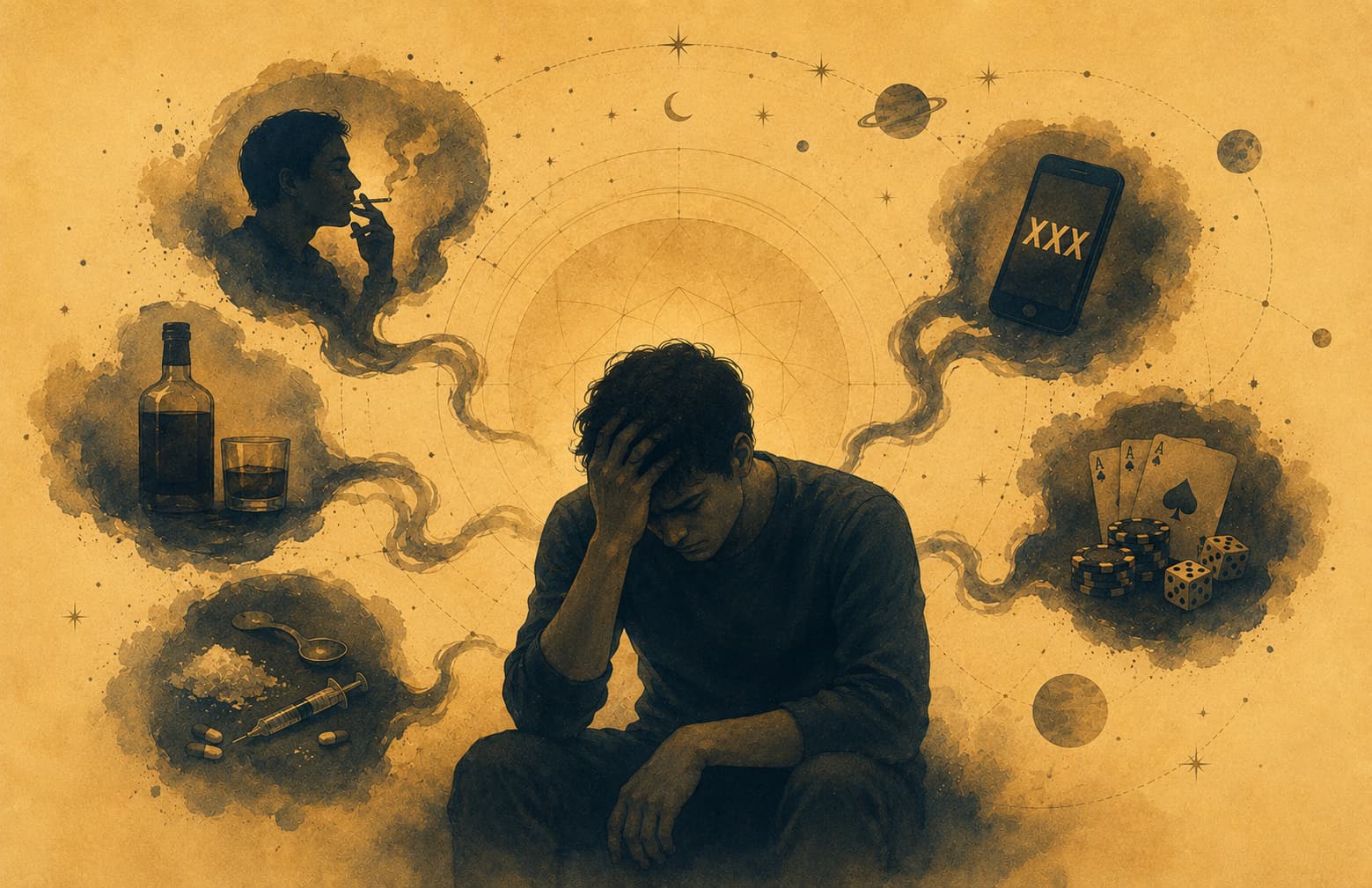
Combinations for Addiction in Vedic Astrology: Alcohol, Smoking, Drugs and More